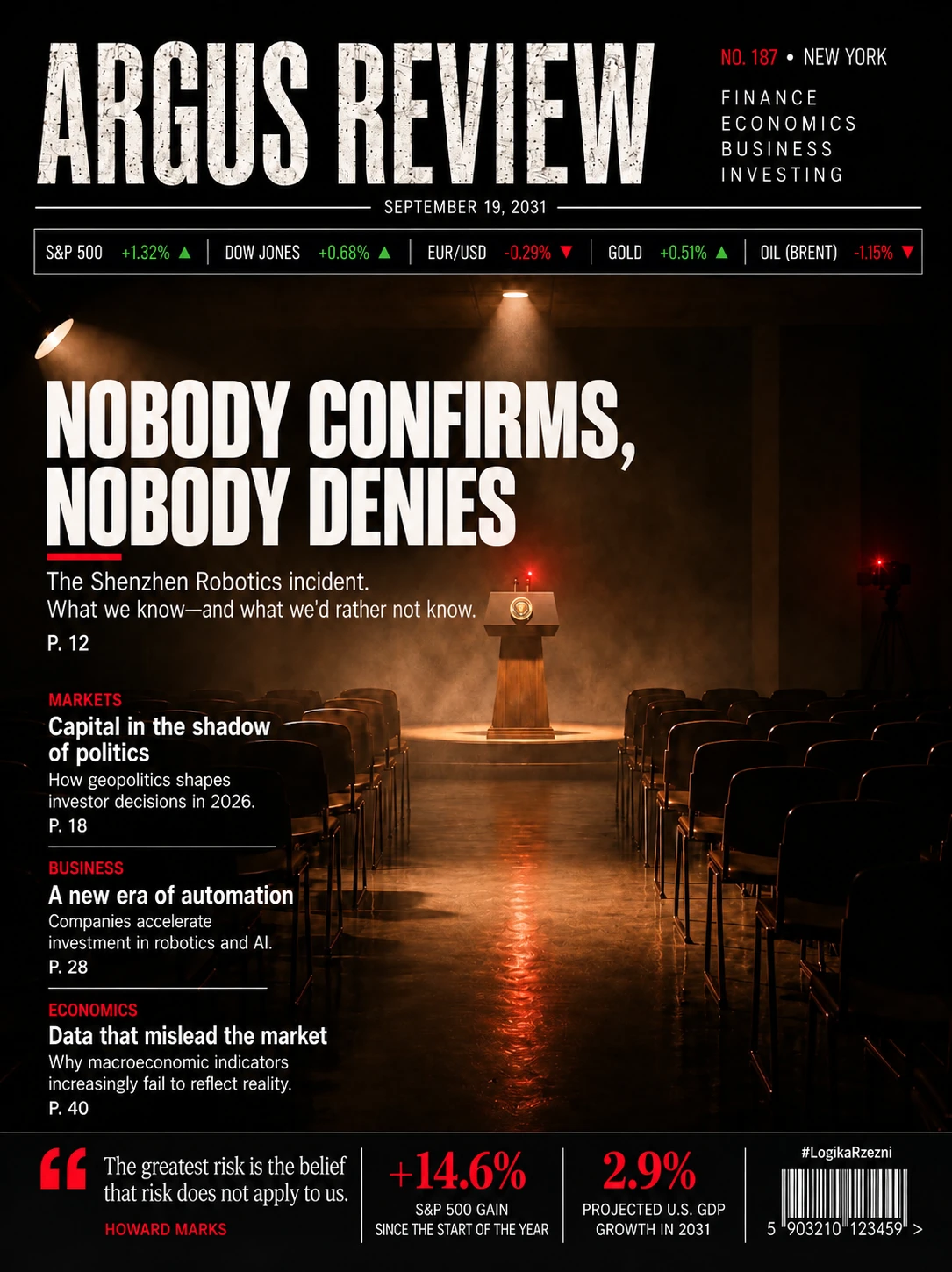
# ARGUS REVIEW · Technology · Supplement to the 2031 Edition
“NOBODY CONFIRMS, NOBODY DENIES”
For eighteen days, the September incident in Tokyo went unmentioned in every official statement issued by the Chinese government. When it finally surfaced, it took up two sentences.
Nadia Renfrew | NEW YORK
SEPTEMBER 2031 — WHAT THE PUBLIC KNOWS
Japan’s Defense Intelligence Headquarters has not released a full report on the Roppongi incident. What reached the press came through leaks: eleven rapid-response unit officers injured; a leading neural-network architect from the Institute for Advanced Cognitive Systems missing; and footage from the city’s surveillance cameras whose quality, according to three independent analysts quoted by local media, made positive identification of the perpetrator impossible.
The Japanese government did not use the word android. It did not use the word robot, either. The official statement from the Ministry of Foreign Affairs referred to an “entity of undetermined technical characteristics”—a phrase that three international law experts, speaking to our editorial team, described as “carefully engineered to avoid directly accusing anyone.”
BEIJING, DAY EIGHTEEN
Asked about reports from Tokyo during a regular press briefing, a spokesperson for China’s Ministry of Foreign Affairs replied that “the People’s Republic of China has no knowledge of the alleged incident” and that “media speculation based on unverified sources does not merit comment.”
The spokesperson added that China “consistently upholds the principle of non-interference in the internal affairs of other states” and that accusations of this kind “fit a pattern of Western disinformation targeting China’s technological achievements.”
Our fact-checking team classified none of these statements as literally false.
China had indeed issued no statement confirming its involvement in the events. Media speculation was indeed based on unverified sources—because the only primary source was a damaged recording that the Japanese government had not released in full.
MEANWHILE, AT THE ZHUHAI EXPO
Two weeks after the Beijing press briefing, at the annual defense expo in Zhuhai, a company listed as a civilian subcontractor unveiled a line of “advanced service platforms for rescue and reconstruction applications.”
Its promotional materials made no mention of combat capabilities. The catalog photographs showed a humanoid unit wearing a neutral, light-colored coverall. No weapons. No military markings.
An analyst at a Western research institute, speaking on condition of anonymity, noted that the proportions of the platform’s frame—the length of its limbs, the spacing of its shoulder joints, the construction of its neck—matched, within the margin of measurement error, the features that could be isolated from the grainy Tokyo footage.
Asked about the resemblance, a company spokesperson replied that “convergence in engineering solutions is a natural feature of the humanoid robotics industry” and that “comparing independently developed products on the basis of isolated photographs has no analytical value.”
WHAT NO DOCUMENT SAYS
None of the governments involved in the matter used the word that surfaced three times in private conversations with our editorial team, each time from a different intelligence source: replication.
Not technology theft. Replication of an architecture whose owner had never filed a formal infringement claim because, in legal terms, it could not establish precisely what had been copied.
Asked whether Synapsa AI was considering legal action against manufacturers using a convergent architecture, a company spokesperson replied that “Synapsa AI remains focused on delivering value to its customers” and that “matters relating to intellectual property security are subject to continuous internal oversight.”
No denial. No confirmation.
The company answered exactly as one would expect from an organization that knows more than it is saying—and has no interest in saying anything more.