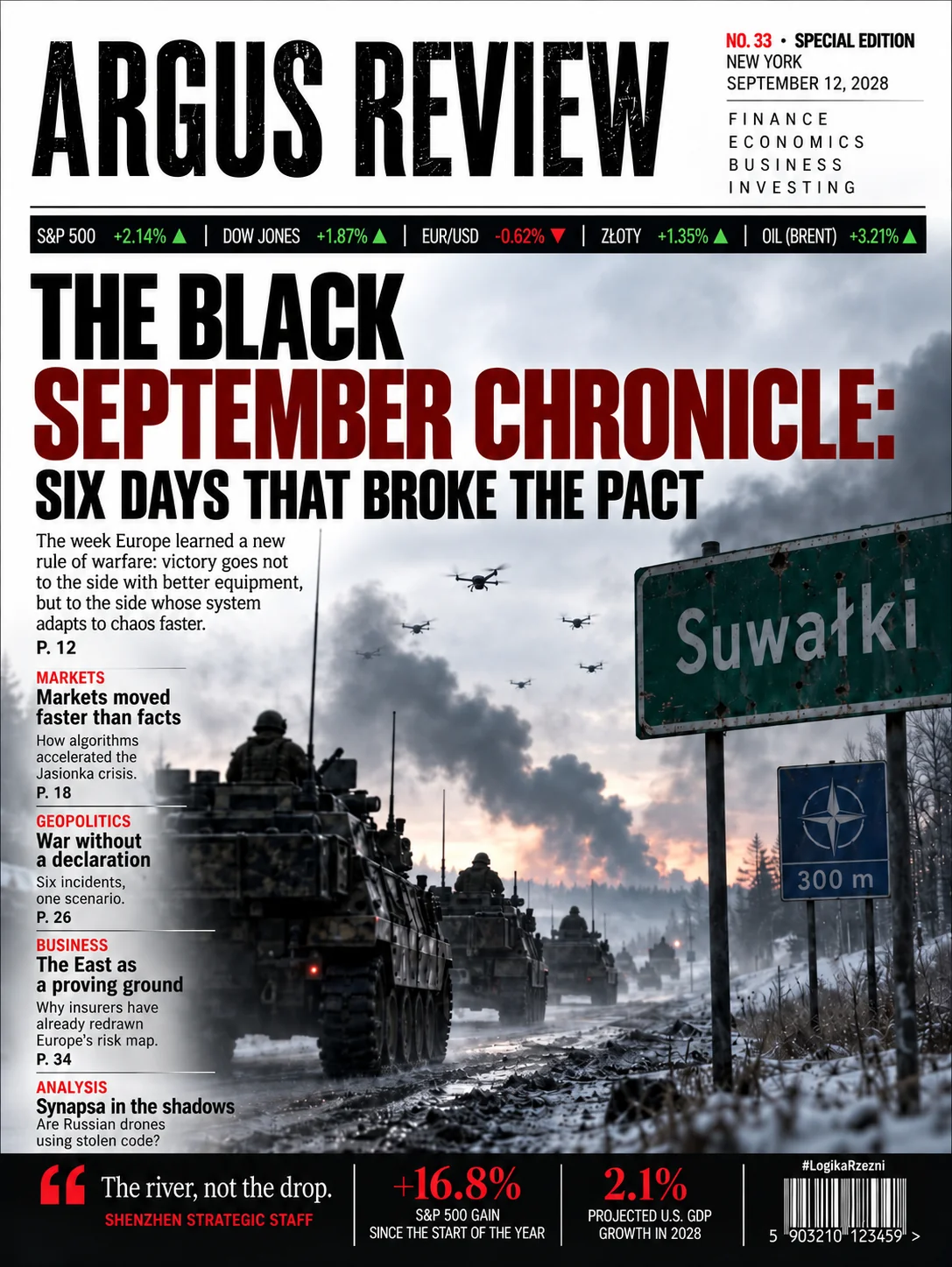
# THE BLACK SEPTEMBER CHRONICLE: SIX DAYS THAT BROKE THE PACT
ARGUS REVIEW · NO. 33 · SPECIAL EDITION
New York, September 12, 2028
Ilona Vasquez
The week Europe learned a new rule of warfare: victory goes not to the side with better equipment, but to the side whose system can adapt to chaos faster.
DAY 1 — “Clear Skies”
September 1, 2028 | Warsaw – Rzeszów – London
Three drones, bearing what appeared to be Ukrainian markings, struck the logistics hub at Jasionka that morning. Before anyone could verify their origin, the markets had already reacted. Automated trading systems powered by Synapsa AI processed the headlines faster than anyone could establish the facts.
The Polish złoty fell 8 percent against the dollar in less than two hours. Only after the market closed was the truth confirmed: the attack had been a Russian false-flag operation.
DAY 2 — The Border Incident
September 2, 2028 | Kaliningrad Border – Vilnius
A Russian transport helicopter “broke down” and landed three kilometers inside Lithuania. Before anyone could reach the site, a Russian team in civilian vehicles had recovered the wreckage and crossed back over the border.
Officially, nothing had happened.
Baltic maritime insurers had already raised their premiums.
DAY 3 — Narva
September 3, 2028 | Narva, Estonia – Tallinn
In Narva, demonstrators took to the streets “to protest linguistic discrimination” and occupied the city hall. Within the crowd, well-organized groups moved without insignia or identifying marks.
Estonian security forces responded with force. For several hours, no one in NATO knew how to classify the situation.
Insurance premiums across the Baltic states climbed before anyone issued an official statement.
DAY 4 — The Suwałki Gap
September 4, 2028 | Suwałki – Gotland
Russia attacked simultaneously from Kaliningrad and Belarus, cutting the Suwałki Corridor.
This was the same territory where, since the spring of 2027, Russian sabotage teams had been dying with disturbing regularity, without any visible contact with an enemy. Now conventional tank columns were rolling in, shielded by swarms of drones.
Analysts who later examined the swarms’ software found an architecture strikingly similar to early, stolen branches of Synapsa’s code. The trail led through a network of shell companies in Kazakhstan and Azerbaijan, all formally engaged in selling civilian equipment.
British forces in Estonia were paralyzed before they even saw the enemy.
DAY 5 — “A Mistake”
September 5, 2028 | Lublin Region – Bucharest
Four Russian missiles “veered off course” and struck grain storage facilities in Poland and Romania. People died.
Moscow issued an apology. The alleged culprit, it claimed, was a Ukrainian signal jamming GPS.
Western leaders lost an entire day checking radar data instead of making decisions.
DAY 6 — The Sea
September 6, 2028 | Baltic Sea and North Sea
Coordinated damage to subsea infrastructure in the Baltic and North Seas, combined with the blockade of shipping lanes by Russian vessels, triggered an immediate and violent sell-off across European financial markets, hitting the commodities and banking sectors particularly hard.
The paralysis of digital communications and disruptions to supply chains drove gas futures into record volatility. Financial institutions dependent on real-time transactions were forced into emergency asset sell-offs.
Further analysis is available in ARGUS REVIEW.
DAY 7 — Decisions
September 7, 2028 | NATO Headquarters, London
The military high commands awoke to a new geopolitical reality, even though not a single shot had formally declared war.
Six distinct threats in six days. None, taken in isolation, was unambiguous enough to trigger an automatic response under Article 5. Taken together, however, their cumulative financial and decision-making impact had paralyzed the continent.
Western defense systems and market algorithms operated according to rigid procedures: one isolated threat produced one predictable response.
From Brussels and Washington, the attack looked like six separate drops—a series of unrelated incidents and unfortunate market anomalies. In reality, it was a single swollen river. Western decision-making frameworks simply could not calculate its full force in time.
For years, a phrase had circulated behind closed doors at the Shenzhen Strategic Staff. Now, in the offices of ARGUS analysts, it sounded less like a maxim than a ruthless operating manual for the week that had just unfolded:
“The river, not the drop.”
Whoever controls the current of chaos does not need to destroy the enemy’s tanks. It is enough to force the enemy’s algorithms to wait forever for the data to be verified.
Six distinct threats in six days. None, on its own, was clear enough to be recognized as war. Western systems run on procedures: one threat, one response.
From this side of the divide, the attack looked like six separate drops. In reality, it was one river. No one had counted it that way.
For years, a phrase had circulated behind closed doors at the Shenzhen Strategic Staff. Now it sounded like an operating manual for the week that had just unfolded:
“The River, Not the Drop.”
### WEEK IN REVIEW
6 days / No formal attack on a NATO member state / Financial losses that defy simple quantification
ARGUS REVIEW will return to this story as new facts emerge.