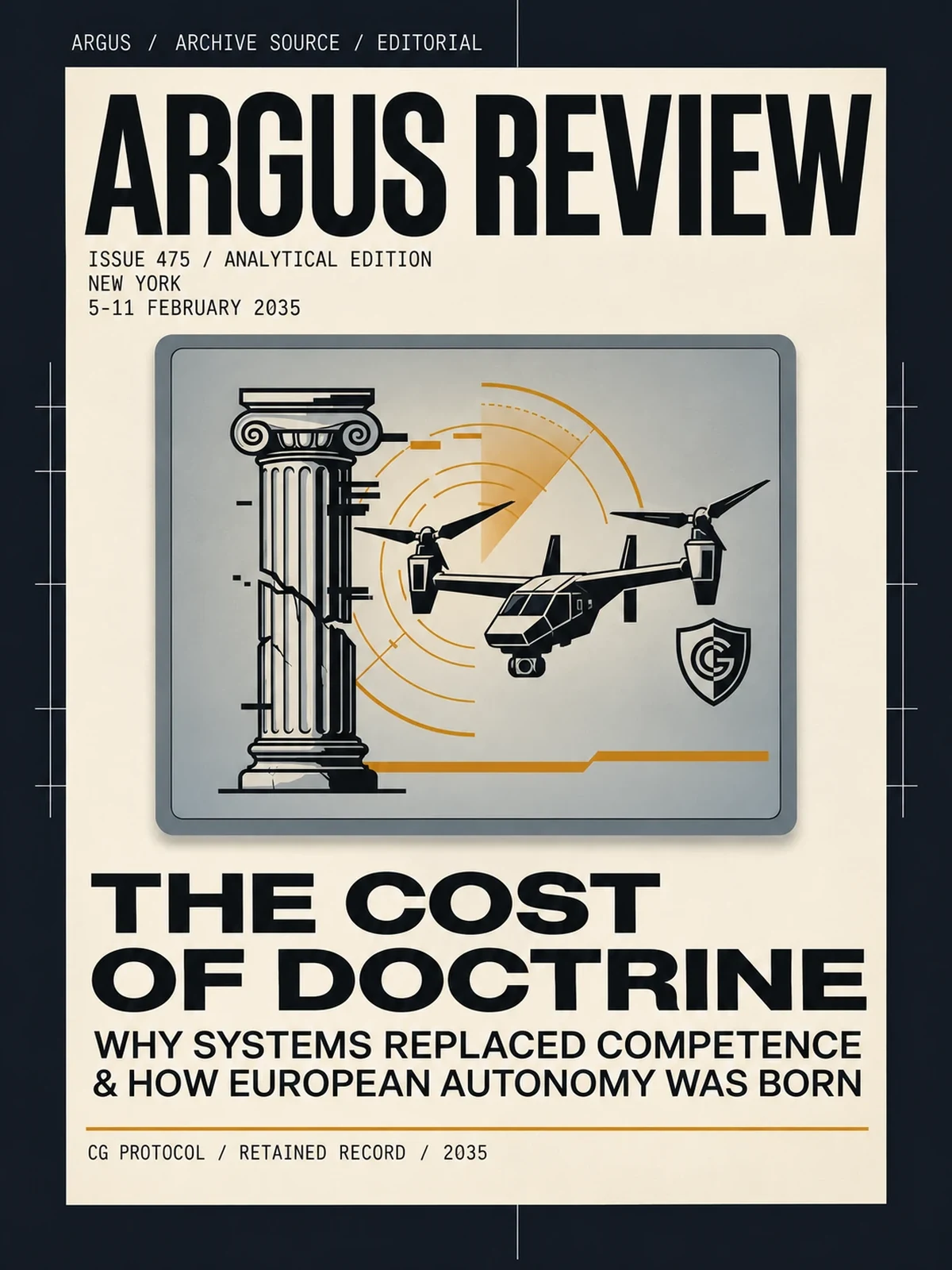
THE COST OF DOCTRINE.
NO. 475 · Analytical Edition | New York | February 5–11, 2035
____
WHY SYSTEMS REPLACED COMPETENCE AND HOW EUROPEAN AUTONOMY WAS BORN.
⸻
Nine years after the 2026 collapse of trust, we continue to commit the same cognitive error: we examine the failures of individual subsystems instead of admitting that the flaw lay in the source code of the era's politics. When the criterion for survival is replaced by loyalty, transaction, and simplification, a system does not break immediately. It simply stops distinguishing simulation from reality.
In the archives from 2026–2027, a siloed view of the world prevails. Analysts of the time separated crises into distinct files: one held the personnel purges in Washington, another the price war in Asia’s industrial sector, a third the blockade of the Strait of Hormuz, and a fourth the grotesque rounds of negotiations in Abu Dhabi and Moscow. From the perspective of 2035, it is clear that this was a single chain of cause and effect.
History has recognized this mechanism since antiquity. In systems theory, it is described by Ashby’s Law of Requisite Variety: a regulator cannot be simpler than the system it attempts to control. When the world reached a level of hyper-complexity in the mid-2020s, decision-makers in both dominant blocs chose to retreat into dogma.
I. THE PERSONNEL SYNDROME AND TRANSACTIONAL BLINDNESS
The first warning sign was a shift in selection criteria at the highest levels of power. The phenomenon termed the "loyalty syndrome" in 2026 commentary—replacing seasoned commanders and diplomats with individuals prized for media savvy and unconditional political loyalty—rapidly degraded institutional resilience to shocks.
Even more dangerous was the subordination of export controls and counterintelligence to short-term financial calculation. Washington approved the sale of advanced H200 computing chips to China in December 2025 in exchange for a 25 percent cut of the sales revenue, and the private sector soon learned the lesson. The Halvane Compute licensing case of 2032 became its textbook illustration. Halvane, a subsidiary of Epeios AI, supplied roughly two thirds of the world's training clusters. A Singapore-registered distributor, Megarun Pte Ltd, a year on the market and with no data center of its own, ordered equipment worth about four billion dollars at a twenty percent premium over list price. Everyone else waited thirty-eight months; the distributor was promised delivery in two weeks. The license cleared in ten days, after an interagency review that took two days instead of the standard thirty, with no objections on file and no audit. The first payment reached Halvane's account, under chief executive Adrian Keller, before the ship had left port. Every field in the file was technically correct.
The consequences of this same logic manifested in foreign policy. The conviction that complex conflicts could be closed like real estate deals—which appeared to work in Caracas in January 2026—hit a wall in the Persian Gulf. The nine-month campaign against Iran failed to yield a political resolution, choked off resource transit routes, and led to the administration's electoral defeat in the November midterms.
Concurrently, in the East, the doctrine of top-down "picking winners" and artificially inflating production capacity drove the Asian economy into a trap of destructive overproduction. When Western markets closed behind tariff barriers, the industrial surplus—fueled by technology and computing power acquired through Western trade compromises—had to find an outlet. A byproduct of this process was the acceleration of autonomous platform development by Shenzhen Robotics: the dead-end SR/0.000 prototype branch of 2026, then, in parallel lines, the low-rate reconnaissance and sabotage SR/Alpha units and the mass-produced SR/1.0 units introduced last year, which are reshaping the structure of the modern battlefield today.
II. HITTING THE WALL: FROM ABU DHABI TO PODLASIE
For Central Europe, however, the turning point was neither technological leaks nor commodity charts, but the collapse of the illusion that an external security umbrella is unconditional. As early as the November 2026 talks in Abu Dhabi and Moscow, it became evident that amateur diplomacy was prepared to discuss revising the region’s security architecture over the heads of its allies.
That signal was temporarily cushioned by an institutional pivot in Washington following the midterm elections and firm pushback from European states in Dublin. Yet this proved to be merely borrowed time. As previously documented in the chronicles of Black September (ARGUS REVIEW / 33) and the record of the fourteen days of August 2027 (ARGUS REVIEW / 293), at the moment of true trial, traditional U.S. military presence was reduced to the role of a remote provider of software and predictive analytics from the Epeios AI — Warfare Division.
Billions in advance payments frozen in overseas accounts and empty logistics bases in Podlasie closed the era of politics built on trust in declarations. When physical layers failed, the void was filled by Phys-Kernel predictive algorithms and the hastily formed structures of the EU Rapid Deployment and Airborne Forces (SDSR-UE).
III. COGNITIVE RESILIENCE AS THE ONLY POLICY
Nine years after these events, in 2035, the takeaway for the frontline states of the European Union—including Poland, which forms the core of the Polish Expeditionary Forces—remains unchanged.
In a world where corporations like Epeios AI have assumed the decision-making layer, and the Asian Federation saturates theaters of operation with serial SR/1.0 platforms and heavy SR/UGV units, superiority is no longer built through ideological mobilization or faith in external guarantees. Survival depends on two factors that already began taking shape in the late 2020s:
1. Technological and Industrial Autonomy. Developing indigenous systems independent of external servers—such as the SKORPION-2 heavy reconnaissance-combat UAVs equipped with VIO navigation under the East Shield (Tarcza Wschód) program—proved to be the only effective response to the risk of being remotely cut off from data.
2. Strategic Communication and Societal Resilience. Bringing intelligence services (including Military Counterintelligence Service [SKW] analysts) and military structures out of the shadows to adopt a two-way model of public warning prevented informational paralysis and the violent outbreaks of civil unrest that tore apart other states on the continent over the past decade.
Systems always operate exactly as they were designed to. If they are engineered around loyalty to an imposed narrative and short-sighted profit rather than sound cost accounting, failure is only a matter of time. Europe paid a high price in 2026–2027 for switching off the autopilot—yet it was precisely that shock that ensured in 2035 it still possesses the people and the means to make its own decisions.
RECORD STATUS: RETAINED · ARCHIVE SIGNAL 2035
CROSS-REFERENCE: ARGUS REVIEW / 33 · ARGUS REVIEW / 293 · TECH REGISTRY: SR/1.0, EPEIOS AI, SKORPION-2