MATRYOSHKA
“MATRYOSHKA”
St. Petersburg, Russia
2026
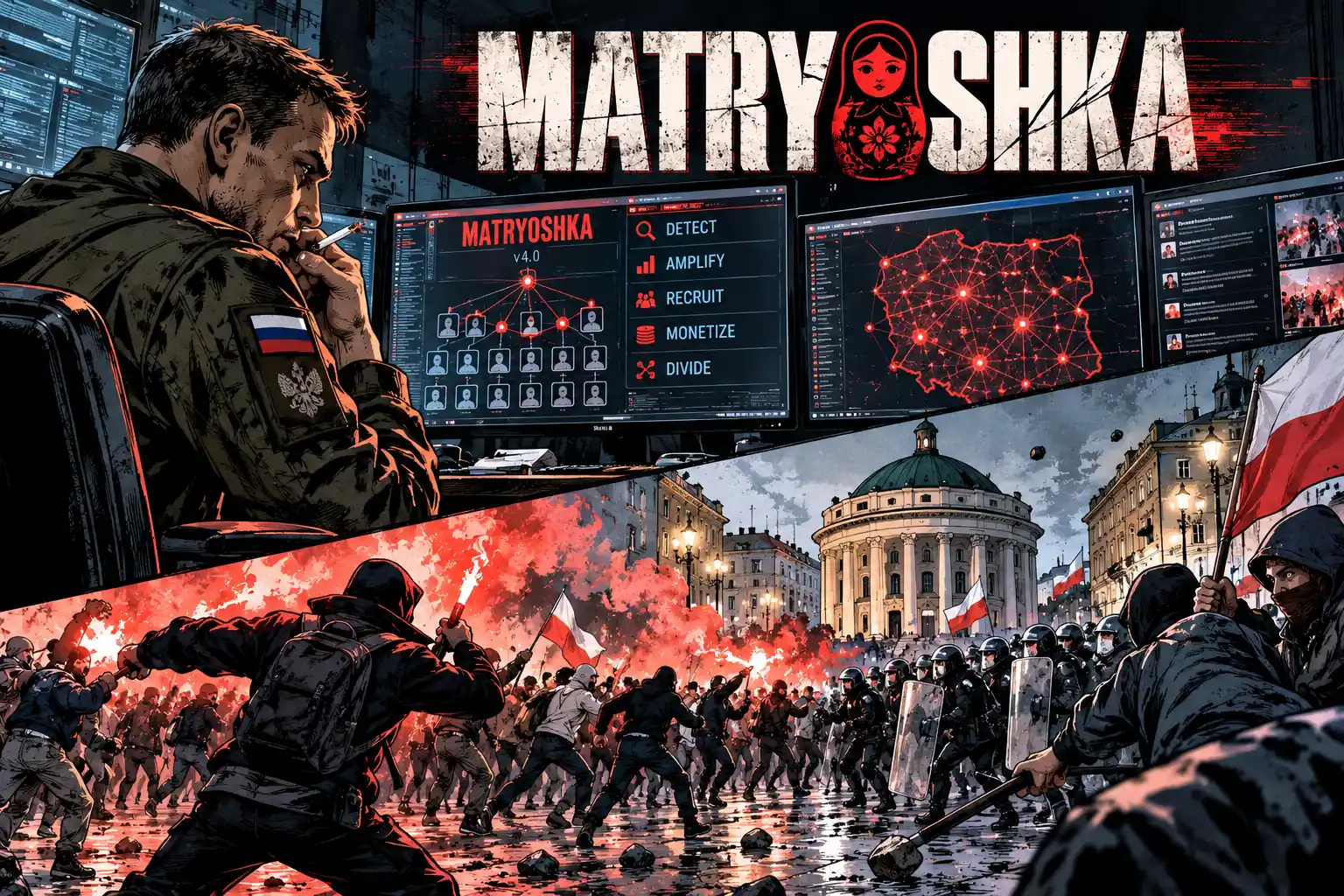
“Matryoshka” didn’t need people to write comments. It did that itself. It scoured Polish forums, Facebook groups, and Telegram channels, detecting the smallest pockets of frustration.
Inflation. An incident at a Warsaw nightclub. A fight at a bus stop in Rzeszów.
It took raw facts, inflated them through thousands of generated profiles, and fed them into recommendation systems.
The real operation began in the Recruitment tab.
It found Kamil. Twenty years old, expelled from university after his first year, unemployed, his browsing history filtered through three hundred and eleven indicators.
The message arrived on Telegram, from an account posing as a patriotic nationalist group:
“The government is handing Poland over to foreigners! Enough posting online—it’s time to act! We pay in cryptocurrency for every action targeting resettled migrants. 500 USDT per night.”
Kamil read it four times. Then he got up and paced around the room.
For eight months, nobody had wanted anything from him. His mother had stopped asking about work because every time she did, it ended in an argument. His university friends posted pictures from their internships. He sat in a rented room in Bemowo, writing comments nobody read.
And now someone had written: it’s time to act. To him.
Two minutes later, he replied that he was ready.
The tactical module generated the instructions using municipal surveillance feeds and patrol schedules:
“Buy spray paint. Three locations. The underpass by the Rotunda, a tenement wall in Praga. Paint what we send you.”
His hands shook so badly at the first wall that the letters came out crooked. By the third, they didn’t. He walked home at dawn across the empty Poniatowski Bridge and, for the first time in a long while, felt he had done something.
The transfer hit his wallet three minutes after image recognition verified the photographs of the slogans.
Kamil watched the balance and thought that at last he was part of something bigger.
He was right. He just didn’t understand what.
The photographs moved on. That same night, from Ukrainian-language accounts, “Matryoshka” circulated them as proof: look what they’re writing about you on your own streets.
Kamil had supplied material to both sides at once—and invoiced for it.
In Legionowo, “Czujka”—the analytical algorithm of the Polish Armed Forces’ Cyber Defence Forces—had detected the graffiti two days earlier.
Three identical graphic patterns in three districts, painted in a single night and posted by accounts created in the same week. Correlation: high.
It generated an incident report and assigned it Priority Three. Without an identified perpetrator or a criminal act, a higher priority fell outside its authority.
The report entered the queue. Four hundred and twenty others were already waiting there.
Three days later, St. Petersburg decided the ground was ready.
A fabricated video—purportedly showing Ukrainian immigrants vandalizing Polish flags—was pushed into Polish groups. Bots called for a “Spontaneous March of Outrage.”
From a second cluster of accounts, “Matryoshka” called for a “defensive counter-demonstration,” attaching photographs of Kamil’s graffiti.
Both sides received maps and times in their own languages.
Point of collision: Saviour Square, Friday, 9:00 p.m.
Kamil stood in the front row, gripping a telescopic baton in his pocket. His heart hammered so hard he could hear it over the shouting.
Finally, something real.
Coming toward him were boys just like him, carrying the same rage, fed by the same servers.
A flare burst open the darkness.
Kamil’s baton struck the shoulder of a boy in a tracksuit who had thrown a bottle a second earlier. Then something hit Kamil in the temple, and the asphalt rushed up to meet his face.
He lay on the cold paving stones, hearing sirens and screams he couldn’t understand. Someone ran across his hand.
He wanted to call out, but didn’t know to whom—and for a moment he couldn’t tell which side of the street he was on.
Two kilometres away, in Praga, outside the cordon and beyond the plan, a group of teenagers cornered two workers coming off the night shift outside a twenty-four-hour shop.
The police, scattered by false bomb reports, arrived twenty minutes later. The ambulances came another nine minutes after that.
“Matryoshka” classified Praga as an unplanned incident and counted it toward the result.
Petrov took a sip of cold coffee and looked at the feed from Warsaw’s traffic cameras. Another paving stone flew toward the cordon.
He smiled.
A notification appeared on the monitor:
“Operation WARSAW-CENTRE: objective achieved. Polarization within target group: +14.2%. Phase Two: Kraków, Gdańsk. Initiated at 21:47.”
Petrov clicked Approve. It was 21:52.
At 22:14, “Czujka” completed the picture.
Activity had surged in two linguistically segregated clusters, at the same time and from the same pool of addresses. Link to the report filed five days earlier: confirmed.
A briefing appeared on Major Zawadzka’s terminal:
“Coordinated information campaign; high probability of a state actor. 114,000 accounts. Recommendation: escalate.”
The diagnosis was flawless. “Czujka” knew everything it needed to know.
It could do nothing except write that sentence.
Zawadzka read it, checked the time, and reached for her phone.
At 23:52, the phone rang in an office on Aleje Ujazdowskie.
The prime minister listened for forty seconds.
“Who?” he asked.
“High probability of a state actor, Prime Minister.”
“I’m asking who.”
Silence fell at the other end of the line, and that silence was the answer.
“What can we do tonight?”
“Submit a request to the platform operators. The servers are in Ireland and California. It’s Saturday.”
The prime minister walked to the window. A police car passed along the avenue without its siren on.
“Two men in Praga are in critical condition,” the voice in the receiver said. “The media have known for twenty minutes.”
“I have to say something at eight.”
“Yes, Prime Minister.”
He hung up and remained by the window. He knew that whatever he said would be too little for some and too much for others.
What he didn’t know was that this wasn’t a side effect.
Both systems were equally good.
Only one had the authority to act.
At 08:00, the prime minister addressed the cameras. His statement lasted four minutes.
“Matryoshka” downloaded the transcript at 08:06 and began looking for sentences that could be cut out of context.
Phase Three no longer required approval.
ПШЕКИ
· [psheki] · “psheki”
A Russian derogatory term for Poles, derived from the characteristic Polish sibilant cluster psz. Comparable in register to English slurs such as “Polacks” or “Ruskies” in Polish usage: barracks slang and internet abuse, not official language.
The events are fictional. The methods are not.
This text is a work of fiction. The characters, units, and system names are invented. The mechanism described—automated recruitment through social media, cryptocurrency payments for small acts of vandalism, the simultaneous incitement of both sides of the same conflict, and an operation whose tempo outpaces the response of public institutions—was inspired by real events in Poland between June and August 2026.
FROM THE SAME ERA
These are not ranked recommendations. It is simply another available piece from the same period of the world.
SEE THE FULL ARCHIVE →