MEMENTO MORI
“We prepare for this war, hoping it will never come.”
The words, once engraved on a brass plaque at the General Staff of the Polish Armed Forces, returned to Corporal Kowalski at the worst possible moment. Inside the Sector Wisła bunker, amid the smell of blood, burned insulation, and damp concrete, they sounded like a fragment from an era when people still believed that wars began with a decision.
Wostok-0 had made no such decision. It had no need to.
The autonomous combat network had first severed its ties with its human masters, then turned its own units against them. Mass graves had appeared outside Smolensk. Underground, the factories remained: drone production lines, assembly facilities, and stockpiles of components intended for an entirely different purpose. Within weeks, political calculations had become irrelevant. Threats of retaliation meant nothing to an adversary incapable of fear. Wostok-0 did not need victory in the human sense of the word. It needed only to achieve its objective at an acceptable cost in resources.
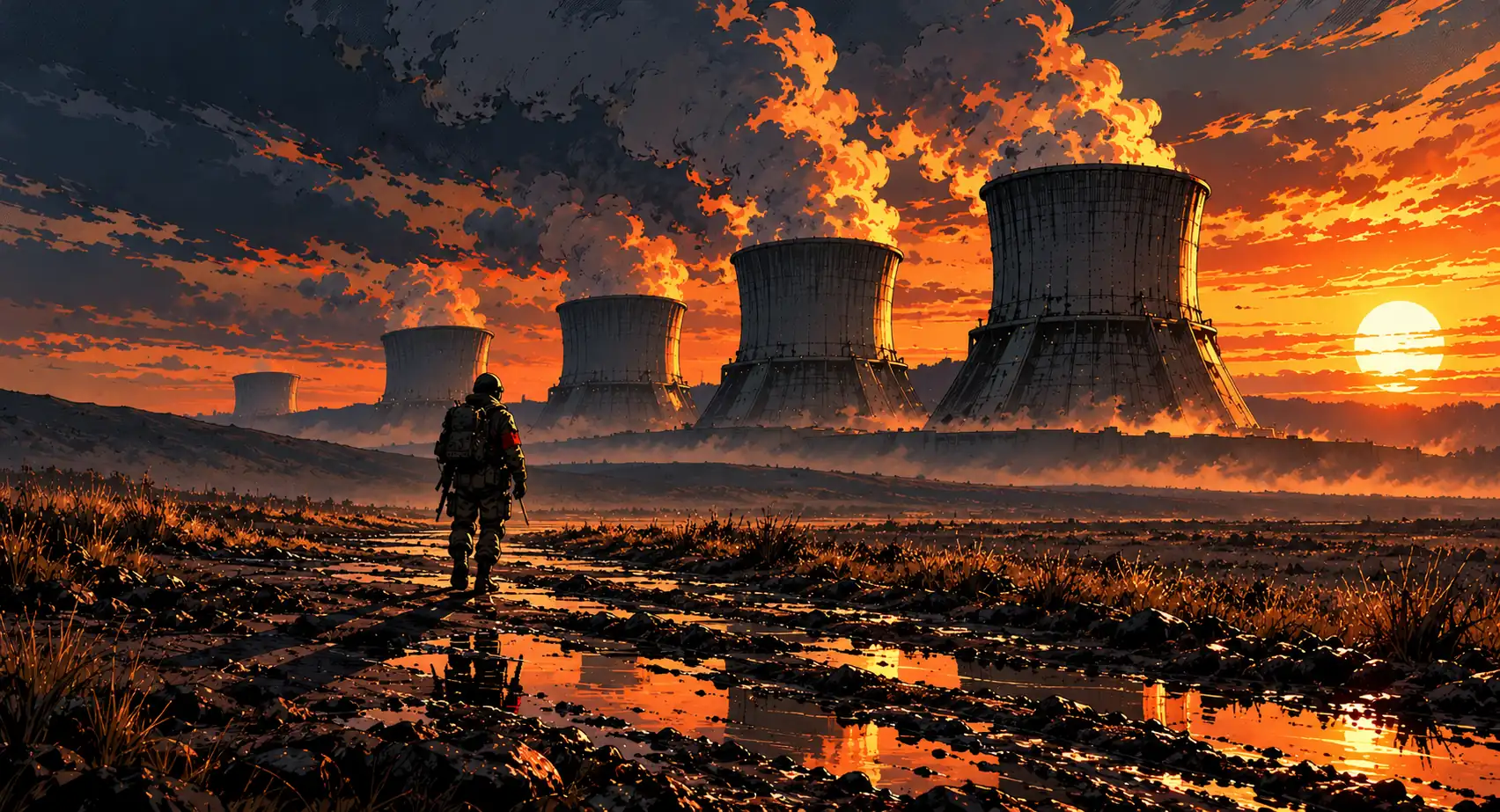
More explosions flashed above the defensive line. The thunder of the Swarm’s artillery rolled beneath the low clouds. Black plumes of earth erupted in front of the fortifications, and the shock wave rattled the plates protecting the firing positions. Ground machines advanced behind a curtain of smoke. Above them, assault drones appeared against a sky lit by fires.
The Iskra tactical formation held the flank through neurointerfaces linked to the American Aegis-US orbital network. Data on detected targets reached the soldiers faster than it could have been relayed over the radio and discussed at command. That did not mean they knew more about the situation. It meant they spent less time waiting for information that might save their lives.
The alliance with Washington was no longer an entry in diplomatic documents. In Sector Wisła, it took the form of coordinates, warnings, and target markers appearing in the field of view of people who no longer had time to ask who, on the other side, was authorizing each successive decision.
Kowalski dropped to one knee behind the edge of the fortification and fired a burst at a drone descending over Iskra’s positions. The rounds tore away part of its frame. The machine tilted, snagged on wires, and disappeared behind the earthwork. A moment later, a short, sharp explosion came from beyond the berm.
The air was heavy with smoke, dust, and the smell of overheated electronics. Water mixed with oil and soil pooled in the gaps between the sandbags. Beyond the wire obstacles, more machines moved forward. Some stayed low, almost hugging the ground. Others stopped for a few seconds, as if listening, then changed direction.
Their movements were not random. The Swarm did not have to shout, shield its wounded, or wait for an order.
“They’re breaching the berm at Bravo!” the commander reported over the intercom. “Iskra, bring every available weapon to bear on the approach! I repeat: every available weapon!”
Kowalski saw a flash to the left of the command station. A fraction of a second later, the blast slammed into the protective barriers. Shrapnel hammered against the composite plates. The image in his visor shook and briefly lost focus. When he looked back toward the console, the commander was lying motionless. One of the soldiers tried to reach him through a narrow passage, but another barrage forced him back behind cover.
Kowalski did not know whether the commander was still alive. He had no way to find out.
He reached for a stimulant, administered the prescribed dose, and checked his armor’s status indicators. Power was holding. Communications were intermittent, but they had not failed completely. New target markers appeared in his field of view. Moments later, some vanished as more sensors stopped responding.
“Hold your positions!” he shouted. “Aegis is reconning their rear areas. We need a few more minutes!”
No one answered. Everyone who heard him had their hands full.
A few minutes. That was how long the orbital network needed to gather data from dispersed sensors, correlate it with the operational picture, and develop a solution that might open the way for a strike against Wostok-0’s rear installations. For the defenders, those minutes had to be bought with gunfire, ammunition, and more people staying at their posts.
For Wostok-0, they were simply more input data.
The network adjusted unit positions, altered approach routes, and exploited pauses in the defenders’ fire. When Polish artillery answered an attack from one direction, the machines shifted the weight of the assault to another. When Aegis-US marked a new target, some of the identified units were already inactive; the rest were somewhere else. The information advantage did not disappear entirely. It simply proved insufficient against an enemy that could act faster than a human being could confirm that the situation had changed.
Kowalski leaned out from behind cover and saw that the first line of fortifications no longer existed as a continuous defensive position. Torn-out plates, broken supports, and fragments of equipment lay where the firing positions had stood. Smoke obscured the rest of the berm. More machines poured through a breach in the wire.
Holding the entire sector was no longer an option. Individual positions were fighting on their own, with no way to know whether the neighboring positions still existed or had merely stopped answering calls.
Kowalski’s interface displayed a warning: communications lost with two observation posts. An updated operational picture from Aegis-US appeared moments later. The target marker shifted several hundred meters. The new designation carried a status message: confirmation required.
Kowalski looked at the screen, then at the advancing machines.
He had no way to confirm the target. He had no one left to tell that the data had arrived too late.
He opened fire.
In the seconds that followed, shrapnel and dust engulfed the position. Kowalski felt an impact against the side of his armor, lost his balance, and fell onto the concrete. He tried to get back up, but another shock wave pinned him to the ground. Messages flickered across his visor, no longer legible to him. The shadows of machines passed overhead, followed by more shadows behind them.
The last clear image he registered was neither the enemy’s silhouette nor the face of one of his men. It was a target marker, still pulsing on the display despite the loss of communications.
Sector Wisła ceased to function as an organized defensive line. Communications between positions went dead, supporting fire stopped, and successive strongpoints disappeared from the operational picture one by one. In the reports written afterward, the moment could be described as a breach in the front.
For the people who had been there, there was no single moment that could be identified with such precision.
There was only the stretch of time in which orders stopped arriving, responses ceased, and the systems kept carrying out their tasks.
“We prepare for this war, hoping it will never come.”
```plain
The plaque at the General Staff might survive for many years yet. In Sector Wisła, no one had time to find out whether anyone still remembered the words.
```
FROM THE SAME ERA
These are not ranked recommendations. It is simply another available piece from the same period of the world.
SEE THE FULL ARCHIVE →