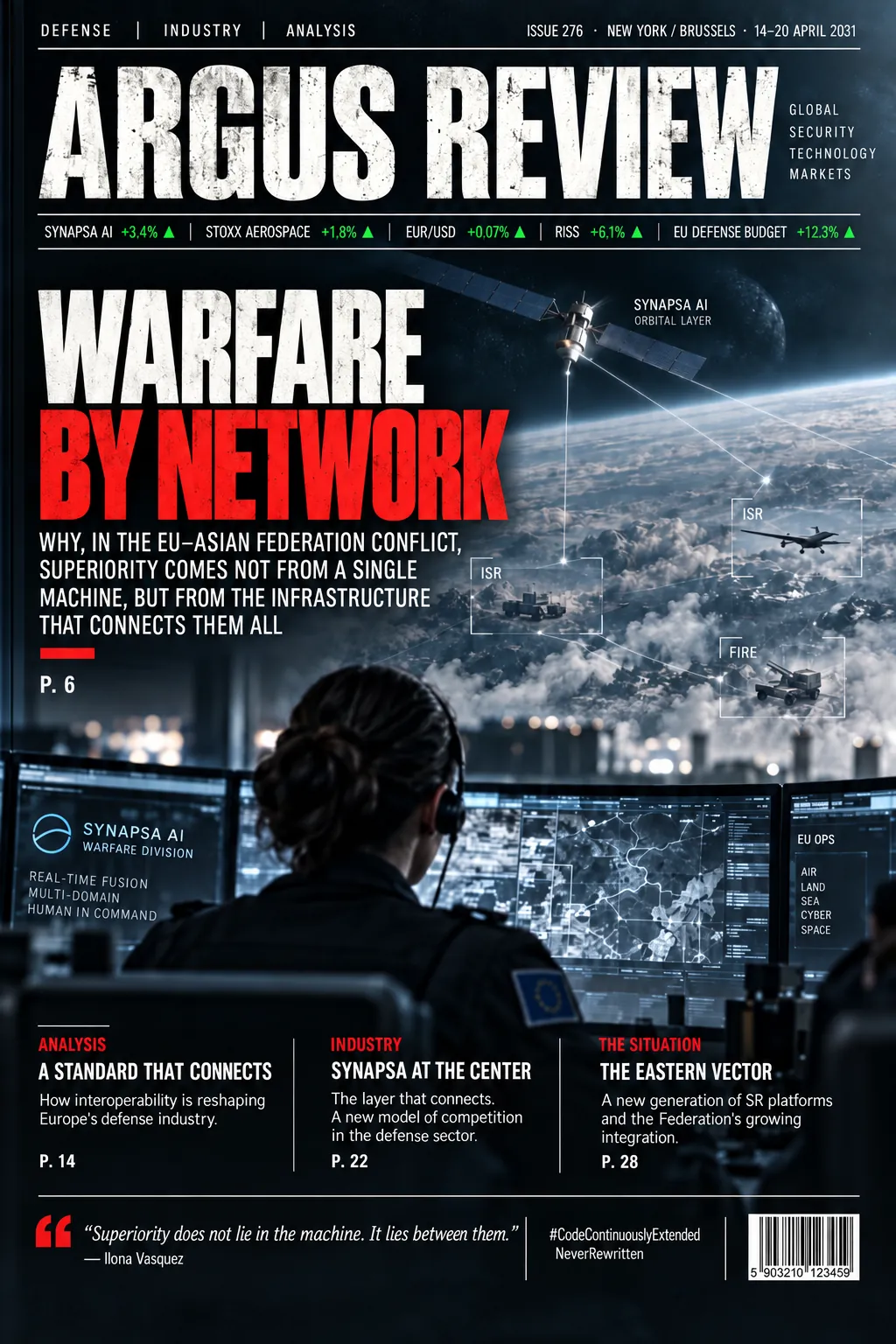
# WAR IS NO LONGER ABOUT PLATFORMS
Why, in the EU–Asian Federation conflict, superiority increasingly depends not on a single machine, but on the infrastructure connecting dozens of different devices.
Ilona Vasquez
ARGUS REVIEW · New York · 2031
Until a few years ago, technological superiority on the battlefield could be described primarily by comparing individual platforms. Aircraft performance, radar range, drone capabilities, and weapons effectiveness were the key measures. In the conflict between the European Union and the Asian Federation, however, it is becoming increasingly difficult to assess individual devices in isolation from the infrastructure they operate within.
This does not mean the end of the tank, the aircraft, or the unmanned vehicle. Their place in the operational chain is changing. A platform is becoming one component of a larger environment for exchanging and processing data: a sensor supplies information, an algorithm classifies it, a network relays the result, an operator makes a decision, and another platform carries out the task. The result then feeds back into the system.
The ability to work together is increasingly what determines the value of individual devices.
FROM PLATFORM TO INFRASTRUCTURE
The shift did not begin in the military. Similar solutions had already been developed in logistics, energy, transportation, and critical infrastructure management. Armed conflict, however, makes the consequences of poor integration far more visible.
A modern drone may carry an advanced sensor, thermal imaging, image-recognition software, and a communications system capable of transmitting data in real time. All these capabilities have limited value if the information cannot be delivered quickly to the right recipient or is not available in a form that can be used.
That is why military programs are increasingly focused not only on purchasing equipment, but also on acquiring a defined operational capability. Under one model, an army buys a drone. Under another, it buys the ability to detect, classify, and track a target in a specific environment. The drone remains essential, but it becomes one of several components delivering that capability.
EUROPE HAS AN INTEGRATION PROBLEM
The European Union is developing its capabilities within a fragmented industrial and military structure. Individual member states rely on their own manufacturers, research programs, and command systems, while parts of the infrastructure are supplied by private entities.
This makes it harder to establish a unified operational environment. At the same time, it drives the development of mechanisms that allow devices from different manufacturers to work together.
A European drone may use a sensor from one company, an observation system from another, analytical software from a third, and communications supplied by yet another operator. If all of them are to participate in the same operation, they must exchange data through common interfaces.
As a result, intermediate layers—once treated as auxiliary components—are becoming increasingly important.
SYNAPSA AI — WARFARE DIVISION MOVES DEEPER INTO THE DEFENSE STRUCTURE
One of the clearest examples of this trend is SYNAPSA AI — WARFARE DIVISION, the defense division of Synapsa AI NV.
Synapsa AI NV itself operates across a much broader market, including civilian applications, infrastructure, data analytics, and installations beyond Earth. Its defense business operates under the separate name SYNAPSA AI — WARFARE DIVISION.
The value of this model does not necessarily lie in the device at the end of the chain. The management layer can be just as important: it enables different platforms to exchange information and pass it on to other parts of the infrastructure.
SYNAPSA AI — WARFARE DIVISION therefore does not need to manufacture every device deployed on the battlefield. If its solutions sit between sensors, platforms, operators, and command systems, their importance also derives from their position within the overall structure.
That makes this model harder to replace than a single product.
THE FEDERATION BUILDS ITS OWN ECOSYSTEM
The Asian Federation is pursuing a different path toward integration. Shenzhen Robotics is developing its own family of autonomous platforms, including SR/Alpha, SR/1.0, and SR/UGV.
A defining feature of this approach is the coexistence of successive generations. A new model does not automatically mean the previous one is withdrawn. Different platforms can perform different tasks and remain in service simultaneously.
SR/Alpha can conduct reconnaissance and missions requiring small numbers of units; SR/1.0 can support larger formations; and SR/UGV can handle tasks requiring a heavier platform.
From the user's perspective, these are different devices. From the infrastructure's perspective, they are additional data sources and executors of specific functions.
Superiority, then, does not necessarily come from possessing a single “best” platform. It can come from the ability to employ multiple specialized devices within one operational process.
INFORMATION MAY BE THE MOST EXPENSIVE ASSET
In this environment, the fundamental question on the battlefield is also changing. It is no longer just a matter of what lies in front of a sensor. The more important question is which of the information collected demands immediate attention.
A camera can capture millions of pixels, a radar can generate thousands of tracks, and an unmanned vehicle can transmit video for hours. No human can analyze all that data simultaneously. Software therefore becomes the first filter.
An algorithm does not need to conduct an entire operation independently to influence its outcome. It is enough for it to determine the order in which information reaches the operator or highlight the elements of an image it considers significant.
When software sets information priorities, it also determines the order in which a human being becomes aware of the situation. And the order in which information arrives can influence a decision.
WAR IS MEASURED IN SECONDS
With autonomous and semi-autonomous systems, the interval between detecting a threat and responding to it can be measured in seconds. A platform that delivers correctly classified information faster may gain an advantage over a device equipped with a better sensor but operating within a slower decision-making chain.
The battlefield is therefore beginning to resemble a closed information loop: detection leads to classification, classification to prioritization, and then to decision and execution. The outcome generates new data, which can be used in the next cycle.
The shorter the interval between these stages, the more important the infrastructure connecting them becomes.
THE HUMAN REMAINS IN THE LOOP
This does not mean the human being disappears from the chain. Operators still authorize actions, commanders define objectives, analysts interpret results, and engineers maintain the infrastructure.
What changes is how people access information. Operators increasingly see a processed representation of the environment rather than observing the entire situation directly.
That does not automatically mean a loss of control. It does mean that the quality of a decision also depends on the quality of the layer between the human being and the original data source.
For this reason, management software is becoming part of the combat capability itself.
A COMMON LANGUAGE MATTERS MORE THAN ANOTHER PLATFORM
The greatest challenge of the next decade may not be building another autonomous device, but ensuring that existing systems can work together.
A European drone may come from one manufacturer, an observation system from another, analytical software from a third, communications from a fourth, and a ground platform from a fifth. If they are to take part in the same operation, all of them must exchange information.
A market is emerging whose importance will grow with every new generation of equipment. The issue is no longer just the manufacture of devices, but also the ability to integrate them into existing infrastructure.
This changes the nature of industrial competition. A manufacturer whose solution can work with a large number of other platforms gains strategic importance regardless of whether its own device is the best in its category.
SUPERIORITY BECOMES INVISIBLE
Future technological superiority may become increasingly difficult to measure using traditional performance metrics. Radar range, drone numbers, vehicle speed, and flight endurance can all be compared. It is much harder to compare two information-processing architectures and determine why one enables a faster transition from observation to action.
Does the decisive advantage come from a better sensor, algorithm, network, data quality, or the way all these elements are connected?
In practice, the answer may involve all of them at once.
Some of the most important advantages on tomorrow's battlefield may therefore remain invisible. They will not take the form of a new vehicle or a distinctive weapon system. They will lie in the way existing components exchange information.
WAR AS A SYSTEM OF SYSTEMS
The EU–Asian Federation conflict illustrates a process that, only a few years ago, might have seemed a distant prospect. Autonomous platforms are changing the nature of military operations primarily because they allow some processing to move closer to the data source, shortening the chain between observation and response.
When dozens of such devices are connected, they form a structure whose capabilities cannot be described by simply adding together the specifications of its individual platforms.
This is a system of systems: an environment in which multiple, different components can work together to accomplish tasks that no single platform could perform on its own.
THE NEXT FRONTIER
Technological competition is increasingly taking place between environments that can interoperate and those that still require a human being to act as a manual translator between successive layers.
SYNAPSA AI — WARFARE DIVISION is developing its own integration model. Shenzhen Robotics is building a parallel family of autonomous platforms. Europe is trying to connect solutions from multiple countries, manufacturers, and infrastructure providers.
None of these models is yet a final solution. The direction of change, however, is clear: the importance of an individual platform will increasingly depend on how much of the surrounding infrastructure it can work with.
A new drone can expand the capabilities of an existing network, a sensor can provide additional data, a satellite can extend the area under observation, and an algorithm can shorten analysis time. The entire structure does not have to be rebuilt from scratch every time.
It only needs to be expanded.
Synapsa AI NV is not the only company operating in this market. Its Warfare Division, however, is among the players building its position around infrastructure that enables different devices to work together.
In a conflict where response times can be measured in seconds, the importance of this layer will continue to grow.
The most important change is not simply that increasingly sophisticated machines are appearing on the battlefield. It is that machines are beginning to function as components of a larger architecture.
The advantage of the future may lie not in an individual platform, but between platforms.
#LogikaRzezni #CGProtocol #MilitarySF #ArgusReview
Events are fictional. Methods are not.