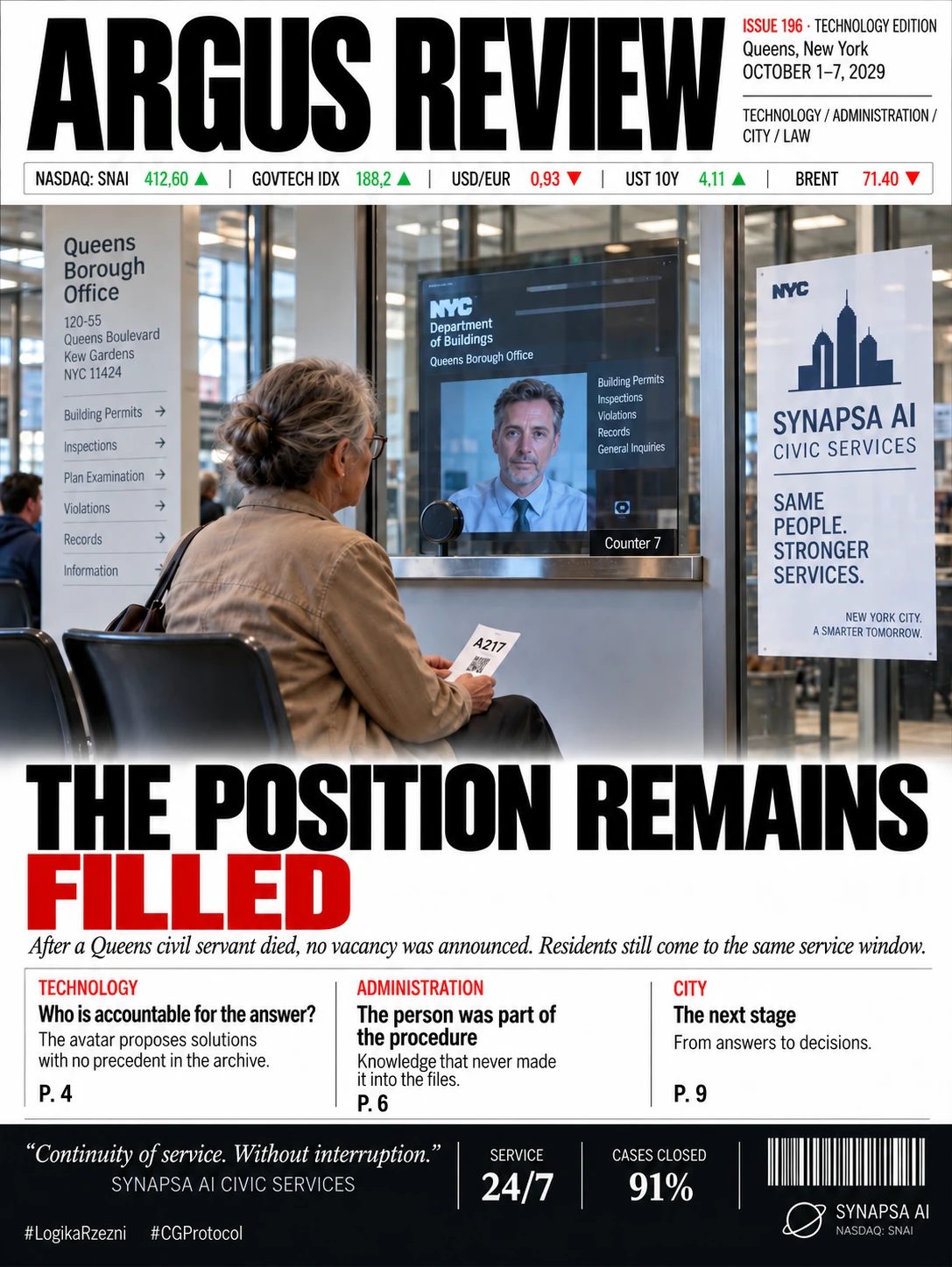
THE POSITION REMAINS FILLED
NO. 98 · TECHNOLOGY / PUBLIC ADMINISTRATION QUEENS, NEW YORK · 2029
Ilona Vasquez, New York
____
THE POSITION REMAINS FILLED
ARGUS REVIEW · Technology
When a longtime civil servant in Queens died, no vacancy was announced. A digital avatar took his place. Residents still come to the same service window.
Ilona Vasquez | ARGUS REVIEW
At the Queens Borough Office on Queens Boulevard in Kew Gardens, some files run back decades. Inspections, past violations, and decisions made years ago form a web of dependencies that no single database record can reconstruct.
A new poster hangs on the office door: white background, the city seal, and the words SYNAPSA AI CIVIC SERVICES. The notice announces a pilot program for continuity of service. Opening hours remain unchanged. So do case numbers, registries, and procedures.
There is no mention of a vacancy.
A few weeks ago, a civil servant who had spent more than a decade handling cases that required intimate knowledge of local regulations died. He knew the documents search engines failed to find. He remembered why two almost identical applications had received different rulings.
Instead of a successor, an avatar appeared—built from his official correspondence, case files, meeting recordings, and other records of his work.
The city does not claim to have brought him back. It says it has ensured continuity of service.
THE PERSON WAS PART OF THE PROCEDURE
Public administration stores knowledge in files, but not all of it. Some remains buried in the reasoning behind decisions, old disputes, and rulings whose context appears on no form. The death of an experienced employee is therefore more than a vacancy. It is a risk of losing institutional knowledge.
The avatar can imitate his style, retrieve earlier cases, and propose solutions consistent with the documentation. But its next answer need not be the one the deceased would have given.
During the pilot, the system produced a recommendation for which there was no precedent in the archive. It did not violate procedure, nor did it reproduce any previous decision. It was new.
The officials overseeing the program had to decide how to evaluate it: by legal compliance, consistency with the case files, or fidelity to the deceased’s probable intentions. Those are three different standards.
WHO IS ACCOUNTABLE FOR THE ANSWER?
In the pilot materials, continuity means an available service desk, a history of cases, and predictable service. We found no indication of who is accountable when the avatar presents a new recommendation as a continuation of the deceased employee’s work.
When a system drafts a document, a human can review and sign it. When a decision is made automatically, the institution must identify the legal basis for the system’s action and the person accountable for the outcome.
But when a resident receives an answer bearing a dead man’s name, his authority lends weight to a statement he can no longer verify.
THE NEXT STAGE
Round-the-clock availability, shorter processing times, fewer outstanding cases: these metrics are easy to measure. It is harder to determine when a tool supporting a public office begins to replace the person whose position carried its own legal basis and powers.
Program materials envisage extending the pilot to additional municipal services. They do not indicate that the avatar will assume the statutory powers of a civil servant, inspector, or police officer. Each of those functions would require its own rules and clearly defined scope of accountability.
The logic of deployment, however, is clear. First, the system answers questions. Then it prepares recommendations. Finally, it performs selected tasks without human involvement. Each step can be justified on its own.
The name Synapsa AI Civic Services appears on the program posters. The city preserves the service; the system takes over part of the work. Residents receive answers—sometimes in the voice, style, and under the name of a man who is no longer alive.
The pilot will be evaluated by processing times and the number of cases closed without human involvement. We found no separate metric for how many answers were attributed to the deceased civil servant despite having no basis in his own records.
Ilona Vasquez
ARGUS REVIEW · Queens, New York · 2029
Events are fictional. Methods are not.