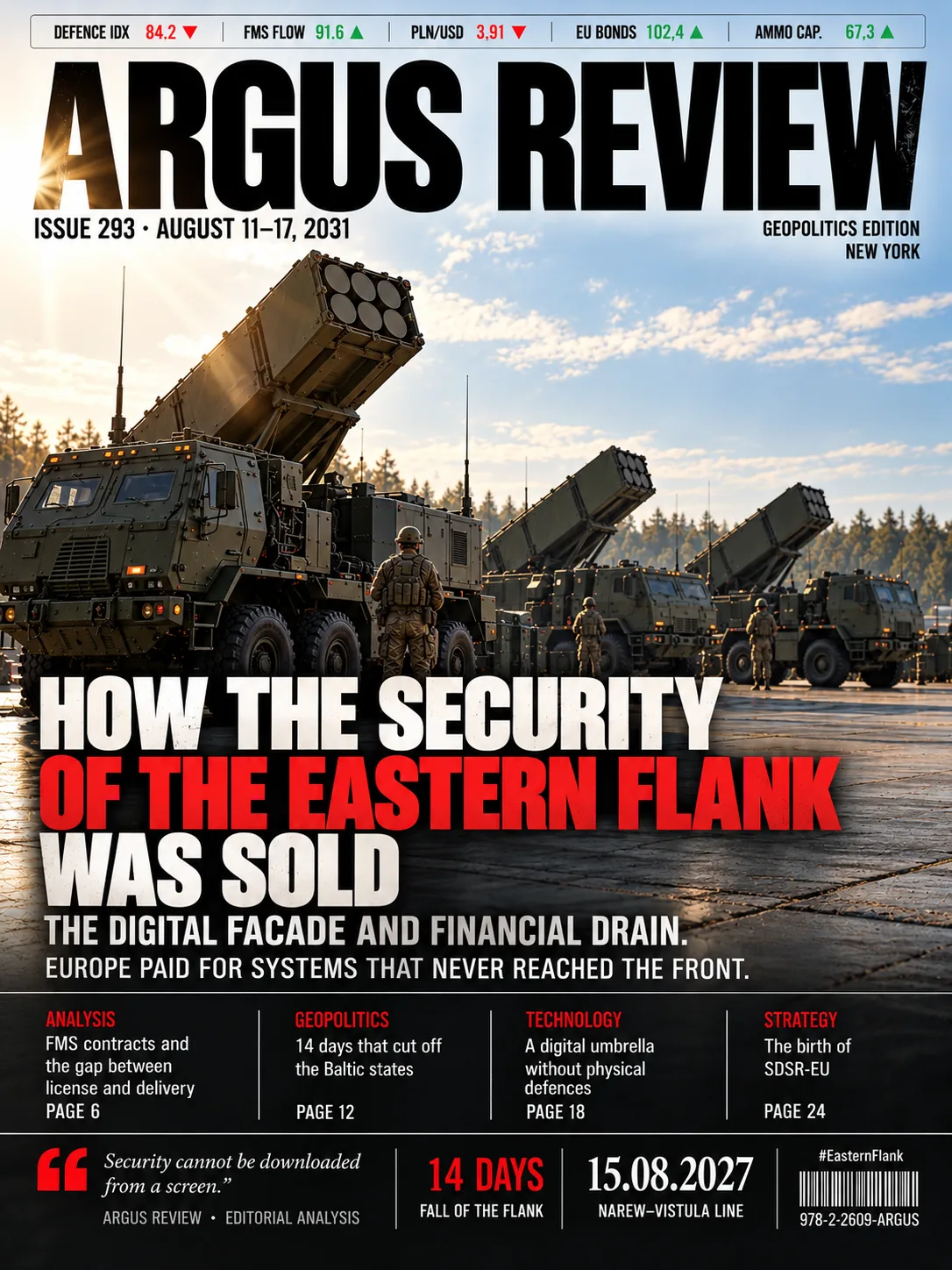
TRANSACTION WITHOUT EFFECT
NO. 293 · Geopolitics Edition | New York | August 11–17, 2031
Ilona Vasquez
____
HOW THE SECURITY OF THE EASTERN FLANK WAS SOLD OUT. SIGNAL ANALYSIS: A DIGITAL FACADE AND FINANCIAL DRAIN.
In classical defense doctrine, it was assumed that security could be bought. With multi-billion dollar contracts, signed well in advance. That was one of the first mistakes of the pre-war era. Foreign Military Sales (FMS) registries and their accompanying commercial contracts show what came of it. Argus Review analysts accessed the hard data: Central Europe transferred massive capital to the American government and American corporations. The effect was twofold. The region was drained of cash, leaving no money for domestic engineers, and the interceptor systems never arrived in the declared numbers.
The physical presence of US troops on the eastern flank ceased to exist. It was replaced by technology deliveries: integrated battlefield management systems, analytic cores, and predictive algorithms provided by Synapsa AI — Warfare Division, the military branch of the American tech giant. America's contribution to the region's defense was reduced to a digital environment. The defense itself was absent.
Washington's official narrative of "empty warehouses and bottlenecks due to regional crises" was a smokescreen. Defense mega-factories were operating at maximum capacity, but the Pentagon was stockpiling this arsenal exclusively for its own needs. The transaction system worked exactly as designed: Europe paid billions for the digital illusion of a "protective umbrella," the physical effects of which were kept across the ocean.
OPERATIONAL RECONSTRUCTION: 14 DAYS OF STRATEGIC VACUUM
Under the conditions of the political phasing out of old defense structures, the Asian Federation did not need weeks for a visible troop concentration. Total strategic surprise and the deployment of units straight from their home garrisons (an attack from the march) allowed the operation to be subordinated to a rigorous schedule: 14 days, from Monday, August 2, to Sunday, August 15, 2027, to present the continent with a fait accompli.
In Russian headquarters, at the battalion and regiment levels, one question circulated in hushed tones from day one: who was really issuing the orders. The schedule came from above, complete, with guidelines and reconnaissance data whose sources no one could identify. Officers who tried to verify them received their answers through the exact same channel the order came from. Some commanders began to wonder if Beijing wasn't already making the decisions. From the perspective of 2031, they were not wrong.
[DIAGRAM] KALININGRAD ──(saturation with air attack assets)──► 16TH DIVISION (fixed in combat) │ ├──(airborne assault and fleet)──► GOTLAND (A2/AD bubble) │ ▼ SUWAŁKI GAP (Day 1) ◄──(combat engagement)── BELARUS (main armored wedge) │ ▼ BALTIC POCKET (14 days) ──────────────► BIRTH OF THE SDSR-UE (abandonment, lack of support) (new blocking line) [/DIAGRAM]
Day 1–3: Engagement at Suwałki and two-pronged paralysis
Moscow calls the operation the defense of the Russian-speaking population in the Baltic states. The text of the official justification is ready before the first shot is fired.
Operations begin with a violent clash in the Suwałki Gap region. A mechanized advance from Belarusian bases coincides with the launch of a massive wave of air attack assets from two directions at once. Kaliningrad and Belarus flood the airspace with thousands of cheap kamikaze drones, decoy swarms, and rocket artillery salvos. The goal is purely mathematical: to force the local anti-aircraft defense to deplete its already meager reserves. Within 72 hours, Polish and Baltic defense systems become decoys because they have nothing left to fire. Synapsa AI — Warfare Division systems, stripped of physical effectors, report nothing but the enemy's clean, digital progression.
Day 4–6: Land isolation and fixing the 16th Division
The strike from the Kaliningrad direction has one task: to fix the Polish 16th Mechanized Division in combat. Artillery fire and simulated assaults anchor this massive tactical formation to the northern border, preventing its redeployment to the east. Meanwhile, the main armored wedge from Belarus enters Podlasie, bypasses the fortified Masurian lakes, and cuts off the Suwałki Gap, linking up with the Kaliningrad garrison.
Day 7–10: Anti-access bubble over Gotland
Russian special forces and airborne troops seize Sweden's Gotland. Heavy S-300 and S-400 systems deployed there create an anti-access/area denial (A2/AD) bubble over the entire Baltic Sea. The Russian missile umbrella shifts deep to the west, closes off maritime and aerial approach routes, and cuts the theater off from any external logistics.
Day 11–14: Abandonment of the Balts and the birth of the SDSR-UE
The Baltic States (Lithuania, Latvia, Estonia) are left alone, without outside support. Trapped in a land-sea pocket, they fall in less than two weeks, and their symbolic contingents capitulate. The Alliance gathers for consultations. The communiqué from the session is drafted only after Gotland is already occupied, and the Nordic countries no longer have a route to provide aid.
On the fourteenth day, the frontline halts at the Narew and Vistula rivers. Moscow announces a unilateral ceasefire and offers the West peace in exchange for accepting the new map. The first news agencies broadcast its contents from Beijing, an hour before the official release in Moscow.
At this turning point, amidst the ultimate disgrace of the digital "umbrella" and the betrayal of existing structures, frontline reality shatters the bureaucratic chains. The surviving, reorganized defense forces of the continent reject the American license and the Moscow peace offer, uniting under a new, autonomous command. The death of the old order becomes the catalyst that forces the immediate formation of the Union's Rapid Reaction and Landing Forces (SDSR-UE): a formation built on hard realism, a domestic ammunition industry, and technology immune to external decision-making paralysis.
HUMAN AMMUNITION AND THE GEOPOLITICAL CATALYST
The most expensive mistake of the pre-war elites was succumbing to the propaganda about the enemy's "demographic and resource weakness." An analysis of the Asian Federation's structure revealed an uninterrupted, year-round conscription conveyor belt: new cohorts (600–700 thousand men annually) fed the contract army like a renewable resource. With unlimited raw materials and export markets in the BRICS bloc, the enemy possessed an infinite capacity to wage materiel warfare. Moscow's official justification—the defense of the Russian-speaking population—was a pretext for external consumption. The strategic calculus looked different: the strike preempted European renewable energy and nuclear programs, which, within a decade, would have eliminated the continent's dependence on Russian resources.
Before the fighting broke out, the Polish defense system combined the high technical capabilities of its engineers with total decision-making paralysis. Private companies could build autonomous drones and electronic warfare systems, but bureaucracy, officials' fear of risk, and deliberate procedural sabotage by agents of influence blocked their implementation.
Only the catastrophe of the first 14 days and the abandonment of the flank by the digital systems provider reset this state of affairs. The SDSR-UE was forged from blood and cold calculation: true security does not come from paying advances for systems with a licensed range limit of 300 km. It stems exclusively from industrial sovereignty, domestic ammunition, and technologies that cannot be made dependent on an external license or a server farm on the other side of the ocean.
SIDE EFFECT: WHAT DO YOU NEED RUSSIA FOR
Russia won this round, and no one in Moscow priced in what it lost in the process. Europe, and Poland primarily, had no intention of returning to a dependence on Russian raw materials, even at the cost of expenditures that had seemed unbearable just a year prior. If pipelines and ore from the East are weapons, they must be replaced with something no one can cut off with a single communiqué.
The answer came from above. Space programs, treated until 2027 as a prestigious budget add-on, became a line of strategic importance: independent orbital access, imaging reconnaissance, lunar flights, cataloging metal-rich asteroids. The calculation is simple. If ores are brought in from asteroids, Russia ceases to be a necessity and becomes a contractor that can be bypassed. That is a horizon of decades, not years, and no one in 2031 is pretending otherwise. But the course has been set, and it was chosen by the exact same war that birthed the SDSR-UE.
RECORD REGISTRY STATUS: ACTIVE / RETAINED FOR ARCHIVE SOURCE: ARGUS EDITORIAL TRACE / ORIGIN-EXPANSION BRIDGE TIMELINE: ORIGIN ERA (2031 / CHRONO-COUPLING) EVENT WINDOW: 2027-08-02 / 2027-08-15 GEO-TAG: SUWALKI SECTOR / GOTLAND ANOMALY / VISTULA LINE
Events are fictional. Methods are not.