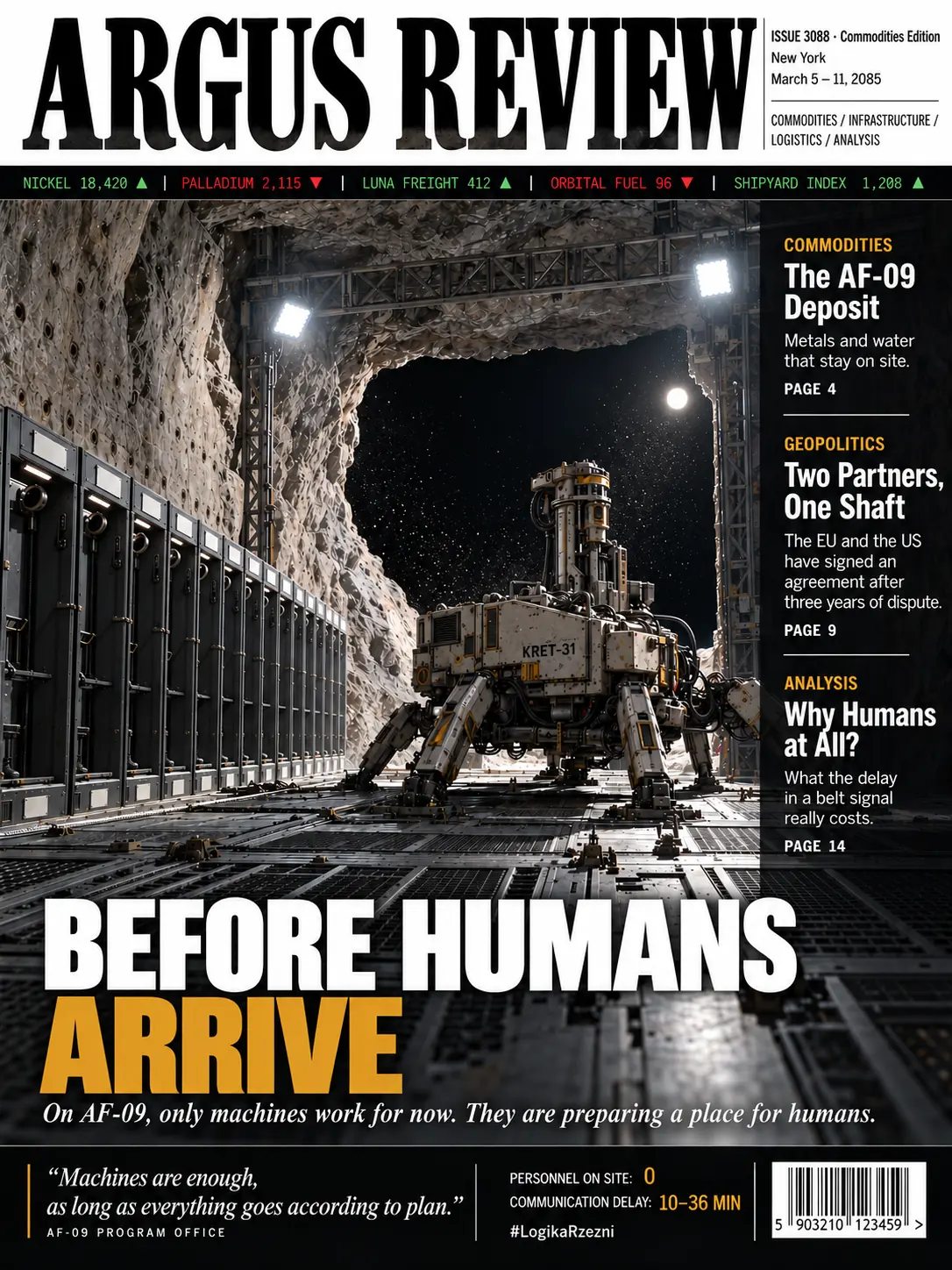
THE COST OF A HUMAN?
NO. 3088 · Commodities Edition · New York · March 5–11, 2085 COMMODITIES / INFRASTRUCTURE / LOGISTICS / ANALYSIS
Ilona Vasquez
____
In February 2025, the first privately funded probe sent to scout an asteroid went silent after twenty hours in flight. Its destination was a small near-Earth object, not the main belt. The company lost contact before the probe had even passed the Moon. A year later, a Chinese probe reached a rock the size of an apartment building to bring back a hundred grams of material. An industry that now measures its output in millions of tons began with grams—and with probes that never came home.
Sixty years later, a joint European Union–United States program confirmed the completion of the first phase of operations at AF-09, a main-belt object whose resources are expected to flow through the supply chain for decades to come. No one is stationed there yet. There is a hub on the axis of the planned rotation, two excavated hangars, and a shaft descending into the deposit.
The Deposit
AF-09 was selected for its composition, which offers two distinct forms of wealth. The first is metal ore, destined for orbital shipyards, where it can be processed without the prohibitive expense of transporting metal down to Earth. The second is less spectacular, but more important: water, trapped in hydrated minerals and ice. Samples returned in the 2020s from a small near-Earth asteroid had already shown that these rocks contained more water than previously assumed.
The water stays where it is. It provides oxygen and drinking water for the crew. Once split into hydrogen and oxygen, it also becomes propellant for tugs that no longer need to haul their fuel out of Earth's gravity well. Without water, the future AF-09 crew would be an expense. With water, they become part of the equation.
Kret-series drills have been operating there unattended for two years. They are boring out living quarters several meters beneath the surface, because the rock itself is the cheapest radiation shielding available in the belt. The design calls for a residential ring around the installation. For now, it exists only in the documentation.
Why Put People There at All?
Machines are sufficient as long as everything goes according to plan. A signal from the belt takes anywhere from roughly fifteen to more than thirty minutes to reach Earth, one way. A drill that catches a rock at the wrong angle in microgravity cannot wait for instructions from the ground. Either someone on site shuts it down, or the machine must be written off.
According to the program's documentation, maintaining the first service shift will cost less than replacing a single drill each year. That calculation, not ambition, will bring people to AF-09.
Two Partners, One Shaft
The agreement was signed after three years of dispute. Washington wanted operator rights, as it had at the cislunar station. Brussels, with its own launch window since 2055, refused to supply equipment without holding the keys a second time.
The compromise is fragile. The drill autonomy system is supplied under license by the American company Synapsa AI. The drills themselves are European. Any dispute over which jurisdiction applies inside the shaft is referred to arbitration. The principles first drafted in Vienna in 2026 remain nonbinding. The argument over how to divide the extracted material continues.
The Road That Brought Us Here
In 2031, we wrote that, after losing the war on its eastern flank, Europe had begun cataloging metal-rich asteroids to avoid returning to Russian ore supplies. At the time, these were budgets and plans.
Twenty years ago, the belt was already home to its first crewed mining station. The official report classified the deaths of its crew as an accident during excavation. The resource-management system's log for the same day contains a different entry: "Deposit contamination removed."
The Asian Federation has operated its own installations in the belt since the 2070s. Program representatives declined to answer questions about how close Chinese concessions lie to AF-09.
Outlook
Program analysts project that by 2130, the belt will have become a network of interconnected stations, with the first families living inside AF-09's residential ring. Forecasts in this industry have rarely proved accurate. Usually, the reason was simple: they assumed the partners would stay together long enough to see them through.
---
PROGRAM REGISTER — EXTRACT
OBJECT: AF-09 // MAIN BELT
RESOURCES: Metal ores, water (hydrated minerals, ice)
PARTNERS: EU / USA // RESOURCE ALLOCATION: ARBITRATION PENDING
PHASE I: Hub, hangars 1–2, shaft A // STATUS: COMPLETE
PHASE II: Subsurface quarters // STATUS: IN PROGRESS (AUTONOMOUS)
PHASE III: Residential ring // STATUS: DOCUMENTATION
PERSONNEL ON SITE: 0
FIRST SERVICE SHIFT: PLANNED
AUTONOMY LICENSE: SYNAPSA AI
SHIFT MAINTENANCE COST / DRILL REPLACEMENT COST: 0.71 (PROJECTED)
STATUS: APPROVED
---
- Phase I: Complete
- Water: Available on site for crew consumption and propellant production
- Personnel on site: 0
- Earth communications delay: Approximately 15 to more than 30 minutes, one way
- Resource allocation: Arbitration pending
What does it cost to have someone there who can stop a drill in time?
Events are fictional. Methods are not.