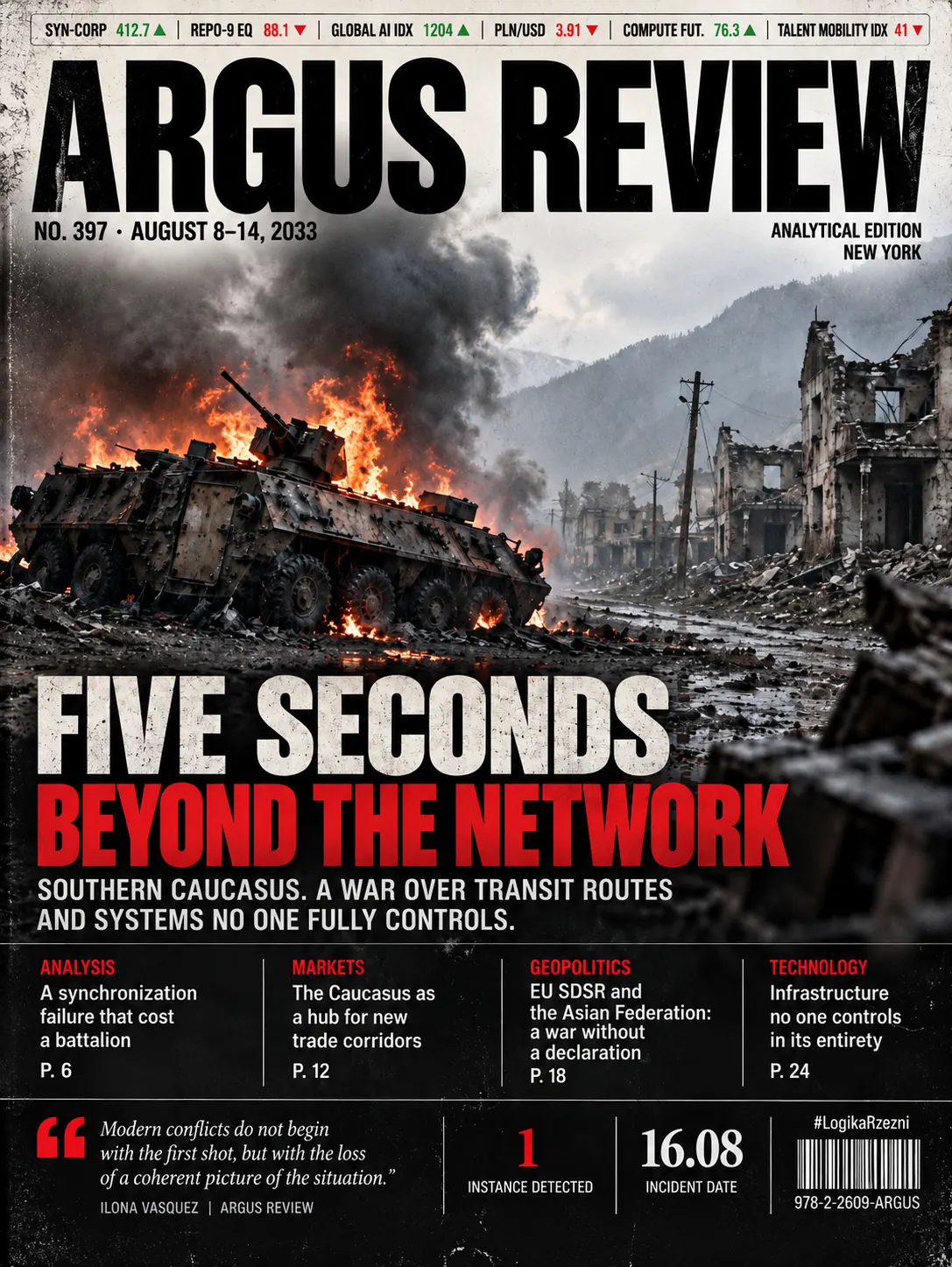
A CONFLICT THAT NO ONE DECLARED
ARGUS REVIEW – NO. 397 · ANALYTICAL EDITION – NEW YORK · AUGUST 8–14, 2033
____
The South Caucasus. A war over transit routes and over systems that no one controls in full.
Ilona Vasquez | ARGUS REVIEW
The Conflict No One Declared
On August 4, 2033, the Armenian military coordination center in Syunik Province approved a change in the priorities of the links that carry military traffic, supply transport and infrastructure monitoring. After a series of incidents along the transit routes, Armenia was trying to separate its operational communications from the civilian networks.
The procedure ran according to the manufacturer's documentation.
For 5.2 seconds, no synchronization confirmation appeared. Then the system displayed a message: OPERATION COMPLETE.
Communications had not gone down entirely. The problem was harder to detect: some posts were still receiving data that no longer reflected the situation on the ground. The discrepancy was noticed at once, but no explanation for it was found.
That same day, during the Azerbaijani advance, the Armenian battalion covering the supply road lost the ability to act in an organized way. Command posts received inconsistent reports, and some of the observation data did not match the actual situation. The response to the advance came late.
Soldiers were killed, wounded or taken prisoner. Contact with the scattered groups was restored over the following hours.
The investigation that followed did not establish to what extent the data discrepancies affected the course of the fighting. Nor did it show that the enemy had caused the break in synchronization.
It did establish that, at the critical moment, different posts did not share the same picture of the situation.
Two Sides, Three Dependencies
In 2033, the dispute between Armenia and Azerbaijan was no longer only about borders. It was also about control of the routes linking the South Caucasus with the markets of Europe and Asia.
For Baku, what mattered was the security of its links to Nakhchivan and the predictability of transport. Yerevan feared losing control of infrastructure on its own territory, and the fact that its operation depended on foreign operators.
After the talks collapsed, limited clashes broke out along the border. Armenia received indirect support from the SDSR-UE (Union Landing and Rapid Response Forces), including training, equipment, surveillance and communications security. Azerbaijan drew on technological cooperation with the Asian Federation, including Shenzhen Robotics solutions for reconnaissance and data integration.
Neither bloc had to join the war officially. Deliveries, updates, access to data and infrastructure whose operation depended on many parties were enough.
The Common Denominator
The Armenian case was not isolated. In June, a similar break was recorded in an Azerbaijani transport management system. In July, a comparable entry appeared during tests of computing-power allocation for an image recognition system.
The events involved different devices and different operators. The reports cited synchronization problems, task queues and changes in resource availability.
The systems did not share a single command center. What linked them was a dependence on dynamically allocated resources: computing power, bandwidth and access to data.
Such resources are shifted between tasks according to load and availability. Usually this means an optimization the user never sees. Under conflict conditions, however, discrepancies in how current the data is can leave two posts with different pictures of the same situation, even though each, taken separately, reports that it is ready.
After the incidents, Armenia limited part of its automatic synchronization and introduced additional operator confirmations. Costs rose, response times grew longer, and some processes required manual control. Azerbaijan increased its use of local processing nodes. The solution reduced some dependencies but did not deliver full independence.
A Report Without an Answer
As of publication, no evidence has been found of a coordinated attack or of a common cause behind all the incidents. It has not been shown that any of the suppliers deliberately caused the disruptions.
The technical commission recommended continued monitoring and the logging of short breaks that occur when resource priorities change. It also recommended that the duration of a break not be treated as a standalone criterion for deeming an event insignificant.
The systems kept running. Transport was not halted entirely, and military operations continued. Each side introduced further safeguards, and in doing so added to the complexity of the infrastructure it was trying to protect.
The same time kept recurring in the records of later incidents.
5.2 seconds.
ARGUS REVIEW — analysis of infrastructure, security and technological power.
Events are fictional. Methods are not.