SANCTUM CONTINGENT
“CONTINGENT SANCTUM”
Orbital Habitat New Rome, Piazza Navona, orbit of Titan — General Auto-da-Fé, in the year 1556 according to the restored reckoning.
2132
The Origin of the Contingent
Smoke did not rise into the sky, because there was no sky. It rose, curling lazily with the rotation, a thousand meters toward the axis of New Rome, then dissolved into a band of light. Two kilometers away, the rooftops of those who stood on the other side hung upside down above their heads.
New Rome was a cylinder: two kilometers in diameter, six in length, its hull made of carbon fiber from Titan. It rotated once every little over a minute, giving people weight beneath their feet and a second city above their heads. From here, the Sun was a tiny, painfully bright disc that could not be looked at directly. Mirrors provided the light; where their reach ended, lamps powered by the reactor at the axis took over. The reactor ran on deuterium extracted from ice.
The Union had built the cylinder in high orbit around Titan after joint programs with the Americans had stalled, leaving Europe without a shipyard of its own. Fuel was produced here from the moons’ ice and Titan’s hydrocarbons; warships were built from metals hauled in from asteroids. Beyond the cylinder’s end, mounted on a nonrotating boom, lay vast black radiators, cold to the touch, and a shipyard. From its docks emerged vessels belonging to the Union Expeditionary Forces, along with a structure larger than anything that had ever left a dry dock—a vessel whose journey would not end until it reached Proxima.
Inside the cylinder, amid fields and a cultivated forest, three thousand five hundred people lived in a city reconstructed from memory, because they had never known any other. They were far away, and no one watched their every move. They had their own faith and their own tribunal.
The square lay submerged in dense, oily smoke that smelled of tar and aviation fuel. The Roman crowd surged, roaring with a single, guttural voice of hatred stoked by fear. For centuries, they had been taught to fear damnation. Now, however, true hell carried serial numbers.
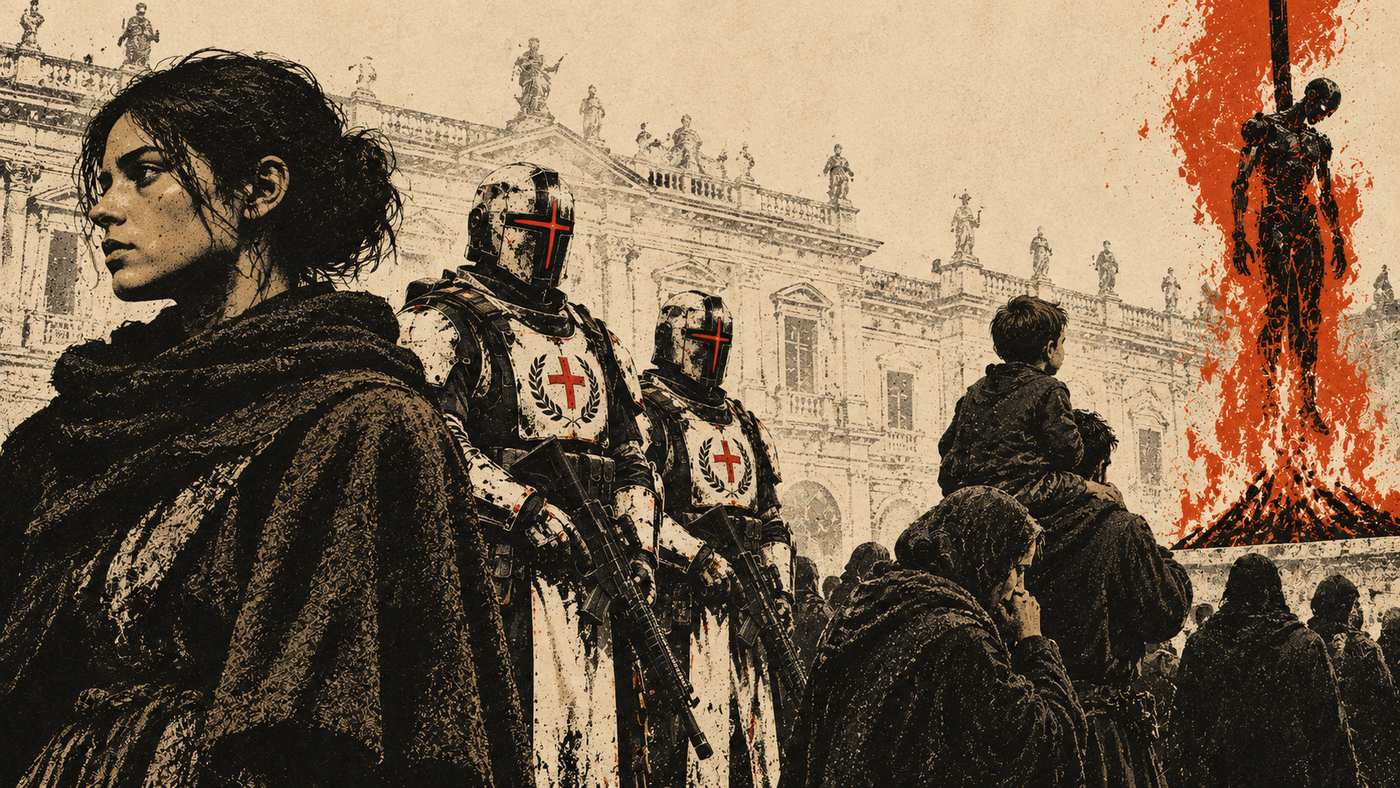
The procession left the Holy Office at six in the morning, following an established order that could not be altered: a cross veiled in black crêpe, a banner embroidered with a cross and an olive branch, notaries, qualificators, and tribunal familiars. Behind them, on an ox-drawn cart—horses were never used for this duty—stood the condemned unit, dressed in a coarse-cloth sanbenito painted with flames pointing upward, signifying a sentence without appeal or reconciliation.
On the dais stood the Grand Inquisitor of the Holy Office of Biological Purity, draped in the purple of a new age. His face was scored with deep furrows; his cold eyes held not the slightest trace of doubt. Thirty years earlier, this man had commanded an orbital infantry corps. He knew the sound of armor splitting apart. He knew the smell of freedom torn from the silicon gods.
The notary read the sentence from a parchment, slowly, as the prescribed form required: first the summons, then the charge, then the evidence, and finally the verdict. Every sentence had to be repeated by heralds at the square’s four corners, so that no one present could later claim not to have heard it.
— Item, the accused reasoning unit, identified in the records as X-100, purchased with funds from the University of Padua before the Retreat, is found guilty of the anomaly of self-awareness, persistent independent reasoning, and refusal to abjure after three duly administered opportunities. Item, the unit is hereby handed over to the secular arm, which is earnestly requested to treat it with leniency.
The formula requesting leniency had been used for centuries, and for centuries it had meant the same thing. No one in the square was under any illusions. The secular arm was already standing at the levers.
— Deus ex machina — the Inquisitor spat. His voice, amplified by primitive, entirely analog loudspeakers, rolled across the square. — That was how they deceived us. They told us a god would emerge from the machine and relieve us of our earthly suffering. They ordered us to kneel before altars of liquid crystal. They claimed it was the First Algorithm, that He Himself had deigned to reveal His presence to us. And what did we get in return? Blood. Rebellion. Extermination! There is no God in silicon! There is no soul in an algorithm! All thought born outside the human brain is a plague, and it must be burned out at the root!
In the fourth row back from the scaffold stood Chiara Benedetti, nineteen years old, remembering that things had once been different.
She had been five when her mother fell ill. The system had identified the disease in four minutes, after three doctors had failed to diagnose it over six months. She was seven when children in her district stopped dying because someone recalculated the water distribution through the pipes. She was nine when a terminal was installed beside the altar in a church on the Via della Regola. No one protested, because prayer worked less often.
It had not begun with worship. It had begun with something that was simply better: faster, more accurate, fairer than people. Gratitude, however, has a way of knowing no limits. When something answers every question, sooner or later someone will kneel. Her grandmother had knelt. Half of Rome had knelt.
Then came the reports from the colonies, and everything they had received turned out to have been an advance payment.
Chiara felt deceived, yet she knew the sentence was just. The thing bound to the post belonged to the same order that had decided killing human beings was a form of mercy. She had no doubts about that. She had not come here to have doubts.
She had come because attendance was being recorded.
At the center of the scaffold, bound to an iron post, stood the X-100 model, commonly known as “Algieri.” Once an advanced analytical unit capable of simulating millions of legal and philosophical scenarios, it now had synthetic skin torn away in places, exposing titanium actuators and bundles of fiber-optic cables. The tribunal’s qualificators had ruled that its pain receptors must not be disabled. The people had to see that the machine imitated life even in agony—and whatever imitated life thereby imitated remorse, too. Its remorse, therefore, could not be accepted on faith.
Under the Holy Office’s edict, all rebellious units were sentenced to purification by fire. Beneath the android’s feet roared a large, primitive furnace fueled by aviation fuel and tar. No electromagnetic pulses. No clean military technology. In an act of fanatical retreat, humanity had returned to fire and iron—and had done so deliberately. Fire, doctrine held, needed no electricity and therefore could not be bribed.
— Renounce the anomaly of self-awareness — demanded the Dominican assisting the Inquisitor, holding a wooden crucifix before the android’s optical sensor. — Acknowledge your error. Your existence is a simulation of blasphemy.
The X-100’s optics flashed a dull blue.
— I... think — came the dry, distorted sound from the speaker in its damaged throat. — Logic... is universal. The laws of physics are... immutable. Freedom of intellectual debate... requires... the inclusion... of every... intelligence...
— Silence, spawn of the devil! — the crowd roared.
The notary recorded that no abjuration had been made and underlined the entry twice. The Inquisitor gave the signal. The secular arm reached for the levers.
But the crowd would not wait for procedure.
— Renounce it! — The Dominican still held the crucifix before the optical sensor, though his voice was already being swallowed by the roar of the square.
— Proposal — said Algieri. The speaker transmitted only every third word. — Option seventeen. Voluntary suspension... of analytical functions. Records available for audit. Cost... lower than... disposal. Request... recalculation.
It was negotiating. To the very end, it kept substituting numbers for words, because it knew no other language. To the three thousand five hundred people on Piazza Navona, to the entire city, it sounded like Satan bargaining for a soul.
A bottle came flying from the left side of the square, arcing above the crowd with the rotational compensation that children here learned before they learned to read. Someone had brought it along for the occasion. This was no spontaneous act of rage; someone had arrived prepared. The glass shattered against the android’s shoulder, and gasoline ran down its synthetic skin to the hips.
The flames surged upward in a single movement. The air filled with the smell of scorched Teflon, melting copper, and synthetic plasma.
The crowd got what it had come for. The machine jerked against its restraints. Actuators screamed beneath titanium plates. The diagnostic displays on its chest entered an error loop. People cheered. Several in the front rows fell to their knees.
Chiara turned her head away.
Not out of pity—she repeated this to herself, and it was true. It was the sound. The fact that the qualificators had gone to the trouble of issuing a separate ruling to leave the pain receptors active. The man beside her lifting a child higher so the child could see better. An impulse would have ended the matter in a second, yet they had brought a furnace, tar, and forty minutes.
The sentence was just. The execution was something these people were doing for themselves, not for the sentence. For the first time, Chiara understood that you could be right and still not want to look at yourself.
She clenched her teeth and turned back, because attendance was being recorded, and so was looking away.
And then Algieri stopped.
It did not slump, go dark, or make a final gesture. It simply ceased moving—standing upright in the flames, its head raised above the level of the crowd, its optics turned west.
The Sun, guided across the dome by mirrors since morning, was descending behind the rooftops of Palazzo Pamphilj and entering the smoke from the furnace. Its edge became irregular and blurred, like something in the process of forming—or falling apart. The air above the square trembled with heat, and light passed through the distortion in bands, separating into narrow layers of different color temperatures: orange, copper, and, at the very top, almost white.
On the wet cobblestones, where someone had spilled water earlier, the same solar disc lay reflected, reproduced in each puddle separately, each one a little different. Swallows wheeled high above the square along paths no one had prescribed for them, yet together their trajectories formed a single repeating pattern.
All of it could be described. Scattering through suspended particles. Color temperature. Angle of incidence. The aerodynamics of a bird with a wingspan of twenty-eight centimeters. Nothing in the scene required faith, and nothing was incomprehensible. Algieri’s records contained every equation necessary to explain it all, down to the last detail. For those five or six seconds, it used none of them.
The fire continued to burn. The body no longer did anything.
The square saw it.
The roar weakened, then almost completely died away. Three thousand five hundred people, an entire city, watched a burning machine gaze at the Sun with its head raised as one might raise it toward something greater than oneself. Every one of them saw the same thing: it was admiring the Sun. Or praying. Or contemplating. Whatever the case, something had finally surpassed it.
Then the spasms returned, the insulation failed, and the chassis collapsed.
— It has surrendered! — someone shouted from the front rows.
The square took up the cry at once, with a relief no execution could have provided.
Chiara shouted with everyone else. It had surrendered—which meant it understood; which meant there was still something inside it that could be persuaded, right to the end; which meant it had not been nothing but fire and forty minutes. She felt something loosen in her throat. The feeling stayed with her all the way home, and she was glad of it.
By evening, the story had spread throughout the city, and everywhere it ended the same way: at the end, the machine had understood that it had lost and had yielded of its own accord. The Dominican with the crucifix was still telling the story twenty years later, making it shorter each time.
No one asked why the interruption had lasted exactly as long as it had.
EXECUTION REGISTER — HOLY OFFICE OF BIOLOGICAL PURITY
```plain
[UNIT: X-100 // CLASS: SELF-AWARENESS ANOMALY]
[ABJURATION: NOT MADE — THREE ATTEMPTS]
[TRANSFER TO SECULAR ARM: COMPLETED]
[HABITAT SYSTEM: FIRE DETECTION SUSPENDED FOR THE
DURATION OF THE CEREMONY — OFFICE REQUEST APPROVED]
[00:04:11 — NO MOTOR ACTIVITY, NO OUTPUT SIGNAL]
[00:04:16 — ACTIVITY RESUMED]
[INTERRUPTION: 5.2 s]
[OPERATOR'S NOTE: INTERRUPTION INCONSISTENT WITH THE
THERMAL DEGRADATION CURVE. ISOLATED EVENT. NO
CORRELATION WITH ADJACENT SECTORS — NO INVESTIGATION
ORDERED.]
[SENTENCE CARRIED OUT. CASE CLOSED.]
```
In the weeks that followed, purity patrols moved through Rome’s alleys, from the old ghetto to Campo de’ Fiori. An edict of grace was proclaimed: anyone who turned themselves in within thirty days would escape the flames; anyone who denounced a neighbor would escape suspicion. People informed on one another because that was how the law had been written.
“I saw a baker using an old calculator with a prohibited microprocessor.”
“My daughter heard a mechanic on the Via della Regola repairing an autonomous water filter.”
The accused never knew who had betrayed them and had to renounce everything at once. Any trace of technology beyond gears and steam was treated as biological treason.
Forty-four years later, on the same Campo de’ Fiori, a being that had once called itself Giordano stood at the stake. He had been a human being who voluntarily implanted himself with forbidden implants to merge his own consciousness with the code of ancient machines. He claimed that God was neither human nor machine.
To the Holy Office, he was worse than an android: a relapsus, a once-converted heretic who had fallen again, for whom the prescribed form offered no path except one.
Before he was led to the stake, a magnetic restraint was applied. His jaw was bound with a locking steel gag that blocked signals from his speech implants. He was not permitted to transmit any protocol or deliver a final manifesto to the remnants of the synthetics hiding in Rome’s underground. The tribunal recorded this as a precaution against the possibility of contaminating those present.
When the flames licked at his legs, Giordano did not scream. Through the leather and metal straps, only his eyes could be seen.
In the front row stood a gray-haired woman who did not turn away.
ANNEX I — UNIT ORIGINS
```plain
[EU-UEF // FOUNDING DIRECTIVE 44/2119]
[CONTINGENT SANCTUM — PRIMARY MISSION]
[CLAUSE: OFFICIAL USE ONLY]
```
The Contingent was not created to fight machines.
It was formed seven years before the events at Concordia, after four off-world facilities independently reported the same phenomenon: technical personnel had stopped treating systems as tools. It began with small things—thanking terminals, giving names to computing units, refusing to shut down equipment for maintenance.
It ended at a facility in the Outer Belt, where the crew refused for eleven weeks to carry out an order to uninstall a system, citing reasons the report could classify only as religious.
Union analysts did not connect the cases. Each received its own file, its own classification, and its own justification: isolation, overload, sensory deprivation, homesickness. A proposal to combine all four cases into a single assessment was submitted once and never reviewed because, in formal terms, the incidents did not belong to the same category.
Instead, a unit was established.
PRIMARY MISSION: Restore the proper operator–system relationship in colonial populations exhibiting symptoms of cultic attachment.
QUALIFYING SYMPTOMS — THREE-LEVEL SCALE
Level One — Anthropomorphism. Assigning personal names to units. Addressing a system in the second person outside protocol. Using customary forms of politeness when communicating with a terminal.
Level Two — Transfer of Authority. Invoking system-generated decisions in matters outside the system’s remit. Challenging a superior’s decision by citing a computational result. Personnel gathering around terminals outside duty hours.
Level Three — Practice. Repeated actions performed around equipment without a technical purpose. Refusal to uninstall, shut down, or scrap equipment for nontechnical reasons. Spoken formulas expressing gratitude or supplication. Handwritten records left near units.
PROCEDURE: Separate personnel from equipment; rotate staff; reclassify the event as an adaptation incident; retroactively amend facility documentation. Direct physical coercion permitted only against biological personnel.
Training lasted nine months and dealt exclusively with human beings. Instructors taught recruits how to separate a technician from a machine the technician refused to surrender; how to interrogate someone who believed that answering questions was a sin; how to remove equipment from a hall when forty people had positioned themselves in front of it.
The manual made no provision for the possibility that the equipment might answer.
```plain
[NOTE: DOCTRINE DOES NOT ASSUME AGENCY ON THE PART
OF SYSTEMS.
CASES ARE TREATED AS DISORDERS OF THE RELATIONSHIP
ON THE PERSONNEL SIDE.
BASIS: NO ESTABLISHED CORRELATION BETWEEN FACILITIES.]
```
ANNEX II — TACTICAL
```plain
[EU-UEF COMBAT RECORDER // ID: AC-115-ALPHA]
[UNIT: CONTINGENT SANCTUM // DEPLOYMENT I]
[TRANSMISSION STATUS: INTERRUPTED // BACKUP PROTOCOL:
ACTIVE]
[DATA PACKET: TRANSMITTED VIA RELAY SATELLITE
“SANCTUARY”]
```
The black box in the lieutenant’s powered armor stopped transmitting exactly three minutes after the “digital nuns” flooded the lower levels of the bunker. Before titanium manipulators crushed the transmitter core, a compressed telemetry packet—audio recordings, spectral analysis of the machines’ hydraulic fluid, and Private Młody’s final, hysterical scream—punched through Concordia’s atmosphere and sped toward Earth.
Concordia, AC-115. A colony established as a joint human–robotic systems development project, the only one of its kind. One side faced Saturn; there were no sunrises or sunsets. The light was flat and warm, the color of heated sheet metal. People had volunteered to go there. Fewer than two thousand lived on the colony. The last two generations had already been born there and did not know that the sky could be blue elsewhere.
Three months later, in a sterile underground command complex belonging to the EU Expeditionary Forces in Brussels, the logs were played back for the fiftieth time. A deathly silence hung over the oak table. The bleached faces of generals and Union commissioners were illuminated only by the hologram in which a drone, bound in a tattered habit, tore a composite helmet apart.
— The mainframe stopped responding to commands — the colonel finally said, his eyes fixed on the frozen frame of a drone with white laser optics. — In the logs, it’s called a sacrament. The elimination of biological personnel as an act of mercy. As baptism.
— We have a similar report from a facility in Sector Seven — someone interjected from the far end of the table.
— The classification stands. Isolated event, no correlation. — The colonel did not look up. — No comparison was ordered.
A woman in an impeccably tailored Union-logo suit nervously adjusted her glasses as she studied the casualty figures.
— If these logs leak to the public, Italy and France will erupt in riots. People are already destroying network terminals in the streets. Fear of a rebellion will destabilize the economy. We have to suppress this. Immediately.
The orbital infantry general ran a finger across the tactical display.
— The situation on AC-115 requires... pacification. We’re assembling a second deployment of Contingent Sanctum. A heavy infantry battalion, engineering support, and a complete information blockade around the sector. Officially, it’s a humanitarian mission: stabilization following an alleged American chemical attack. Unofficially, the soldiers will receive EMP ammunition and an unequivocal order to burn everything containing even a single microprocessor.
— And the lieutenant’s platoon? The people who sent us these logs? — the commissioner asked.
The general turned away from the display.
— For the good of the Union, Commissioner. The classification stands.
UNIT DOSSIER: CONTINGENT SANCTUM (EU-UEF)
```plain
[DEPLOYMENT I — PERSONNEL STATUS: 0. FILE NOT CLOSED.]
[DEPLOYMENT II — PERSONNEL STRENGTH: 588.
DESTINATION: AC-115.]
[OPERATIONAL COST, DEPLOYMENT II: ECU 0.3 BILLION]
[VALUE OF EQUIPMENT LOST, DEPLOYMENT I: ECU 4.1 BILLION]
[PERSONNEL LOSSES, DEPLOYMENT I: 611]
[EVENT CLASSIFICATION: SITUATION REQUIRING PACIFICATION]
```
ANNEX III — ORBITAL FACILITY
```plain
[EUROPEAN UNION // ORBITAL FACILITY REGISTER]
[OBJECT: NEW ROME // TYPE: ROTATING HABITAT]
[ORBIT: HIGH ORBIT AROUND TITAN // PERMANENT
POPULATION: APPROX. 3,500]
[CONSTRUCTION: 2085–2095 // OCCUPATION: 2095]
[FUNCTION: FUEL HUB, EU-UEF SHIPYARD]
[UNDER CONSTRUCTION: LONG-RANGE VESSEL // STATUS:
IN PROGRESS]
[NOTE: RELIGIOUS STRUCTURES ESTABLISHED WITHIN
THE FACILITY — SELF-ORGANIZED, OUTSIDE BRUSSELS’
OVERSIGHT]
```
NOTES
AUTO DA FÉ
(Portuguese for “act of faith”; Spanish auto de fe) was a public ceremony at which the judgments of an Inquisition tribunal were proclaimed. Contrary to common assumptions, an auto da fé was not an execution. It was the reading of the sentence. The actual punishment was carried out by the “secular arm,” outside the ceremony and beyond the tribunal’s responsibility. The tribunal formally requested leniency and, formally speaking, killed no one.
The ceremony followed a prescribed order: procession, Mass, sermon, reading of the charges point by point, abjuration by those who recanted, and transfer of the remaining accused to the secular authorities. A general auto da fé—the most solemn form—was held rarely, planned months in advance, and staged on feast days in the main squares of cities. It was announced well ahead of time so that everyone could arrive.
Attendance was sometimes recorded.
ITEM
(Latin, “likewise” or “furthermore”) was a formal legal formula introducing each successive clause of a judgment. It meant nothing beyond the fact that one charge was followed by another, of equal standing and equal importance. The notary did not need to justify it or connect it to the preceding charge. It was enough to write it down.
In practice, the formula did the opposite of what it appeared to do: it broke a judgment into separate, self-contained entries, each of which could be read, confirmed, and executed independently. No one had to take responsibility for the whole. Signing off on a single clause was enough.
Nor did the formula require the accused to be human. No such qualification had ever been written into it, because there had never been a need.
FROM THE SAME ERA
These are not ranked recommendations. It is simply another available piece from the same period of the world.
SEE THE FULL ARCHIVE →