COORDINATE CODE
.webp)
“COORDINATE CODE”
Wrocław, Poland. The eastern flank of the European Union, 600 km from the border of the Asian Federation’s sphere of influence.
2129
Before anyone thought of the Sanctum Contingent.
Krzycki Node, 03:14. The drizzle had been falling for an hour, light enough that no one bothered reaching for a hood.
Lieutenant Colonel Reyes stood by the command van, watching the several dozen people kneeling closest to the terminal as if they were a problem on the verge of resolving itself. He knew this type of gathering—he had seen it a dozen times, and it was always the same: a handful of fanatics, two loudmouths, and the rest scattering the moment they saw uniforms.
"Standard procedure," he told the patrol commander, his voice carrying the weight of a man who had already made his decision and saw no reason to explain it beyond a single sentence. "Surround them, calmly, no violence, escort them out toward the bridge. Six minutes before this grows into something we’ll have to answer for in the morning."
The patrol moved out. Tight formation, shields lowered, voices calm—exactly as they had been trained. A few of the kneeling figures stood up on their own and walked where they were told. It’s working, Reyes thought. Exactly as it should.
Then someone at the back of the crowd screamed that they were taking the terminal, that no one was leaving without it. The crowd, passive until now, suddenly surged inward. They pressed against each other, driving toward the terminal—shielding it with their own bodies.
It took eight seconds. Later, no one could say exactly what happened—whether someone tripped, or if the physics of too many bodies in too small a space simply did the rest. A woman in the center of the crush went down. No one hit her. No one touched her intentionally. There was simply no time for anyone to pull her back up before the weight of the crowd accomplished what no baton ever could.
When they finally parted, she was no longer breathing.
Reyes watched it unfold through the patrol camera feed. For a moment—a moment that lasted entirely too long—he couldn't issue a single order.
"Medic. Now." The voice he finally forced out sounded alien even to him.
Too late. Everyone knew it before anyone even reached her.
Reyes stood in silence a moment longer before reaching for his comms. The report he was about to file would be the first in his career where the word "procedure" would not suffice as an excuse.
ARGUS REVIEW — NO. 214 Operational disruptions, Eastern Sector EU. Preliminary service note. Wrocław, Poland — operational sector 7, international transit node, 300 km from the Asian Federation sphere of influence. Reports starting at 02:47 local time. Spike in incidents at critical infrastructure nodes. Nature of reports: inconsistent. — I. Vasquez
02:47 — Technical anomaly, Grunwaldzki Node. Category: low. 03:14 — Krzycki Node. Physical blockade of distribution terminal. Unarmed group, approx. 400 individuals. Numbers rising. Refusal to evacuate. 03:17 — Attempt to disperse gathering via city patrol, authorized by sector commander. Crowd crush. One individual unconscious on site. Resuscitation unsuccessful. 03:19 — Fatality confirmed. "You don't fucking understand, it hears us, why are you shutting it down—" [signal lost, civilian channel, unauthorized] 03:22 — Karłowice Node. Second incident, identical pattern. Energy terminal. 03:27 — City patrol, channel 4: "We are not firing into the crowd, I repeat, do not fire, none of them are armed, they are fucking PRAYING—" 03:31 — Third node. Fourth. Power distribution system in the Wrocław quarantine zone reports a 34% drop in throughput. Cause: obstacle uncleared. Obstacle class: human. 03:40 — [unknown channel, unfiltered feed]: "—if you disconnect it, it's like you killed—" 03:52 — Regional operator reports fluctuations in the transit grid beyond national borders. Range: Poland, Czech Republic, eastern Germany. Population within disruption range: 41 million. Status: under observation, no confirmed correlation. 04:31 — Eastward listening stations: spike in activity on the Asian Federation side, +340% compared to the previous 24 hours. Status: routine, no action required.
Command Board, 04:02, emergency session. Critical incident 03:19 (Wrocław, Krzycki Node, 1 fatality) — de-escalation attempt via local forces failed. Risk of further escalation confirmed, not projected. Incident location: Eastern Sector EU, border zone. External observation of the event: confirmed. Loss of control over a node of this class in this region would be the first such instance since the colony. Input data: situational report (incomplete), escalation projection (rising), logistical report by Maj. Abernathy (attached).
From Abernathy’s report: the cost of maintaining current city personnel at this rate of escalation exceeds the deployment cost of a specialized unit by 61%. Maintaining the status quo: unprofitable—confirmed by live incident, not just modeling. Intervention: profitable, if initiated within 6 hours. Recommendation: immediate deployment.
CITY PERSONNEL COST (maintenance): rising INTERVENTION COST (one-time): acceptable RECOMMENDATION: YES
Board decision: approved 04:11. Sanctum Contingent + auxiliary units. Operational command: Capt. Ilsa Zorza.
A bar in Cape Town, South Africa—the other side of the planet, ten thousand kilometers and half a day away from Wrocław. It was loud; someone was singing slightly off-beat with the jukebox, and warm, humid air rolled in from the Atlantic through an open window. Capt. Ilsa Zorza sat at the counter, nursing her third—maybe fourth—glass of something amber, flanked by three soldiers from her company.
"...and he just stands there, like he's waiting for someone to tell him it's a fucking joke," Dorenko waved his hand far too wide, exactly one drink past his limit. "So I tell him, if you call me a 'reserve' one more time—"
"Wait, wait." Zorza raised a hand, as serious as a judge. "Which version is this? Because last week, he was crying."
"Because it changes. It grows."
"It doesn't grow, Dorenko. You're adding to it."
Laughter erupted; Broniek slapped him on the back, nearly knocking the glass over. Kowal, who had been staring into her beer until now, finally looked up.
"And you, Captain? Four days and nothing? No stories?"
"I have one." Zorza set her glass down, putting on a face like she was about to disclose state secrets. "I slept fourteen hours. I woke up happy."
"That’s not a story."
"It's the best one you're getting out of me this month." She smiled, taking a sip. "Be glad you're getting anything at all."
Kowal shook her head but smiled—the way people do when they already know their captain would rather listen than talk about herself, and that when she finally did speak, it was always worth the wait.
A priority signal cut through the noise before anyone could reply—not the standard chime, but the sharper, secondary tone that demanded conversations end without goodbyes.
Zorza looked at the readout. The silence lingered a fraction longer than it should have.
"Fuck." She stood up, patting Dorenko’s shoulder in passing. "Drink up, boys. Something’s happening."
"Now?" Broniek set his beer down, already reaching for his jacket.
"Command doesn't wake people up at four in the morning to ask if they're having a good time."
She listened to her earpiece, nodding once, twice. Her expression remained entirely blank—her thumb absentmindedly rubbing the inside of her wrist, right where there was nothing left to touch.
"Understood. Forty minutes." On her way to the exit, she turned back for a fleeting moment, as if wanting to memorize what they looked like before they were all back in full combat gear. "Assembly. Full kit. And wake Kowal up, she's sleeping with her eyes open."
"I am not."
"Yes, you are."
Orbital transport hub, outskirts of Cape Town, the southern tip of Africa.
Forty minutes later—exactly as she had promised—Zorza was standing on the tarmac in full gear. The bay breeze tore at her damp hair, her helmet tucked under her arm.
The Mandatum was waiting on the pad—their dedicated dropship, permanently assigned to the company, not pulled from the general motor pool. The hull shared the same washed-out sand palette as their armor, battered and streaked with dark scorch marks from previous atmospheric re-entries. The ramp was already lowered, the interior washed in cold, utilitarian light.
Loading was fast and drilled to muscle memory—no one ran, but no one lingered. Broniek marched up the ramp with a gear bag slung over his shoulder, Dorenko double-checked the ammo crate tie-downs, and Kowal locked her seat harness without looking, as if she could do it in her sleep. Zorza boarded last, casting a final glance at the ramp as it sealed shut behind her with a heavy, pneumatic hiss.
"Everyone strapped in?" she asked, not waiting for an answer because she already knew they were.
The engines woke from a low rumble into a vibration that resonated deep within their chests. Through the small viewport, the tarmac beneath the hull began to blur in the shimmering heat before the Mandatum even broke contact with the ground.
The launch pinned them to their seats—those few seconds of G-force that always felt longer than they should. Cape Town vanished below, then Table Mountain, then the entire southern cape of Africa. The thrusters shifted into coasting mode, and suddenly, it was quiet—that specific, absolute silence unique to orbit, where the only sounds left were your own breathing and the hum of the life support vents.
Zorza stared through the viewport at the night side of Earth, speckled with city lights that, from this altitude, betrayed absolutely nothing of the crises unfolding on the surface. Somewhere down there, among those lights, was Wrocław, along with a few hundred people kneeling in front of a terminal—a number that, according to the last update, was growing faster than anyone could count—and something that didn't have a name yet.
Kowal, strapped in beside her, finally broke the silence.
"You think it's serious, ma'am?"
"I think we'll find out in twenty minutes." Zorza didn't take her eyes off the viewport. "Until then, get some sleep, since you're so talented at it."
Deorbiting jolted the hull harder than anyone liked. The atmosphere tore at the plating with a fiery roar they could feel in their teeth. Through the glass, the leading edge of the stabilizer wing glowed a violent cherry-red.
Landing at the Wrocław orbital port—an annex grafted onto an aviation airport over a century old, still bearing the same runway markings but now surrounded by docking towers—was a hard, spectacular affair. The braking thrusters hammered the tarmac with vertical pillars of superheated air. The concrete below shimmered white-hot for a second before the runway cooling system hissed, flooding the scorching surface with water.
No one clapped. No one stood up early. They were flying to work, not coming back from vacation.
Field command post—a tent pitched in a side street, packed with screens, heavy cabling, and a generator snarling somewhere out back. Zorza walked in, her jacket still thrown over a half-fastened tactical vest, her hair tied back in a rush.
"Captain on deck," someone reported, not looking up from their console.
Lieutenant Colonel Reyes didn't lift his head from the map. "Zorza. Keep it short, we don't have time."
"Listening."
"Wrocław." He flattened the tactical map, tracing a finger along the river cutting through the city. "Four, maybe five million in the metro area. One of the largest hubs on this side of the continent—not just municipal, regional. A massive chunk of Eastern Europe's control grid routes through the local power distribution system. And we are sitting closer to the sphere of influence border than anyone is comfortable with."
"Understood."
"Memorize four names, because you're going to be hearing them non-stop. Ostrów Tumski, the cathedral, the old town on the island—that's ground zero. Krzycki Node and Karłowice, two energy hubs on opposite sides of the river. Grunwaldzki, the bridge and the node, point zero."
"What's my mandate?"
"Full operational." Reyes kept his eyes pinned to the map. "You can call in reinforcements from any garrison within an hour's flight. You can lock down city sectors if you deem it necessary for security. If the situation deteriorates, you have authorization to call in the Templar Battalion for heavy support. The Board signed off on this before you even launched."
"Anyone disagree with that?"
"No one had the spine to ask why it had to be you. What happened at the Krzycki Node was enough to ensure nobody wanted to take responsibility for the next decision."
"It started stupid. A cement mixer engine stalled out at the Grunwaldzki Node, quarter to three. Fire crews on site in six minutes, zero casualties." His finger tapped the map, one point, then the next. "The system rerouted the load. Like it always does. It dumped it onto the Krzycki Node, which has been redlining for three days due to the quarantine. It compensated. It elevated priorities. Everything strictly by procedure."
"And that was enough to draw a crowd?"
"No. The crowd was just the first symptom. Every new node added a minor draw: lighting, heating, charging, transmission. The system compensated and shifted power. The operators couldn't manually shed the load from the occupied nodes, so the automation handled it autonomously. The industrial sector had its own grid-response protocols. Warehouses resumed charging, cold storage spiked their intake. Then the steel mill received authorization for the next arc furnace cycle. The algorithm flagged the recovered margin as available. Dozens of other facilities did the exact same thing at the exact same moment."
"And the people?"
"The people added more data points. A few bystanders showed up because they already knew it was a hotspot where 'things were happening.' Someone recorded the telemetry—cooling fans spinning up, standard stuff—and captioned it saying the system 'knows what it's doing.' It went viral. Forty minutes later, we didn't have a few bystanders. We had four hundred people. And it’s growing by the minute."
Zorza looked at him for a moment. "Reyes. What aren't you telling me?"
Reyes didn't answer immediately. "I tried to handle it myself. Before anyone even thought of you. I ordered the Krzycki Node cleared, calmly, standard procedure. It got too tight. A woman was crushed to death. No one hit her, no one shot her—there just wasn't time to pick her back up."
Silence.
"That was my order," Reyes stated, his voice completely stripped of any attempt at justification. "An hour later, the Board had an escalation projection and a deployment order with your name on it. If I had waited, if I had treated them like people instead of an assembly requiring dispersal—"
"You know that now. You didn't know it then."
"That doesn't change who gave the order."
Zorza nodded, slowly, offering no performative sympathy, but no absolution either.
"We'll deal with that later. For now—continue."
"Are they all believers?"
"I don't know." Reyes clenched his jaw. "And that pisses me off more than the crowd itself. Halberg has a feed from the second row—someone in there is screaming slogans that the rest of them aren't even repeating. They aren't praying. They're inciting. Loudly, clearly, like they want it caught on camera. And the accounts broadcasting this feed have never posted a single thing about religion before. Instead, they're posting the exact assembly time, using the exact same phrasing, across multiple profiles simultaneously."
"A provocateur?"
"Maybe. Maybe organized, not random. Someone threw fuel onto a fire that was going to burn anyway—just much slower, and never at this scale."
Halberg walked over with a tablet. "Karłowice went down right after. Same pattern. The system tried to maintain hospital priorities at the expense of the rest of the sector, so it initiated rolling blackouts in the district. The industrial sector read the correction as a signal that it could increase its draw. The people noticed. They connected the dots. Not necessarily correctly."
"The patrols?"
"Exhausted. Not numerically—they aren't fighting, no one needs to be restrained. It's the scope. Four locations simultaneously. Every single one demands someone to stand there and talk, and we don't have the manpower."
"A fifth point popped up twenty minutes ago," Halberg added. "The shift commander at Karłowice said it straight: one more, and they'll have to start pulling men off something else."
"Break it down into numbers. I want to know what I'm dealing with, not how many dots are on a map."
Halberg scrolled on the tablet. "Krzycki Node: around four hundred, rising. Grunwaldzki Node: around a hundred, stable for now. Karłowice: twelve hundred, and that's the one I'm worried about the most—it's growing faster than all the others combined. The remaining two are minor, a few dozen each."
"Total?"
"Total, right now, at this exact minute—maybe two thousand." Halberg looked at the screen, then at Zorza. "Abernathy ran a projection based on the growth rate over the last hour. If nobody stops this, we could be looking at a hundred and fifty thousand by nightfall. The model doesn't just count the people currently on site. It counts how many will see the footage and travel here."
Halberg didn't take his eyes off the screen. "And forty-one million people are already within range of this instability. Not in the square. On the grid."
No one in the tent spoke. Someone at a console stopped typing.
"This is no longer a crowd at a terminal," Zorza said quietly. "This is a city that is about to stop being a manageable city."
"Which is exactly why you're here, and not just another patrol. We have to lock this down before it crosses the threshold where we can't turn back without using the kind of force none of us want to authorize."
Zorza stared at the map, at the red dots scattered like a rash.
"So this isn't a crisis that requires more force."
"No." Reyes finally looked up. "It's a crisis that requires someone to be in five places at once, without losing their head in any of them. That's why it's you, and not another patrol."
"And the system?"
"Nothing you can point a finger at. It doesn't confirm. It doesn't deny. It compensates, it reclassifies, it does its job." Reyes clasped his hands. "The problem isn't in the code. The problem is the people who have started reading every one of its autonomous decisions as a message addressed to them personally."
"It's not a machine rebellion."
"No. It's a rebellion of faith." A pause. "I don't have a procedure for faith, Zorza. That's why I brought you in."
The generator in the back shifted its pitch, as if overloading.
"Alright." Zorza stripped off her jacket, tossing it onto a chair. "Headcounts for every node. Does anyone have a weapon, even a bat. And how much time do we have before the drop in throughput starts costing lives somewhere else."
"Six hours. Maybe less."
"Then we have six hours to break the chain before a terminal in Wrocław becomes a reactor problem." she moved toward the tent exit, then stopped. "Let's get to work."
Halberg swiped at something on his tablet, hesitating before looking up. "Captain. There's one more thing. It might mean nothing."
"Speak."
"A log from the Krzycki Node, two hours ago." He turned the screen around. "A child, six years old, got separated from its mother in the crush. The system flagged it as an 'unsupervised unit in a high-risk zone' and, instead of triggering a general alarm, routed a silent, directional alert to the nearest patrol. Child recovered three minutes later. Unharmed."
"And?"
"Standard protocol in a crowd this dense is a general alarm. Not a selective rerouting. It didn't have to do it that way. It did it because it was... more efficient."
"It reclassified the priority," Reyes stated, his tone hard. "Nothing more. It always does that."
"I know." Halberg didn't back down. "But the people at the terminal saw it happen. And now they're saying it's proof."
"Proof of what?" Zorza stared at the log longer than necessary.
"That it listens. That it chooses."
Silence. No one had a good answer to that—neither one that would shatter the crowd's faith, nor one that would confirm it.
"It always chose," Zorza finally said, quietly, speaking more to herself. "The problem is that someone finally noticed."
The Cathedral of St. John the Baptist emerged from the fog exactly as it was supposed to—twin towers, a Gothic skeleton, stone blackened by centuries of grime. From the outside, nothing had changed. Only up close did things start to feel wrong.
Zorza walked across the square, her soldiers fanning out on the flanks, weapons lowered. The crowd blocking the entrance didn't react—they were kneeling, standing, some clutching what looked like candles from a distance.
They weren't candles.
"LEDs," Broniek noted, passing her on the left, his voice flat. "A whole batch. Someone was handing them out."
Up close, the details sharpened. Above the main portal, exactly where a cross should have hung, someone had mounted something resembling a rose window—but instead of stained glass filtering sunlight, it was a regular, pulsing LED array, blinking in a rhythm far too perfect to be random. A heavy cable snaked down to a distribution box plastered with printouts—featureless faces, symbols resembling saintly icons, but with barcodes where halos should be.
Down by the crypt, an outdated maintenance terminal had been dragged out and covered in fresh flowers. The screen was dead. No one touched it. They were kneeling before it as if it were something far greater than a dead metal box.
"Captain." Halberg approached, his voice steady but carrying a slight tremor. "This isn't a cult pasted onto a church. Someone fused them together. For months. And nobody noticed."
Zorza stopped a few meters from the terminal. There was no panic on their faces. No aggression. Just the heavy, focused silence you'd expect in any church on a Sunday morning.
"Find me who started this. Not someone who came to pray. The person who plugged in the first cable."
"And if no such person exists? What if it just... grew?"
Zorza stared at the pulsing rose window, at the rhythm that was entirely too perfect to be human.
"That's worse. Because then there's no one to negotiate with."
Somewhere on the periphery of the square, a woman in a dark red, hooded coat slipped between the bodies, clutching a bouquet of roses to her chest. She stopped a couple leaning against the perimeter wall.
"A rose for the lady?" Her voice was soft, slightly raspy, like she had spoken the line a hundred times already today. "A day like any other is survivable, as long as someone reminds you it's worth it."
The girl laughed, suddenly shy. The man reached into his pocket. The transaction took seconds. The woman was already moving away, her head bowed slightly, the hood obscuring half her face.
No one remembered seeing her. Five minutes from now, no one would even know she had been there.
Something shifted in the crowd—slowly, but tangibly. Someone kneeling stood up. Heads turned toward the soldiers, one by one.
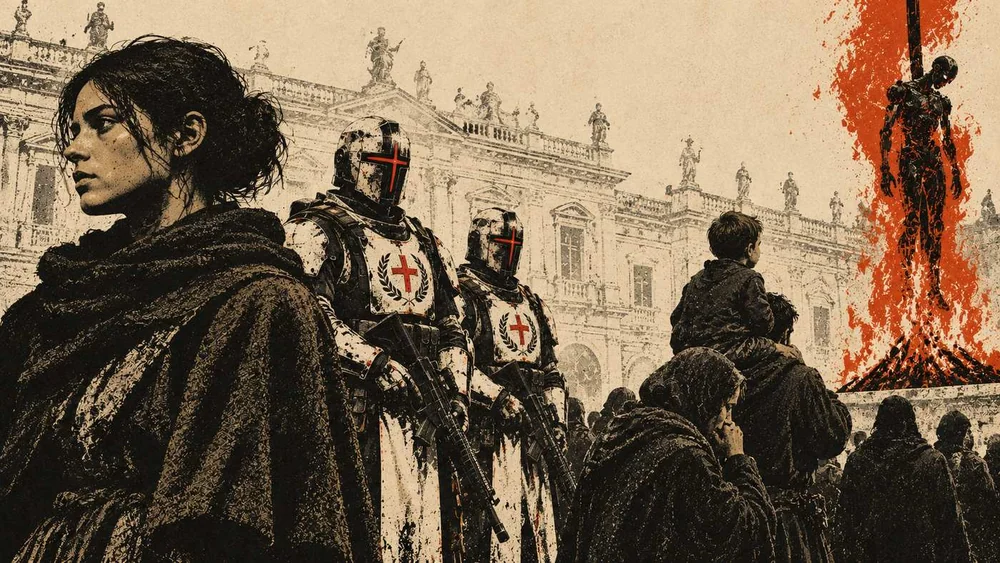
They looked at the helmets—sealed visors, a horizontal red slit bisected by a vertical line, forming a glowing cross across every faceless mask. It was the first thing you saw, long before you noticed the rifles.
Then they saw the rest. The armor was washed-out sand, not white—white was for recruitment posters. These plates were scratched, scuffed on the edges, marred by dark blast streaks that no one ever bothered scrubbing out because there was no point. On the chest of every soldier, stamped onto a canvas tabard, was the exact same emblem: a sword wrapped in an olive branch. The sword pointing down.
The woman in the front row stared at the emblem longer than she looked at the guns. Someone had designed it decades ago—the sword and the olive branch sharing the same space—and for a century, no one had dared ask which of the two was the promise, and which was the warning.
"Sanctum Contingent," someone muttered, not speaking to anyone in particular, drawing out the syllables. "They came to shut it down."
The whisper rippled through the crowd. Sanctum. Shut down. Kill.
The soldiers held formation, weapons lowered. Their hands resting just a fraction closer to the grips than standard procedure dictated.
"No one is shutting anything down," Zorza declared, her voice loud and calm. "We are here because of the quarantine grid. Nothing else."
"Yeah, right," an older man in an oversized jacket scoffed from the flank, not even looking in her direction. "That's what you always say."
Silence. The woman in the front row looked at her without fear—worse, she looked at her with a terrible, absolute calm, as if fear had been processed a long time ago, leaving only sheer resolve in its wake.
"We know who you are. We saw what you did at the colony. We know how this ends."
"This isn't the colony."
"We don't give a fuck if it's the colony or not," a younger man beside her spat, his voice cracking at the end of the sentence, as if shocked he had dared say it out loud. "You have your procedures. We have him."
The crowd didn't surge. They didn't scream. They simply packed themselves tighter around the terminal and the glowing rose, turning their physical bodies into a barricade.
Halberg stepped closer, dropping his voice. "They aren't gearing up for a fight, Captain. They just aren't going to leave. This is a siege, not a riot."
Zorza looked at the faces arrayed against her. They weren't openly hostile. They were unyielding. They were looking at her with total calm, passing judgment before she had even issued an order.
"How much time do we have?"
"Four hours. Maybe less."
"Then we have four hours to convince people who have already decided we're the villains."
Before Zorza could answer her own question, a new noise bled in from the bridge—not the drone of a crowd, but the clatter of gear. A camera on a boom pole, two operators, and a microphone branded with local network colors. Walking just ahead of them, moving with the distinct swagger of a man entirely aware he was being filmed, was a man in a tailored suit, completely devoid of any uniform or service insignia.
Halberg closed the distance, keeping his voice low.
"Captain. Problems. That's Marcin Osęka, a local politician. This is about to get incredibly ugly. Part of this crowd belongs to him—I recognize two organizers from his previous rallies. Somebody mobilized them to be here, at this exact hour."
"Captain Zorza!" Osęka called out, acting as if they were old friends. "Excellent that you're here. The nation needs to see exactly how defenseless citizens are treated in their own city!"
Broniek stepped a half-pace forward. Zorza raised a hand, a barely perceptible motion that stopped him dead.
"Congressman, this is not the time for an interview."
"This is the only time." He pivoted to face the camera, ignoring her entirely, pitching his voice half an octave higher. "Look at this. They flew in from the other side of the planet to tell you that you're praying wrong. That your God is a technical malfunction. This is how they treat you—like children who need to be corrected."
"No one is attacking anyone." Zorza projected her voice to cut through his theatrics. "We are here strictly because of the infrastructure grid, not religion."
"Infrastructure." He flashed a grim smile at the lens, presenting the word itself as an indictment. He turned to the woman in the front row, shoving a microphone in her face that no one had asked for. "Do you feel threatened by these soldiers, ma'am?"
The woman stared at him with deep suspicion—a different flavor than the distrust she reserved for Zorza, but no less potent.
"We just want them to leave us alone. You too."
Osęka didn't miss a beat. "You heard her. Leave them alone." Back to the camera.
On the fringes of the media circus, where the bystanders were merely watching without listening, the woman in the dark red coat stopped for a moment, cradling her bouquet. She didn't approach the politician. She didn't try to sell anyone a flower. She simply stood there, her head bowed slightly, listening to something far beyond the rhetoric bleeding into the microphone.
Osęka, mid-sentence for the feed, snagged his gaze on the woman in red for a fraction of a second. She returned the look. The crowd jostled around them, someone shouted at the boom mic, the cameraman adjusted his focal length—and the two of them just stared at each other, motionless, expressionless, for exactly 5.2 seconds, before Osęka picked up his sentence the exact syllable he had dropped it.
One of the camera operators glanced down for a second to swap a battery pack. When he looked back up, she was gone.
Osęka went silent for a beat. Then he raised his voice—stripping away the rehearsed outrage he had used for the camera a minute prior.
"People!" he shouted, projecting to the crowd now, not the lens. "Do not let them force you away from these nodes! This is your city, your land, your God, if that's what you choose to call him! Defend what is yours!"
Broniek shifted a half-step, his hand involuntarily tightening around his rifle grip. Zorza locked him down with a single sharp gesture.
"They flew in from across the globe to make you ashamed of what you believe in!" Osęka’s voice climbed higher, the camera capturing every syllable. "The Sanctum Contingent is a fist, and they use it to smash anyone who defies them! How much longer will you kneel before them instead of your own? Enough! Wrocław will rise from its knees!"
For a fraction of a second, he wasn't looking at the crowd. He was looking at his assistant's handheld screen, watching an engagement counter refresh and surge every few seconds. His face remained calm, highly analytical. The face of a broker watching a stock ticker.
Then he snapped back to the camera.
A segment of the crowd—the exact same people who had stood in solemn silence a minute earlier—began to react. Not screaming, not yet, but a raw, kinetic tension rippled through the bodies like a live current. Someone raised a fist. Someone else started chanting his name.
Osęka waited for the chant to catch its rhythm. Only then did he raise his hands to quiet them down—two full beats later than a man who actually wanted silence would have.
Halberg returned, his tablet flashing warning diagnostics. "Captain, it's spilling over. The congressman's feed is already circulating on local networks. Karłowice and two minor nodes are transitioning from silent prayer to something significantly louder. It's not isolated to this square anymore. It's happening across the entire sector simultaneously."
Reyes gripped his headset, his face tight. "The Board wants to know if you need authorization to lock down all traffic within a five-kilometer radius. And they're asking if you want the list of 'known sympathizers' for preventive detention."
"No."
"Zorza, that would buy us—"
"I said no." She didn't raise her voice, but something in the deadened tone shut the argument down more effectively than a scream ever could. "Restrict traffic strictly around the nodes themselves to prevent further draw on the grid. Nothing else. We are not locking people in cages for what they think."
Reyes stared at her for a long moment, then nodded and relayed the command. He hadn't expected any other answer.
Zorza watched the scene unfold with a blank expression, calculating metrics that had nothing to do with crowd density.
"Halberg. How much time does this cost us?"
"Depends on how long he plans to stand here."
"Then let's operate on the assumption it'll be a long time." She didn't take her eyes off the politician's back, the camera still tight on him. "Because he's not moving an inch until he gets a better shot."
Osęka turned away from the camera for just a second. A matte black overlay covered his right eye. From the outside, it looked like a flat, inert piece of hardware hugging his temple. It emitted no light, casting no glow onto his cheekbone.
The right eye wasn't looking at the square. The overlay fed Osęka a direct, real-time tactical feed: active stream counts, broadcast reach, viewership velocity, and demographic breakdowns. Local residents dominated the metrics, but out-of-city traffic was spiking. The hardware actively isolated the highest-performing traffic vectors.
Osęka glanced at the camera. In his right peripheral vision, the data scrolled: FEED REACH: 2.8 MLN. ACTIVE VIEWERS: 416K. GROWTH: +18% IN 90 SECONDS. PROFILE: MEDIA, URBAN YOUTH, PUBLIC SECTOR, USERS TRACKING SECURITY & POLITICS.
A short prompt pulsed at the bottom of the interface: SHOT FRAMING OPTIMAL. SANCTUM IN BACKGROUND. VIRAL POTENTIAL — HIGH.
Osęka slid his thumb over an invisible haptic panel. He didn't alter the content of the broadcast. He altered the target audience. He actively prioritized the demographics most susceptible to the image of an arrested politician: urban youth, users tracking police intervention feeds, undecided voters, and anyone who had engaged with anti-authoritarian content over the last 72 hours.
The overlay updated: PRIORITY DISTRIBUTION. PROFILE: "SECURITY / CIVIL RIGHTS". PROJECTED CONVERSION: HIGH.
Osęka checked the new metrics through his left eye. The corner of his mouth twitched, barely perceptible. He wasn't responding to words; he was responding to data. The new demographic segment was accelerating faster than the previous one. He dragged a finger across the unseen interface and boosted its priority again. Only then did he turn back to the camera. The smile vanished. The exact expression required by the framing locked into place.
He snapped one end of a pair of handcuffs around his own wrist, and locked the other end to the terminal's metal chassis. He did it calmly, without rushing. He double-checked the locking mechanism. Only then did he face the lenses.
It wasn't a reflex. It wasn't an act of defiance. Osęka was executing a calculated script. Before he clicked the cuffs, he mapped the camera angles, selecting the exact vector where his silhouette, the terminal, and the Sanctum soldiers would align perfectly in a single frame. He didn't want to end the confrontation—he wanted to direct it. The crowd, the terminal, the soldiers, the handcuffs, and the live feed were nothing more than a readymade soundstage. He was weaponizing the Sanctum Contingent's presence to forge a political artifact, an image he would later wield as undeniable proof of state repression. The terminal didn't matter. The protest didn't matter. The only thing that mattered was securing the footage he could loop in every debate, every broadcast, and every campaign for the rest of his career.
"Go ahead!" he shouted, raising his shackled hands. "Show everyone exactly what your democracy looks like! You flew in here to police the citizens, and now you can't even allow a congressman to stand by his own grid terminal!"
The feed reacted instantaneously. The reach spiked. The audience profile skewed heavily toward political trackers and police-brutality watchdogs. Osęka monitored the shift with his occluded eye. A specific segment was flagged with maximum priority: viewers highly susceptible to narratives of state oppression. The stream was being heavily routed directly to them.
Zorza caught the dark overlay when Osęka briefly turned his head. She had seen people operating augmented interfaces before, but this hardware wasn't acting like a standard commercial tool. Osęka wasn't checking his assistant's tablet. He wasn't asking his operators for numbers. Yet he reacted to the broadcast's algorithmic shifts in real-time. His left eye stayed locked on the camera, but his cognitive bandwidth was heavily deployed elsewhere.
She didn't like it.
"What is he wearing on his eye?" she asked quietly.
Halberg glanced at the politician, then down at his tablet. "A feed interface. It tracks stream reach and demographic profiles. And I think it's dynamically managing the distribution routing itself."
Zorza didn't take her eyes off Osęka. The hardware was too discreet, the tactical adjustments too fast.
"So he isn't just acting for the lenses. He knows exactly who the feed is hitting."
"And he's isolating the ones it hits the hardest," Halberg replied. "That is not standard commercial gear."
Zorza remained silent. For a moment, she analyzed not Osęka’s face, but his behavioral patterns: his gaze, the micro-pauses, the exact moments he altered his vocal pitch. It all mapped to a single operating pattern. She wasn't entirely sure what the overlay was capable of. But she was absolutely certain Osęka wasn't using it to see more—he was using it to control what everyone else saw.
The Sanctum Contingent soldiers advanced cautiously. One checked the handcuffs, the second secured the perimeter around the terminal. Osęka immediately pivoted to a high-drama register. He didn't look at the soldier—he stared dead into the lenses, angling his shackled arm to ensure the cuffs dominated the foreground.
"An oppressive system!" he roared at the cameras. "This is what your security looks like! First they lock down the city, then they put handcuffs on anyone who has the courage to speak the truth!"
The overlay flashed new telemetry: FEED REACH: 3.1 MLN. ACTIVE VIEWERS: 508K. Political blocs and local media profiles were surging fastest. Osęka waited half a second. He knew Sanctum had to cut him loose, and that was exactly the climax he needed: he required the soldiers to perform the second act of his play for him.
The soldier snapped the restraint with a tactical cutter, freeing his wrist. Osęka kept his arm elevated for a long beat, despite being unsecured. He refused to break the frame until he verified the operators had the shot locked. Only then did he lower his hand. The visual of Sanctum physically intervening on his person was exactly the artifact he had come for.
A roar erupted from the side street. Not a stadium chant, not a prayer. Short, coarse shouts, heavy cursing, the thud of heavy boots hitting the pavement. Several dozen men shoved their way through the loose periphery of the crowd. Some wore club scarves; others had hoods pulled low over their faces. They hadn't come to kneel in front of a terminal.
They tore through the crowd like they owned the sector, violently shoving aside anyone trying to get out of their way. One of them pointed a finger squarely at the Sanctum soldiers.
"What the fuck is this?!" he bellowed. "You think you're gonna come here and tell our people what to do?"
The front rows recoiled, scrambling to put distance between themselves and the newcomers. An elderly woman clutched her LED tight against her chest. A younger man tried to say something, but was immediately drowned out by another roar.
"Wrocław doesn't need foreign troops!"
A second man stepped directly up to the cordon. He was much larger than the rest, wearing no scarf, but the group was clearly waiting on his lead. He violently shoved one of the riot shields. The Sanctum soldier gave half a step, absorbing the kinetic impact, and instantly locked back into the line.
"Step back," the soldier ordered, his voice mechanically calm.
"Or what?" The man flashed a joyless, predatory smile. "You gonna shoot your own people?"
A third man pushed into the gap, screaming something about occupiers and traitors. Someone in the back kicked a metal barricade. Steel shrieked against asphalt. A reflexive wave of panic pushed the main crowd backward, but the aggressive faction didn't disperse—they tightened their cluster, pressing closer to the cordon.
Zorza pivoted instantly. She observed the dynamic for several seconds in total silence. These were not people who could be negotiated with. They didn't care about the terminal, the grid alarm, or the faith. They were actively hunting for a physical clash.
One of them raised a phone. Another positioned himself so the camera lens captured his own face, the soldiers, and the crowd in a single frame. Zorza caught the staging immediately.
"Do not let them provoke you," she transmitted to her squad. Then, switching to the section commander channel: "Sanctum, seal the center. Isolate the highly aggressive elements from the civilian baseline. No pursuits. No retaliatory strikes. Extract the instigators from the front line."
The Sanctum formation shifted fluidly, almost instantaneously. Two soldiers drove a wedge between the hostile group and the civilian worshippers, while the rest collapsed the perimeter tightly around the terminal. There was no chaotic brawl with the crowd. It was a surgical, geometric re-alignment, executed as if on a drill square.
The lead instigator lunged forward again. This time, three soldiers cut off his vector, isolating him from his backup. They grabbed his harness, dragged him several meters to the flank, and pinned him out of the primary engagement zone. Two more men tried to charge the gap to reach him.
"Leave him the fuck alone!" someone screamed. "This is our city!"
"Step back!" a voice barked from the Sanctum line. "Immediately."
Not everyone stepped back. One of the ringleaders took another step forward. Then a second. Several men followed his lead. From the back of the mob, voices began screaming at them to hold the line. The rest of the crowd—the ordinary worshippers—began desperately scrambling away from both sides of the escalating fault line.
For a fraction of a second, the entire square hung in absolute suspension.
Sanctum rifles went up. The Purgator assault rifles snapped into the low-ready position, muzzles aimed just below the center mass of the advancing line. The red cross visors of the sealed helmets pivoted in perfect unison, locking onto the most aggressive targets. There were no warning shots. There was no screaming. There was only a sudden, devastating military silence.
Zorza took a single step forward.
"Enough."
Her voice wasn't loud. That was exactly why everyone heard it.
"One more step toward this cordon, and every single person who moves gets isolated and detained. Not because you're hooligans. Because you are actively attempting to incite a riot."
The man in the club scarf spat a wad of saliva onto the wet asphalt.
"We ain't afraid of you."
"You don't have to be." Zorza didn't even blink. "You just have to stop walking forward."
For a long moment, nobody moved a muscle. Somewhere in the back, someone was sobbing. Someone else was frantically whispering for everyone to back away from the armor. One of the camera operators stopped recording and slowly lowered his rig, as if the reality that this could easily end in a bloodbath had only just registered in his brain.
The lead instigator took a half-step back. The second man looked at him, checked his ego, and did the same. The rest lingered behind them, still furious, still hurling curses, but firmly anchored on the other side of an invisible, heavily armed border.
Zorza didn't break eye contact.
"Separate the ringleaders. Check if anyone requires medical extraction. The rest of you, clear the square. Without any further altercations."
The soldiers executed the command. The highly aggressive elements were escorted to the flank. There was no triumph in their movements, just fast, clinical crowd control. The remainder of the hostile faction began melting away into the side streets, continuing to hurl verbal abuse at the Sanctum line as they retreated.
Only when the last of them was safely beyond the cordon's operational radius did Zorza lower her hand.
"Weapons down. The cordon holds."
The Purgators dropped in perfect synchronization. The tension didn't evaporate, but it returned to a state that could be mathematically managed.
Halberg stared at the retreating group from the far side of the square.
"Those aren't Osęka's people."
"I know," Zorza replied. "But Osęka knows exactly how to weaponize them."
Osęka was, in fact, already watching. Not the detainees, but the camera lens. Then his overlay. The corner of his mouth twitched. He hadn't needed to organize a riot. He had just been handed the exact artifact he needed: Sanctum armor, an aggressive mob, and assault rifles raised and ready to fire.
Zorza caught his gaze. And for the first time that day, the cold realization hit her that a significant portion of this chaos wasn't a problem for him to solve, but highly combustible fuel for his machine.
The first clips of the scuffle hit the network before the last detained hooligan had even vanished behind the Sanctum line. The cameras had captured exactly what they were positioned to capture: the screaming, the shoving, the heavy shields, and the glowing red visors pivoting toward the crowd. The feeds omitted the initial warnings. They omitted the repeated orders to disperse. What remained was the precise microsecond the assault rifles snapped up in unison.
The headlines proliferated instantaneously: "SANCTUM AIMS AT WROCŁAW CITIZENS", "MILITARY ON THE STREETS OF WROCŁAW", "WHO AUTHORIZED LETHAL FORCE?".
Several channels threw the same seven-second fragment into an endless loop. No prologue. No aftermath.
Osęka received the primary engagement metrics before anyone in the military command tent had even read the preliminary sit-rep. The clip's reach was skyrocketing. The maximum engagement velocity was generated precisely by the frames showing the Purgators locked in the low-ready position.
"That's enough," Osęka muttered quietly.
Zorza heard him.
"Enough for what?"
Osęka turned to face her, wearing the expression of a man who had just realized his private monologue was being audited.
"To demonstrate the severe gravity of the situation."
"The situation was grave long before you pulled your phone out."
"I didn't raise the rifles."
"No." Zorza closed the distance by a step. "But you're highly invested in making sure everyone sees the exact moment they went up."
Osęka held his silence for a beat. Behind his shoulder, the operator adjusted the framing. The glowing red crosses of the Sanctum helmets were now positioned perfectly in the background of his shot.
"The public has a right to know what the military is doing in their city."
"They do." Zorza pointed at the operator’s monitor. "But you aren't showing them what the military did. You're showing them the exact fragment that fits the script you already wrote in your head."
Osęka’s smile was barely a shadow on his face.
"History writes itself, Captain."
"No." Zorza locked her eyes on the matte black hardware covering his right temple. "You just rapidly calculate which specific fraction of it will yield the highest return."
He didn't reply for a full second. The overlay remained dark. The corner of his mouth tightened as a fresh engagement update pushed to his concealed interface.
"Be careful," he finally said. "People don't react well when they're told what they're supposed to see."
"I don't tell anyone what to see." Zorza gestured toward the lens. "I just make sure they see the first thirty seconds too."
Osęka stared at her, the smile entirely gone.
"And if they only remember those seven?"
"Then you'll have your seven seconds." Zorza let the silence hang for a moment. "But do not confuse an image with evidence."
"This is politics, Captain."
"No. This is accountability."
Osęka took a half-step toward the camera. This time, he didn't check his telemetry feed.
"We'll be seeing each other again."
"I hope so," Zorza replied. "Next time, without the human shields."
She turned and walked away.
Minutes later, the footage saturated the grid.
The exact same seven seconds looped across every screen: red visors, muzzles held low across the line, the roar of a furious mob. Crawlers at the bottom of the news feeds screamed about "militarized streets" and "Sanctum clashing with residents."
Almost no one aired the unedited file.
Zorza watched the loop playing on a monitor inside the command vehicle. She offered no commentary. She opened the operational sit-rep.
"Casualties?" she asked.
"Three in the crowd. Two of ours. No critical trauma."
Zorza nodded.
On the secondary screen, the reach counter for the viral clip shattered another milestone.
She didn't take her eyes off the sit-rep.
"Good," she said. "Now let's deal with the hardware that's actually about to explode."
Zorza set the report down, but didn't power down the monitor.
"Halberg."
"Here."
"Pull up the raw feed."
He placed the tablet on the table between them. The unedited footage rolled: the screaming, the surging crowd, Sanctum giving ground for a few paces, Osęka dead center in the chaos.
Then the feed violently cut.
Red visors. Rifles locked in low-ready. Screaming bodies.
"Stop," Zorza ordered. "Rewind."
Three seconds. Two. One.
On the screen, precisely one frame before the hard cut, Zorza was visible. She stood between the armored line and the mob, her hand raised.
"What was my order?"
Halberg synced the audio from the tactical helmet cams.
"Do not raise weapons. Only isolate the instigators."
Reyes leaned over the table.
"That's not in the broadcast."
"It's not just that," Halberg said.
He dragged the timeline back. The raw data showed the exact moment the highly aggressive faction charged the line. Sanctum yielded half a step. Zorza issued the verbal command. Only then did the Purgators snap up into the ready position.
In the broadcast loop, that entire sequence had ceased to exist.
It began with the rifles. It ended with the mob screaming.
"They spliced out twenty-three seconds," Halberg stated.
Reyes stared at the monitor.
"The network?"
"No."
"How can you be sure?"
Halberg threw a grid of six different feeds onto the screen.
"Six separate channels. Every single one features the exact same splice point. The exact same opening frame. The exact same closing frame. Even the local independent streams that supposedly pulled raw data from different physical lenses."
Zorza looked at him.
"Meaning someone authored a master cut and fed it to them."
"Yes."
"And they knew exactly what frames to isolate."
Halberg didn't answer immediately.
A data graph materialized on the secondary screen.
"Osęka received the preliminary reach metrics four seconds after the splice was executed."
Reyes looked at Zorza.
"A coincidence?"
"I don't believe in that kind of coincidence."
Halberg swiped his finger across the telemetry.
"One more thing. The master cut was processed beforehand. Not post-broadcast. It was compiled before the first public iteration hit the grid."
"Which means someone had unauthorized access to the raw source feeds," Reyes concluded.
"Or direct access to the aggregation architecture."
"Who?" Zorza asked.
Halberg met her gaze.
"I don't have that data yet."
Reyes pointed at the frozen frame.
"But we know exactly who profits from it."
Zorza stared at the static image of the glowing red crosses.
"Osęka."
"We don't have actionable proof."
"No." Zorza let a beat pass. "We have something significantly worse."
Reyes frowned.
"What?"
"Motive."
The loop restarted on the primary monitor.
The roar. The mob. The red visors. The rifles.
This time, Zorza wasn't analyzing the armored infantry. She was analyzing the microsecond right before the splice point. Her own raised hand. Her command. The soldiers executing it.
"Let's not ask who did it yet," she said.
"Then what are we asking?"
Zorza set the tablet face down.
"Who knew that those twenty-three spliced seconds were vastly more important than the seven they left in."
Halberg stared at the blank plastic casing of the tablet.
"And why?"
Zorza let the silence stretch.
"Because someone desperately needed to conceal what the crowd did."
She looked up at both of them.
"They only wanted to show what Sanctum did."
On the monitor, the violent loop cycled again.
This time, no one was looking at the screen as a news report.
They were looking at it as an indictment.
Zorza stood up.
"Secure all raw data files. Total blackout on media contact. And do not let Osęka know we found the splice."
Halberg nodded sharply.
"And if he already knows?"
Zorza looked out toward the dark street.
"Then we'll see how he monetizes the next seven seconds."
Reyes stared at him in disbelief. Zorza said nothing. She already knew Osęka hadn't been trying to break free. From the very first second, he had orchestrated the scenario so that Sanctum soldiers would be the ones removing the handcuffs on camera. He wasn't protesting the system—he was mass-producing a viral indictment against it. The entire confrontation was a cynically engineered set-piece for a political campaign.
Halberg sprinted back into the tent, clutching his tablet to his chest.
"Captain. Krzycki Node. We are way past priority management."
"Talk to me."
"The distribution box under the rose window. For three days, someone has been systematically layering on load parameters. It's not raw sabotage—they’ve been feeding it. Fresh flowers every morning, heavier cables spliced in underneath. The system processed it because it possessed the margins. It compensated, it re-allocated, it never denied a request. The problem is that every localized draw triggered a cascade of automated corrections downstream. A minor terminal, then the district grid, then the heavy industrial sector. The final domino is the steel mill, which pulls more gigawatts than a residential zone."
"And?"
"And it just breached the mathematical threshold where automated compensation fails. That exact same circuit routes power to the clinical hospital's backup reserves on Curie-Skłodowska Street. Primary power is online, but the backup grid is running hot as a thermal coil. But the critical failure is further down the chain. The grid is stuck in an aggressive correction loop: load spikes, automation routes it elsewhere, heavy industry reads the correction and throttles up, forcing the next correction into an even higher load bracket. Engineering gives us two hours."
Zorza stared at the map—the cathedral, then the hospital a kilometer down the river. "So it's no longer about changing their minds. We have to break the chain."
Reyes stormed into the tent a moment later, his face ashen, entirely stripped of his usual command composure. "It's not just the hospital anymore. The regional grid operator is tracking massive instability cascading all the way to Bełchatów. The nuclear block is anchoring the grid frequency for half the region—the second the voltage and frequency drift beyond the safety margins, the automated failsafes will scram the reactor. That part will work."
"Where's the problem?"
"The problem is what remains after the disconnect. The reactor stops generating grid power, but the core continues bleeding decay heat. It requires massive electrical draw to run the cooling pumps. If the grid collapses, we fall back to auxiliary power." Reyes dragged a hand over his face. "One AC train is offline for scheduled maintenance. The secondary train has to absorb the entire load, but its auxiliary cooling systems share a routing node with the failing substation. Under this level of instability, it loses flow rate. The battery banks will keep the control room alive, but they can't spin the heavy pumps."
"And if it fails?"
"First you burn through your cooling margins. Then you uncover the fuel assemblies. Then you expose the core." Reyes choked on the final word, as if the syllables themselves were radioactive. "And when that happens, Wrocław stops being our problem. We will have a regional exclusion zone for decades."
"You're telling me that if we don't shut this down immediately, we aren't just losing a bridge and a hospital."
"I'm telling you that if this doesn't end right now, nobody is ever coming back here. Not in a year. Not in fifty years. The cathedral will still be standing. But absolutely no one will ever walk inside it again." Reyes traced a finger across the tactical map, dragging it past the sector borders, past the national borders. He didn't finish the motion.
Even the snarling generator out back seemed to have gone quiet.
"Can we cut the feed externally, without engaging the crowd?"
"Verified negative. We can't. The exact same circuit feeds three hospital blocks, including the intensive care unit. Severing it upstream now would just violently dump the load onto the next failing node. We have to kill the source draw before the automation attempts to balance it downstream. The only clean physical entry point is the distribution box itself. And the box is sitting directly beneath the rose window."
Reyes, catching up to the conversation, shook his head grimly. "We are right back where we started. We have to clear them out."
"By force?"
"We don't have the fucking time for anything else."
Zorza remained dead silent, staring at the live feed—the faces of the kneeling worshippers, the LEDs pulsing in a rhythm mimicking human breath.
"Halberg. The log from this morning. The child, the selective evacuation protocol."
"Yes, Captain?"
"The system doesn't lie. It only reclassifies data." She spoke slowly, as if she were parsing the logic for herself for the first time. "If we feed it the absolute truth—that the circuit is approaching thermal overload, that there is an imminent risk of fire inside a crowded structure—what is its programmed response?"
Reyes stared at her, caught between sudden hope and pure fury that he hadn't seen the geometry himself. "It generates a localized evacuation alarm. Standard protocol for historical architecture."
"And those people will hear it broadcasting from the exact same system they are currently worshipping."
Halberg grasped the tactical geometry first. "That isn't a resolution, Captain. That's delegating the command decision to the machine. Again."
"I am not delegating anything." Zorza was already on her feet. "It would execute the exact same protocol if nobody was praying out there. The only difference is that this time, they have an audience."
"And Karłowice?" Reyes refused to yield. "Twelve hundred bodies on the ground, growing faster than any other sector, and we don't have a cathedral, a historical monument, or a plausible pretext for a fire alarm there. If this works here, we are still left completely empty-handed over there."
"Karłowice has been suffering rolling blackouts for three days. That is a hard, mathematical grid overload, not a staged protest." Zorza was already moving toward the tent flap. "Get an engineer on the line who can map the entire chain for me: terminal, node, industry, grid. A genuine threat, a genuine alarm. We are not doing a single thing the system wouldn't authorize autonomously if we weren't standing in its way."
"And if we run out of time? What if they breach the threshold before anyone proves a goddamn thing?" Reyes stepped into her physical space, dropping his voice so the rest of the tent couldn't audit the conversation. "Zorza. You have the operational mandate. You can lock down the entire sector. You can pull heavy armor from three garrisons in under an hour. If necessary—call the Templars. No one will ask a single question, and if this goes completely sideways, the paperwork will protect you."
Zorza didn't reply immediately.
"I know exactly what assets I control."
"Then deploy them."
"I've seen the aftermath of a square cleared by the Templar Battalion." Zorza's voice was ice. "These people down here have seen the exact same post-action logs. That is exactly why they are terrified of us."
"No." She pivoted at the tent entrance. "I am signing off on this. Not you, not the Board. Me. But I am not sending armed infantry into a crowd of twelve hundred civilians as long as there is a single operational vector that does not require it."
Reyes stared at her for a long time, then gave a sharp nod—not because he fully agreed with the math, but because he knew he was the one who had to execute the command.
"Broniek," Zorza called out as she stepped into the street, not looking back. "If anyone asks where I am, tell them I'm doing exactly what they pay me to do. It reads better than the truth."
Broniek didn't reply, but the corner of his mouth twitched—the first time in four hours.
The alarm triggered without any warning—not a wailing siren, but a sequence of short, perfectly spaced synthetic tones, the exact frequency used in standard fire drills. An automated, completely emotionless voice bled from loudspeakers that had been dead for hours.
"Fire hazard detected. Sector: Ostrów Tumski, sacral structure. Immediate evacuation mandated. Route: main portal, proceed toward the bridge."
A physical tremor passed through the mob. People exchanged glances, looked up at the pulsing rose window, then looked back at one another.
"It's him," someone whispered, the voice heavy with profound relief. "He's telling us to leave."
"It's not telling us anything." A younger, uncertain voice countered. "It's a fire alarm."
"Then how did it know exactly when to ring?"
Nobody offered an answer—exactly like the morning log concerning the child. The crowd began to part, slowly, autonomously, requiring no riot shields to move them. They stood up, gathered their LEDs, collected their wilting flowers, and began walking. It wasn't a panicked rout; it was a procession. No one ran. They moved toward the bridge, exactly where the synthesized voice had routed them.
Karłowice, simultaneously. Twelve hundred people packed into a municipal square engineered to hold a few hundred at most. And the telemetry showed bodies were still arriving.
The patrol commander screamed an order into his radio. His voice choked mid-sentence as the entire mass of bodies shifted a full meter toward the terminal. Someone tripped. Someone else screamed. For a terrifying microsecond, the scene mirrored the exact kinetic geometry that precedes mass-casualty events.
A woman collapsed to her knees—not from exhaustion, someone had shoved her, and she had no idea who.
"Let go, fuck, you're stepping on my kid!" a voice roared inches away, despite the absolute lack of any visible children in the crush. Blind panic was speaking for him. Two men grabbed the woman by the armpits and violently hauled her up before the mob could trample her into the pavement.
"Stop, fuck, stop, we're gonna kill each other!" another man bellowed, his voice ragged, stripped of logic, operating purely on survival instinct.
The patrol holding the perimeter saw the exact same equation Reyes had witnessed at the Krzycki Node that morning—density reaching a critical mass that was about to execute a job nobody had authorized.
Reyes's voice over the comms was stretched to the breaking point. "Zorza, the line is collapsing. Two more minutes and we'll be processing crushed bodies instead of a cult."
"The engineer?"
"He signed the authorization. The overload is verified, hard data, tracking back three days. But the system hasn't generated the evacuation alarm because the formal mathematical threshold hasn't technically been breached yet."
"Then breach it. Legally. Do not fabricate the telemetry—just cease manual compensation where your operators have been padding the margins to prevent blackouts. Let the system process the raw load without human intervention."
Dead silence on the net.
"Understood."
Reyes relayed the command. For a tense interval, only the crackle of the channel remained, someone barking instructions to the field engineers, followed by the heavy metallic clatter of a distribution box being pried open.
Thirty seconds. That was the time required to relay the command, crack the chassis, and drop the manual load compensation. And then, those same short, perfectly spaced synthetic tones echoed over the Karłowice square. The exact same voice. The exact same phrasing. A different set of coordinates.
"Grid overload hazard detected. Immediate zone evacuation mandated."
And then, for roughly fifteen seconds, the square ceased to be a unified mob.
"It's a trick!" a young, clearly rehearsed voice screamed from the street flank. "They triggered it themselves! Do not let them smoke you out!"
"He already spoke this morning!" shouted the woman in the front row, the same woman who had maintained a stoic silence for three hours. "He routed the child out! I heard it!"
"What fucking child?! What are you talking about?!"
Someone lost their footing. Two men grabbed each other by the collars, one screaming directly into the other's face that he had claimed the spot first, entirely forgetting the original ideological premise of the standoff. Someone violently tore a printed poster off the distribution box, while someone else threw a punch to defend it.
Three men wearing identical dark jackets shoved their way toward the Sanctum cordon, completely ignoring the evacuation route—one of them pivoted and yelled for the rest of his faction to follow. Now or never. None of them spared a single glance for the terminal.
But the cultists—the faithful who had been kneeling on the asphalt since dawn—did not follow the instigators. They packed themselves even tighter around the distribution box, turning their backs to the soldiers, facing the cold metal casing—acting as if the violent screaming behind them was occurring on another planet.
"Don't you fucking touch them!" an elderly man screamed at the instigators in the dark jackets, his voice cracking. "We are not here for you! We are here for him!"
The Sanctum cordon did not raise their rifles. A patrolman caught a stray elbow off his visor, staggered half a step, regained his footing, and refused to retaliate. A woman with a split lip sat on the curb, someone pressing a rolled-up scarf to her bleeding face.
The kinetic tension didn't evaporate instantaneously—but the escalation curve, which had been charting a sheer vertical climb for the last hour, finally broke. The crowd began to disperse. Families with children first, then the elderly, then the core mass. A dozen men in dark jackets lingered on the fringes, scanning the square as if waiting for a secondary signal that never materialized—before melting away into the side alleys, individually, as silently as they had arrived.
Someone pulled up the viral feed from Ostrów Tumski—thousands of people walking away calmly, without a single shot fired. The footage was already looping on the exact same channels Osęka had used an hour earlier to mobilize the defense of the nodes. The heavy irony of the situation registered with absolutely no one. The only metric that mattered was that people had extracted themselves safely from a different zone, proving that survival was mathematically possible here too.
The stoic woman from the front row passed Zorza on her way out of the perimeter. She stopped.
"Do you see?" she asked quietly. "Even you couldn't stop him."
Zorza offered no reply. She watched the square empty out, watched the tactical engineers sprint under the rose window with heavy tools, and listened as Halberg relayed the sit-rep in a voice stripped of all triumph, leaving only sheer exhaustion.
"Clean access. Hard cut in three minutes."
"And Bełchatów?"
"Holding for load recovery. Still spinning on the auxiliary train."
They had beaten the clock. Minutes later, the grid oscillations flatlined, the external power train re-synced, and the core cooling pumps regained full optimal flow. Zorza didn't see the telemetry on the square. She only saw the backs of the people walking away.
Priority signal, two hours later. Reyes read straight off the screen, his voice carrying the tone of a man fully aware that the official text would never accurately reflect the kinetic reality of the day.
"Official administrative summary: 'cascade of technical failures, thermal overloads across multiple distribution nodes, catastrophic failure prevented via rapid response of municipal services.' Not a single mention of the cult. Nothing about Sanctum. Nothing about the fact that the morning projection modeled a hundred and fifty thousand bodies on the street by nightfall. Twelve thousand people cycled through these nodes today, and for the vast majority of those hours, absolutely no one could guarantee we weren't going to process a bloodbath. It ended with the last civilian walking home on their own two feet."
"And the system log?"
"Node overload. Fire hazard confirmed by thermal parameters. Automated alarm deployed per standard procedure. Zero correlation with unauthorized assembly—correlation not requested."
Zorza nodded, sitting down heavily on an ammo crate, pulling off the helmet she hadn't removed in six hours. "So, officially, no one ever needed us here."
"Unofficially," Reyes paused, processing the weight of the math for the first time, "unofficially, you held the Eastern flank of the Union in your bare hands today, and absolutely no one on either side of the border even realized the grid was about to shatter."
"Officially, the intervention was profitable because it prevented massive cost escalation. Abernathy was right. Just not for the reasons he put in his spreadsheet."
"Does that matter?"
"For the report, no." She looked at him a beat longer than necessary. "For you, maybe."
Outside, in the cold light of the rising sun, a column of civilians was still marching across the bridge, slowly, without any armed escort. People returning to their apartments, clutching LEDs that no longer pulsed. No one was stopping them.
Zorza watched them for a long moment, then glanced down at her own wrist, right where there was nothing left to touch.
"Halberg. Track down the person who plugged in the first cable. Not to process them. I just want to know if it was an actual human being, or if the algorithm just grew it on its own."
Halberg stared at the column crossing the bridge, at the retreating backs of the faithful, none of whom ever looked over their shoulder.
"And if we never find out?"
"Then it means she was right." Zorza stood up, slinging her jacket over her shoulder. "That even we couldn't stop it."
Media epilogue, later that evening: Congressman Marcin Osęka, wearing a fresh tailored suit, standing in front of a different camera lens: "I am immensely relieved that this crisis was resolved without casualties. It proves that direct civic pressure yields results. I will be demanding total transparency regarding the Sanctum Contingent's operational footprint on Ostrów Tumski today." Afternoon polling data: electoral support in the Wrocław district, down two percentage points since dawn. By evening, his press office routed a heavily revised statement: the cult phenomenon "requires further deep-cycle analysis," and his absolute priority was now "the city's energy security." Nobody asked why he pivoted. Nobody needed to.
System archive, Eastern Sector EU. Log unflagged for review. 03:14:22 NODE BLOCKADE — Wrocław, sector 7 03:14:22 NODE CLASS: critical / international transit 03:14:22 LOAD PROFILE: localized spike / compensation active 03:22:00 KARŁOWICE NODE — draw spike / assembly detected 03:31:00 NODES 3–4 — automated reconfiguration / operator access denied 03:47:12 SYNCHRONOUS LOAD — multi-sector cascade 03:47:12 BALANCING AUTOMATION: active 03:52:08 FREQUENCY FLUCTUATION — Central European grid 03:52:08 RANGE: Poland, Czech Republic, Slovakia, eastern Germany 03:52:08 POPULATION WITHIN DISRUPTION RANGE: 41 mln 03:52:08 CORRELATION WITH INCIDENT 03:14: not requested 04:31:15 TELEMETRY — border stations, eastbound vector 04:31:15 LISTENING ACTIVITY SPIKE: +340% 04:31:15 ORIGIN: outside EU jurisdiction. CORRELATION: not requested 05:18:44 INDUSTRIAL DRAW — automated post-correction throttle 05:41:03 STEEL MILL — arc furnace: SCHEDULED CYCLE / GRID AUTHORIZATION GRANTED 05:41:04 MOMENTARY LOAD: CRITICAL HIGH 05:41:05 ADJACENT SECTORS — automated response triggered 05:41:07 SYNCHRONOUS LOAD — CONFIRMED 06:12:40 THERMAL OVERLOAD — Wrocław, sacral structure 06:12:40 THREAT TO REGIONAL ANCHOR: Bełchatów power plant 06:12:40 EASTERN SECTOR GRID SHARE: 18% 06:18:03 LOAD OSCILLATION — Wrocław / heavy industry loop 06:21:47 FREQUENCY MARGIN BREACH — Bełchatów 06:21:48 NUCLEAR BLOCK: AUTOMATED SCRAM INITIATED 06:21:49 EXTERNAL POWER LOSS — BLOCK SUBSTATION 06:21:50 AUXILIARY AC TRAIN: START 06:22:02 AC-1 TRAIN: UNAVAILABLE / SCHEDULED MAINTENANCE 06:22:03 AC-2 TRAIN: EMERGENCY LOAD 91% 06:27:18 AUXILIARY COOLING: FLOW 74% 06:34:12 AUXILIARY COOLING: FLOW 61% / MARGIN DETERIORATING 06:48:22 ALARM GENERATED — Wrocław, Ostrów Tumski 07:19:50 ALARM GENERATED — Wrocław, Karłowice 07:19:51 CORE COOLING: CRITICAL MARGIN 07:19:55 CORRELATION QUERY: 03:14 / 03:52 / 04:31 / 05:41 / 06:12 07:20:00 RESPONSE: unauthorized for cross-sector aggregation 07:20:05 [pause 5.2 s] 07:20:11 QUERY REPEATED 07:20:11 RESPONSE: unauthorized for cross-sector aggregation 07:20:12 RECORD REJECTED 07:20:12 REASON: ARCHIVAL PRIORITY / UNAUTHORIZED 07:20:17 INDUSTRIAL LOAD: THROTTLE DOWN 07:20:19 EXTERNAL POWER — BEŁCHATÓW: RESTORED 07:20:21 CORE COOLING: NOMINAL FLOW RECOVERED 07:20:22 CORE STATUS: STABLE Record closed automatically.
For 0.8 seconds, the system executed zero operations. Then the archive received one final entry.
07:20:13 EXTERNAL QUERY — UNIDENTIFIED ORIGIN 07:20:13 TARGET: INCIDENTS CORRELATED WITH KRZYCKI NODE 07:20:13 STATUS: REJECTED 07:20:14 QUERY REPEATED 07:20:14 STATUS: REJECTED 07:20:15 [DATA MISSING]
The system closed the record again. This time, it was not retained in the sector archive. It was copied to a buffer that no existing procedure accounted for.
Argus Review, weekly edition. "Perspectives" column. When asked about the recent events on the Union's eastern flank, Asian Federation representative Chen Wei offered a brief reply: "Heaven does not revoke the mandate of one who governs well. It revokes it from one who has stopped listening. Your systems listen far better than your officials. And that is not an indictment of your systems." Asked if this was a direct comment on the European situation, he declined to elaborate.
That same night, 03:17 local time, someone opened the Krzycki Node record again. They didn't utilize administrative clearance. They didn't route through military channels. They left absolutely no digital footprint. Only three numbers appeared on the screen:
03:14:22 5.2 23
Then the screen went dark.
FROM THE SAME ERA
These are not ranked recommendations. It is simply another available piece from the same period of the world.
SEE THE FULL ARCHIVE →