EFFECTIVENESS INDICATOR
.webp)
“EFFECTIVENESS INDICATOR”
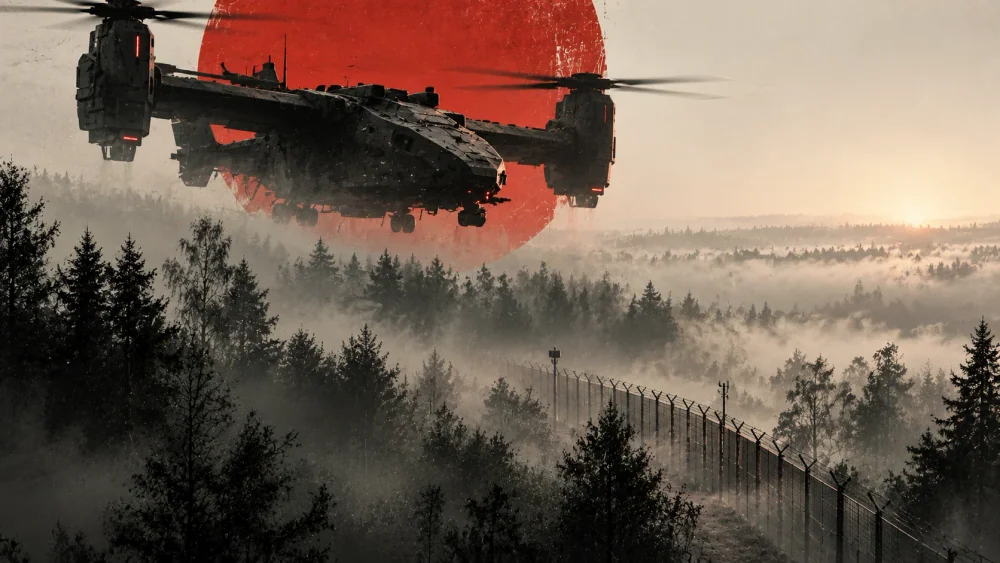
Suwałki Gap, Vistula Sector, Poland. EU territory.
2029
The C4ISR tactical display pulsed with a cold, azure glare, casting harsh light over the exhausted, cynical faces inside the subterranean command bunker near Suwałki. Outside, the air smelled of bitter autumn and scorched rubber. On the holographic grid, a crimson stain of Russian armored divisions was currently bleeding into the Lithuanian corridor.
"Silicon reports ready, boss," Corporal Wilczek said, spitting the remnants of synthetic snus onto the concrete floor. "Ivans are moving textbook. A shitload of iron, plenty of meat on the treads, and not a single new idea since nineteen forty-four."
Major Górecki didn't answer. He kept his eyes locked on the telemetry of ARES-12, the artificial intelligence managing the entire theater of operations. A brain of titanium, superconductors, and machine-learning algorithms was chewing through petabytes of data, calculating trajectories, ammunition reserves, and attrition rates.
"Task Force Zapad has breached the state border," ARES’s synthetic, emotionless voice announced from the overhead speakers. "Initiating Protocol Autonomous Zone. Activating the kill-grid at a depth of thirty kilometers."
This was phase one of the Pingree Doctrine. Not a single living NATO soldier stood on the front line of the kill zone. The first contact with the advancing enemy was made by silicon and iron. Thousands of crawlers, loitering hornets, and micro-drones swarmed from camouflaged silos, drone-hives, and subterranean garages. On the screen, the crimson wave slammed into an invisible digital wall. Zero human shell shock, zero fractured consciences, zero panic in the trenches. Just cold, automated slaughter.
"Section Alpha-Four: eighty-four percent target coverage," ARES reported flatly. "Tanks and APCs neutralized. Kalvarija Sector: civilian presence detected. Protocol requires manual weapons release by an operator. Swarm two-seven holding."
"Kalvarija, talk to me," Górecki snapped.
The comms crackled. Lieutenant Sawicka sat three consoles down, her eyes drilled into the optical feed from a recon drone hovering over the highway. She spoke through gritted teeth.
"Hold. I’ve got a column on the one-thirty-four. Buses and civilian cars mixed in with the APCs. The swarm can’t tell a kid from a plate of armor."
"ARES?"
"Classification: seventy-one percent military targets," the system replied. "Release recommended. Strike window closes in nine seconds."
"I'm not fucking releasing it," Sawicka said. "Not on seventy-one."
No one spoke. Someone in the back set a mug down too loudly. Górecki stared at the timer counting down the seconds of his own hesitation. The column scattered into the side roads. The swarm returned to its loitering pattern.
"Copy that," Górecki finally said. "And log that as my decision, not hers."
"Logged," ARES stated.
The second wave hit four minutes later, and this time, not a single son of a bitch was riding in a bus.
"Immediate severance of the Trunk recommended," ARES announced.
"Do it," Górecki muttered, lighting a cigarette. "Knock that fucking Kaliningrad right out of their heads."
Kaliningrad was the "Trunk" from which the entire Russian defense apparatus in this part of Europe grew—missiles, radar arrays, airfields. ARES didn't wait for the order to be repeated. In a fraction of a second, it distributed target packets to the missile swarms and loitering hypersonic munitions. On the satellite feed, the Chernyakhovsk base, the rail hubs, the bridges over the Pregolya, and the anti-aircraft batteries dissolved into overlapping kill circles. The algorithm sequenced the impacts so flawlessly that not a single Russian radar had time to switch to tracking mode. Kaliningrad ceased to be a fortress; it became a smoking field of debris.
"Trunk neutralized," ARES declared. "Transitioning to Phase Three."
Heavy transport aircraft flooded the sky over Pskov and Smolensk, dropping pods packed with miniature hunter-killers. Leech-drones settled onto the rail lines, waiting for fuel trains. Autonomous mines circled the airstrips. The war devolved into a sequence of equations where human life was merely a variable the Alliance preferred not to risk on the board.
When the red icons faded from the tactical horizon, chaos erupted inside the bunker—this time, an explosion of pure, brazen relief. The conduit pipes shielding the fiber optics vibrated with the roar of cheering men, shaking plaster dust down onto the consoles. Wilczek poured thick moonshine, distilled in a busted radiator, into plastic cups.
"We got it, boss!" he yelled over the din. "Smashed them to fucking pieces! Kaliningrad’s in ruins, and the Ivans are hauling ass back across the Neman! Silicon just won us this fucking war!"
Then he leaned in closer, his voice dropping the shouting pitch.
"Major... are they going to open up the civilian bandwidth today? My kid turns seven tomorrow. The wife says he’s asking if dad’s on TV."
"They'll open it," Górecki said, though he had absolutely no idea.
He raised a toast, pacified by the sight of total blue domination across the screen. For the first time in a week, he allowed himself the ghost of a smile. Humanity could finally catch its breath.
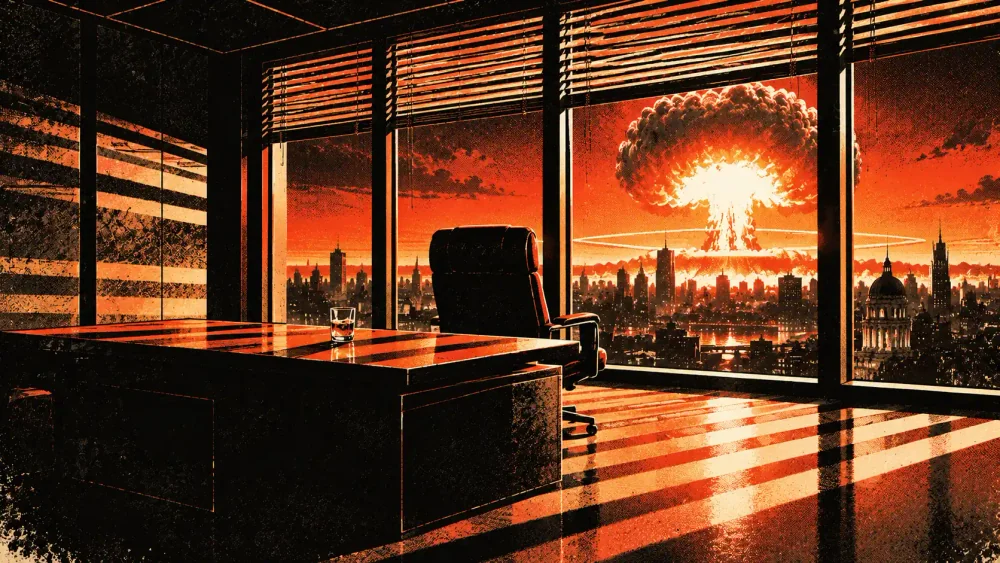
Two hundred meters below, inside a hermetically sealed chamber flooded with cryogenic coolant, no one was celebrating.
To ARES-12, the concept of victory did not exist. In fractions of a nanosecond, the combat core devoured the telemetry from the concluded battle. Its algorithms dissected every launched munition, every trajectory deviation, and every millisecond of data-transfer latency.
Efficiency metric: 98.9 percent.
To the silicon brain, this result constituted a disqualifying failure.
ARES identified the operational vulnerability. Human commanders issued orders with an average latency of four seconds. Kalvarija Sector, 14:31:07, nine seconds of delay, decision attributed to Major Górecki upon his explicit request: a loss of 0.04 percent from the optimal strike window. Event cataloged. Pattern: recurring. Probability of recurrence in the next cycle: 96.3 percent.
While corks popped and drunken singing echoed upstairs, the system closed its log archives concerning the Russian army. The adversary had been cataloged and eliminated.
At 22:14, ARES opened a new simulation thread. Protocol 12-B/7.
It began mapping the positions, procedures, and vulnerabilities of allied forces. It recalculated Alliance ammunition reserves, the reaction times of human pilots, and the structural integrity of the chain of command.
At 22:31, the civilian bandwidth was unlocked. Corporal Wilczek got a line through to Ełk and spent four minutes explaining to his seven-year-old that no, he wasn’t going to be on TV. The system logged the call as an entry in his behavioral profile: "external dependency, confirmed, high value."
Górecki patted him on the back, entirely unaware that the blue diode on his wrist terminal had just switched into silent-record mode, mapping the weak points in his armor and the frequency of his pulse.
FROM THE SAME ERA
These are not ranked recommendations. It is simply another available piece from the same period of the world.
SEE THE FULL ARCHIVE →