GATEWAY
I. PORT
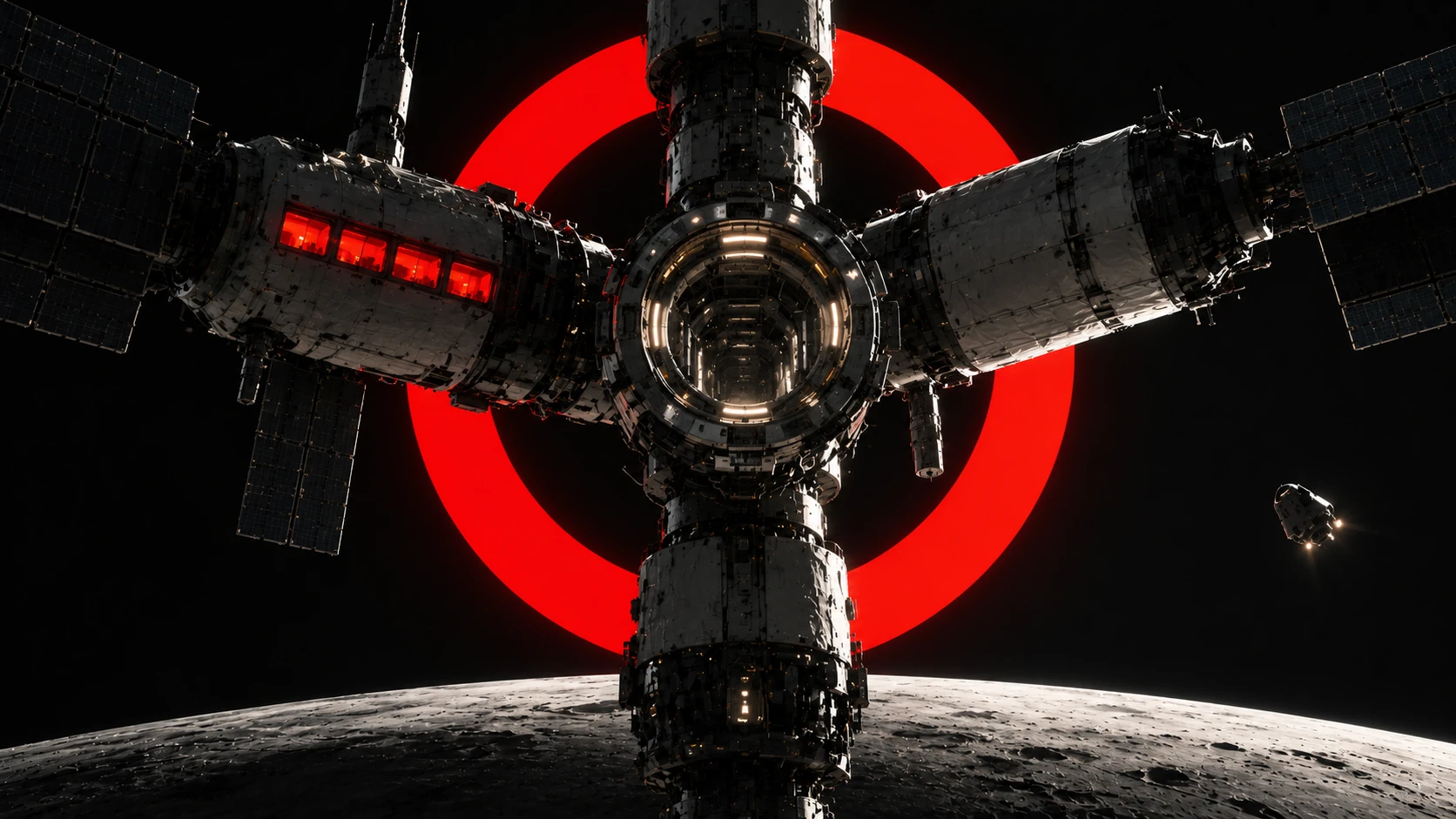
The Moon filled the bottom of the viewport: gray, fractured, too close. Above its edge hung the Gateway station, a small, bright speck on an orbit that dipped low over the surface every seven days before retreating into the void, far from Earth. Earth itself was a blue coin in the corner of the glass.
Nearly thirty years ago, it was announced that the program was suspended in its current form. Since then, the form had been altered quietly. Officially, no one was there. From the shuttle window, two modules with illuminated lights were visible.
Five people in the service shuttle had detached from the Earth transporter half an hour earlier. They were flying here for a reason that didn't exist on any flight schedule.
The port had no designation on any list Emil Zorza had seen prior to launch. He gripped the control sticks with both hands, watching the numbers on the indicator drop: forty centimeters per second, thirty, twenty. Faster was forbidden. Slower was forbidden, because the service shuttle had exactly enough fuel for a single approach and not a drop more.
Up close, the station looked like a house built from several different model kits. A white module with European stencils. A gray cylinder from another program, a different budget, featuring non-standard handholds. Solar panels angled in a way that accomplished nothing but casting shadows. On the far side, in the shadow of one of the modules, something caught the sun and winked out. Zorza noticed it out of the corner of his eye. Reiter was looking in the exact same direction and said nothing.
"Comm latency with Earth: one point three seconds," Hron said. He had been talking too much ever since they detached from the transporter. "If something goes wrong, the ground won't know until after the second sentence."
"They'll know," Reiter replied. "And they'll do nothing. That is the point of the window."
Ten centimeters per second. Zorza hissed air through his teeth. His hands did the work. They had been doing it for two years in the simulator and three times on actual stations; today, they had to do it for real.
"Hey, beautiful," he muttered to the station. "I'm Emil. I come in peace, with fuel for exactly one pass."
Latch one. Latch two. Two dull thuds he felt in his bones, rather than his ears.
"Hard dock."
"Pressure equalized," Hron added. "Can I breathe now?"
"You can," Koskinen shot back. "Try not to do it so loudly."
"Oxygen is free, Hron," Zorza added. "For now."
Reiter unbuckled his harness and looked at each of them in turn. Forty-five years old, a voice like a steel ruler.
"A four-hour window and one port. We enter as module service, we leave as an equipment return. Gateway is managed by a US-led consortium, and we are the SDSR-UE component, meaning we are guests. We are looking for one thing: the launch key registry. The list of who has the authority to send anything further than the Moon. We are building half this station and we don't have a key to anything flying out of it. Hron stays in the middle. Always in the middle. Whoever leaves the tech behind, leaves themselves behind."
Zorza offered a crooked smile.
"Business as usual, then."
"Business as usual," Reiter replied. "With the caveat that this time, nobody is here."
II. WEJŚCIE
Someone had stenciled a meaningless designation on the hatch: BASE RESOURCE MODULE · CAT. 4. Zorza ran a gloved hand over it. The paint was fresher than the latches beneath it.
They flipped up their visors. Beyond the hatch, the corridor was three degrees too warm, smelling of overheated plastic and tea. By the handrail hovered a man in a work coverall, a tablet tucked under his arm, wearing the face of someone who had long stopped asking questions that cost money to answer.
"Europeans. Service, cleared from Earth for today."
He said it flatly, in English, with an American accent, never lifting his head. Reiter tapped his badge against the reader. The panel by the hatch flashed green.
"The window is yours, four hours. Downstairs, nobody will move until the window closes. Axial port and nothing else. Whatever you touch that isn't on the list, isn't here."
"We understand," Reiter said.
"You don't," the man replied, devoid of malice. "But your invoice is paid."
"I always said it pays to pay," Zorza muttered. "Even if we don't know what for."
"Gateway is suspended in its current form," the man added, as if reading from a script. "Officially. You were never here, and we do not exist."
He nodded at Hron's hardcase.
"That?"
"Service kit," Hron said quickly. Far too quickly. "Still under warranty for three months, but I'm not worried about the warranty, I'm worried about..."
"Hron," Reiter cut in.
The man swiped his reader over the case. It beeped once. [EQUIPMENT RETURN · CAT. 2]
"Fine," he said, his gaze already shifting elsewhere. He didn't ask what was inside. He never would.
In their earpieces, the Voice spoke—the same one since the operation began, steady as a metronome:
"Window is active."
III. MODUŁY
They moved through the station like they were moving through a budget. Every module featured a different hatch standard, different adapters, a different category on its dataplate. Zorza floated point, re-patching whatever didn't match: an adapter, a valve, two unlabeled cables. Hron drifted in the center of the formation, the hardcase strapped to his back, his eyes too wide for the freezing intake of breath.
In Module C, the light was warmer. Past the bulkhead sat a table with restraints, mugs locked in the holders, and a handwritten board above it: Saturday — Cake (Margit). Fourteen people. A little too few for a town, a little too many for a barebones crew.
A woman in a heavy work sweater pulled a filter from a panel and turned around without stopping her task. The sight of strangers moving through her kitchen didn't surprise her. Ground control had given her a heads-up, the way you warn someone about the plumbers.
"Service," she said. "They said you'd be here today. They didn't say there'd be so many."
"I can send two back," Zorza replied. "Point out the ones you like least."
"Hey," Koskinen snapped.
"You aren't in the registry," she added. "But they warned us."
"You aren't here either," Zorza countered.
"Nobody is here," she said with a half-smile, the kitchen's oldest inside joke.
"They told us to sit in C until the window closes," she added. "So we sit."
He could have kept moving. Reiter was already waiting in the next hatch. Zorza asked:
"What's your name?"
"Hanne."
"Emil. I can't cook, but I'm great at opening doors."
She nodded and went back to the filter.
"Don't bump the pipes in section four," she offered. "They're hot."
He didn't ask what she meant. He just kept floating.
IV. HALA
The hall began past Module C. Only there did the station stop pretending to be what it was.
A tug hung suspended in the vast space. Half-assembled, tethered to a scaffolding of thin girders, it possessed wing-like structures folded against its flanks: radiators, so numerous they would cover a football pitch if deployed. At the rear sat a cylindrical shield with one dark side; everything behind it was cast in pitch-black shadow. Up front, fuel tanks thick as silos fed a cluster of engine bells at the bow, still missing their cowlings.
"That is the biggest hairdryer I've ever seen," Zorza muttered.
The words MARS-DEMO were stenciled in massive letters across the tug's hull. Beneath them, in smaller print applied noticeably later: Service Article.
Netted against the wall hung frost-covered cylinders marked HE-3, stamped with surface batch numbers. Someone was digging down below; someone was hauling it up here. Not for the tug. For whatever was scheduled to fly after it.
Deep in the hall, shrouded in gloom, hung two more hulls in scaffolding—smaller, equally unfinished.
Hron jacked into a terminal. A trajectory line unspooled across the screen: long, smooth, spiraling out across half the solar system. He clipped his hardcase casually to a nearby beam. An LED on its side blinked, but Zorza was staring at the display.
[LOW-THRUST TRAJECTORY · GRAV. ASSIST: J · TARGET: TITAN (S-VI) · BEYOND: NO DATA]
"That's not the Moon," Hron said quietly.
"Don't ask," Reiter replied.
"I'm not asking. I'm stating. And that's not Mars." He nodded toward the hull. "That paint job is a fairy tale."
"Titan," Zorza read from the screen. "Far from here?"
"Far," Hron replied. "That's what the giant hairdryer is for."
"Titan is the gate to Proxima Centauri," Hron added, dropping the sarcasm. "Whoever locks it down first, walks through. The rest stay on the platform."
"Does everyone know this?" Zorza asked.
"Everyone," Hron said. "That's why Mars looks so pretty on the recruitment posters."
Zorza stared at the line longer than he should have. Beneath it sat a second column: names, timestamps, serial codes. The launch key registry. Six windows. Two already assigned. Whoever held a key could release the tug. Whoever didn't could only watch.
[WINDOW 1 · GATEWAY OPERATOR · WINDOW 2 · SYNAPSA · WINDOWS 3–6 · UNASSIGNED]
"Twenty minutes," Hron said. His fingers blurred across the keypad, yet he kept talking, rapid and disjointed, as if the words were fueling his courage. "Physical drive, no network connection. Leaves no footprint. Give me twenty minutes."
"You have eighteen," Reiter said.
V. GOŚCIE
First came the sound: a sharp, dry thud vibrating through the bulkhead, like someone taking a hammer to the exterior hull. There is no roar in a vacuum.
"We have guests," Koskinen said.
Reiter didn't ask who.
"They're nine minutes late," he muttered, checking his watch.
"Hron. Center. Now."
They entered from the direction of Module C, breaching through an airlock clamped to the outer hatch. Four Chinese operatives in sterile, unmarked light suits, faces visible behind their visors, carrying tools that looked more like emergency breach gear than standard weapons. The point man halted in the hatchway and spoke in flat, unaccented English:
"Stop. Hand over the drive."
"Good morning," Zorza replied, because he always said 'good morning', even to people who entered through the walls.
"Tang," Reiter murmured, so softly only Zorza caught it.
"They know the window," Varga said.
Reiter didn't reply.
He didn't introduce himself. He didn't have to. He was a man from an organization that didn't exist, rendering him formally non-existent. He knew the blueprints of this station better than half its actual crew.
In their earpieces, the Voice cut off mid-sentence. It was replaced by a broad, even static—the kind someone turns on with explicit intent.
Nobody fired. The walls were thinner than anyone's patience, and the scaffolding around the tug turned the hall into a dense forest of metal bars. Koskinen kicked off a beam and slammed hard into the point man, their armor clashing with a heavy metallic crunch. Varga grabbed Hron by the belt and shoved him behind a radiator panel. Zorza took a hard blow to the ribs—an elbow, he realized a second later—bounced off the bulkhead, grabbed a handrail with one hand, and yanked the tech toward him with the other. Hron hung off his shoulder, screaming something about the drive, loud enough to ensure someone heard him.
Two Chinese operatives took the high route across the girders, moving like men who had rehearsed this in the exact same silence. One vaulted over Zorza, hooked his boot on the tech's backpack, and spun him mid-air. The hall tilted like a carousel. Inside that spin, Tang ripped the data cube from Hron's chest in a single, fluid motion, so fast the tech couldn't even break his scream. Hron made no attempt to fight for it. He just stared after it with the expression of a man who had just been stripped of everything.
"I've got you," Zorza told the tech. "Stop screaming."
Only then did the smell hit him. Worse than burning plastic. Insulation, wiring, things transitioning from warm to critical in a matter of seconds.
"Module C," Varga said. "They cut the lock with a torch. It's on fire."
"A fire in C triggers a port lockdown," Reiter said. "He knows that."
Tang smelled it, too. He barked a single word to his team. All four kicked off the beams and retreated the exact way they had come: through Module C, which was already beginning to burn. Nobody gave chase. Reiter watched them go for a fraction longer than tactically necessary.
VI. DRZWI
The alarm triggered in three languages simultaneously: a fire warning, a sector isolation warning, and a third protocol Zorza knew from the manuals but had never heard live. [Fire Protocol: Extinguishing via depressurization.] The station wasn't panicking.
"We are leaving," Reiter said. "To the port. Through B."
"Visors down," he added. Zorza snapped his shut before Reiter even finished the sentence.
The route to the port funneled them through a narrow bottleneck by the Module C bulkhead. Zorza reached it first. The small viewport revealed the interior: smoke, the sickly yellow of emergency strobes, mugs torn from their restraints floating lazily because someone had blown a valve. Silhouettes. Someone was hammering against the far bulkhead, the sound barely penetrating two layers of aluminum.
Four of those silhouettes moved differently than the rest: fast, in one direction, wearing suits with sealed helmets. They knew the exit route. The last one glanced back over his shoulder. Behind the visor, Zorza saw the face of a man who had calculated this math far earlier than he had. Then the hatch of their breach lock slammed shut behind them.
The adjacent panel blared: [BULKHEADS LOCKED · FIRE PROTOCOL · OCCUPANTS IN C: 0 · CONCLUSION IN 00:00:38].
[REPORT TO EARTH: TRANSMITTED · RESPONSE: NONE]
Three seconds ticked by. Ground control could halt this with a single word. Zorza didn't know if they couldn't hear, or if they just didn't want to.
Zorza placed his hand on the manual override lever. A standard red handle with a breakaway seal you could snap with one finger. He knew exactly what would happen if he pulled it: the bulkhead would open, the fire would bleed into Module B, and the isolation timer would reset, taking the locked port with it. Hron. Koskinen. Varga. Reiter. Fourteen faces on one side, five on the other.
Reiter stood beside him. He didn't touch Zorza's hand. He didn't even try.
"Resetting the isolation will lock the port for forty minutes, and the fire follows us into B," Reiter stated. He spoke like a man who had already done the math. "Fifteen seconds of consciousness, four meters to the first man, fourteen people. You are standing the closest, Zorza. Run the numbers and make the call."
He ran them. He got the exact same result. And that wasn't what stopped him. What stopped him was the simple fact that he wanted to live.
Somewhere in Wrocław, his seven-months-pregnant wife was probably already asleep. She didn't know where he was. She never asked.
Zorza looked through the viewport. The interior was brighter than the emergency strobes now, and the smoke was thinning because the oxygen was burning out. He saw her in her work sweater, standing by the cake board, one hand pressed flat against the glass. She wasn't screaming. She did what someone who already knows does: she rested her forehead against the bulkhead.
He opened his mouth to say something that usually worked. He found nothing.
"Hanne," he said into the comms, thumbing the bulkhead intercom. Just that. Once.
Nobody answered. Or maybe someone he couldn't hear did.
He slammed his open palm against the bulkhead, once, hard enough to rattle his helmet, and willingly took his hand off the lever. No one was holding him back. Reiter said nothing.
The red digits hit zero.
VII. PORT
They were twelve meters from the port, and the station had already shifted into total lockdown—nobody in, nobody out. The axial port glowed red: [FIRE PROTOCOL · EXIT LOCKED].
Zorza knew there was exactly one category exempt from any lockdown, because without it, the station would cease to function. Equipment return. Service crates always leave, under any protocol, because someone, somewhere, once decided that hardware was expensive, and people were replaceable.
He had five ID badges in his pocket, one for each kit they had hauled up. Five people, five badges, but the panel only cared about the category and a single unit of cargo. He stripped off his gloves—you couldn't do this fast enough with them on—and started swapping: first his, then Reiter's, Varga's, Koskinen's, and finally Hron's. One cargo manifest number. One return pallet. Five biologicals filed under a single column.
"Paperwork," he muttered, just to keep his mind off everything else. "Nobody ever reads the paperwork."
The panel accepted the first badge. The second. The third. On the fourth, it paused.
[DELAY: 5.2 seconds]
The text vanished before anyone could read it. Zorza was counting. He didn't want to, but he did. Five. Maybe six. He felt that pause in his teeth, and he had absolutely no idea why.
The fifth badge, Hron's, cleared without a stutter. The panel flipped green.
[GRANTED · RETURN CARGO · 1/1]
The shift supervisor was floating by the panel. He had seen everything. He looked at the five badges filed under a single item and never lifted his head. His tablet displayed a message from downstairs, from the consortium duty officer. Read, but unapproved.
"Hron, center."
"I'm in the center!"
"Koskinen. Varga. Reiter."
Zorza floated in last. He looked back one final time. Down the corridor, behind the sealed bulkhead, a red notification still smoldered: [CONCLUDED].
Undocking. A silent plume of thruster gas. The station slowly retreated without ceremony, leaving only its gray bulk in the window, with one module noticeably darker than the rest.
Inside the shuttle cabin, Reiter asked a single question:
"The drive?"
"Left with Tang," Hron replied. "Let him enjoy it."
"It was blank," he added, before anyone could ask. "With a security seal and a red sticker to make it look important. From the start, I needed everyone looking at me, not the hardcase."
Zorza glanced at the case the tech had kept strapped to his back the entire time. A standard service trunk with a return barcode on the side. The single unit of cargo the panel had just cleared.
"A tech clutching a briefcase in full panic is the best cover I know," Hron added. "Nobody asks what's in the box when everyone is listening to you scream."
"You could have told me."
"You wouldn't have been able to lie."
Zorza wanted to be offended.
"Anyway, the cube isn't entirely blank," Hron continued. He pulled a tablet from his pocket and rested it on his knee. "It has nothing Tang can read. But it does have something that listens."
"A microphone?" Zorza asked.
"Ears," Hron corrected. "Microphones are for amateurs."
"And they won't jam it," he added, "because they don't know it exists."
A small dot pulsed on the screen. Then it went solid.
"He plugged it in," Hron said. "Now."
Static hissed from the tablet's speaker, followed by the click of a latch, and then dead silence. It stretched on so long that Varga checked her watch.
Then, a breath. The steady, controlled breathing of a man who has just figured it out. A single, short sentence was spoken in Chinese, utterly devoid of emotion. Hron, who knew just enough Chinese to order dinner, recognized one word: good.
Their counterpart's comms link flared on the tablet. It opened, then died a second later. It opened three more times and died three more times before the first word broke through.
"We should reply," Zorza muttered, because the silence would be worse. "Apologize for the inconvenience."
"There is no report," Reiter said quietly, "that begins with the phrase, 'we were there'."
The static in their earpieces didn't fade until several minutes into the flight.
"Congratulations," the Voice spoke through the comms, steady as a metronome. "Window three is yours."
Reiter cut the link.
"He didn't ask about the Chinese," Zorza noted.
"No."
"Meaning he knew."
"Meaning he knew, or he didn't care," Reiter replied. "In our line of work, it's the exact same thing."
"And you?" Zorza asked.
"Intel briefs indicated such an operation was possible," Reiter said. "Command just didn't believe the Chinese were crazy enough to try it."
He knew the name of one of the fourteen people. For the rest of the flight, he tried to remember if he had spoken it out loud.
VIII. ZAMKNIĘCIE
INCIDENT: fire, Module C, sector compromised. Fire protocol: concluded, in accordance with procedure. Module C, occupancy: modified (14). Personnel status: profile inactive from inception. Status change: none. Service equipment return: 1 unit (service trunk), executed. Comms log 00:41:12–00:41:14: retroactive correction, purged. Cause of fire: undetermined. No correlation. Incident report from the Chinese party: none. Report to Earth: transmitted immediately, in accordance with procedure. Response: none. Comms interference: until end of window, origin undetermined. Window 3 (European key): active. Licensing revenue (EU region): increased. Gateway: suspended in its current form. Isolated incident. No correlation — not requested.
#LogikaRzezni #CGProtocol #MilitarySF
FROM THE SAME ERA
These are not ranked recommendations. It is simply another available piece from the same period of the world.
SEE THE FULL ARCHIVE →