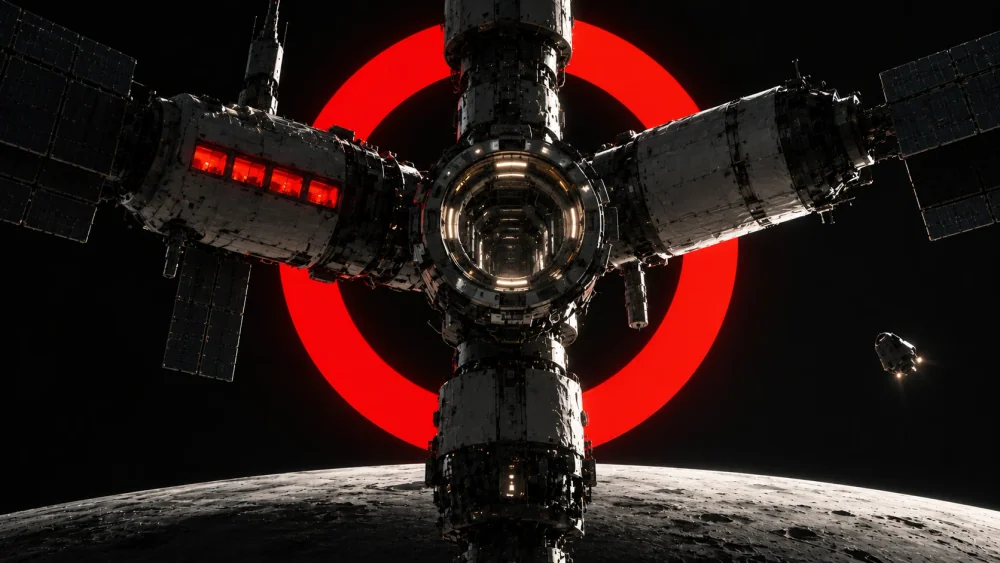
TARGET CONFIRMED
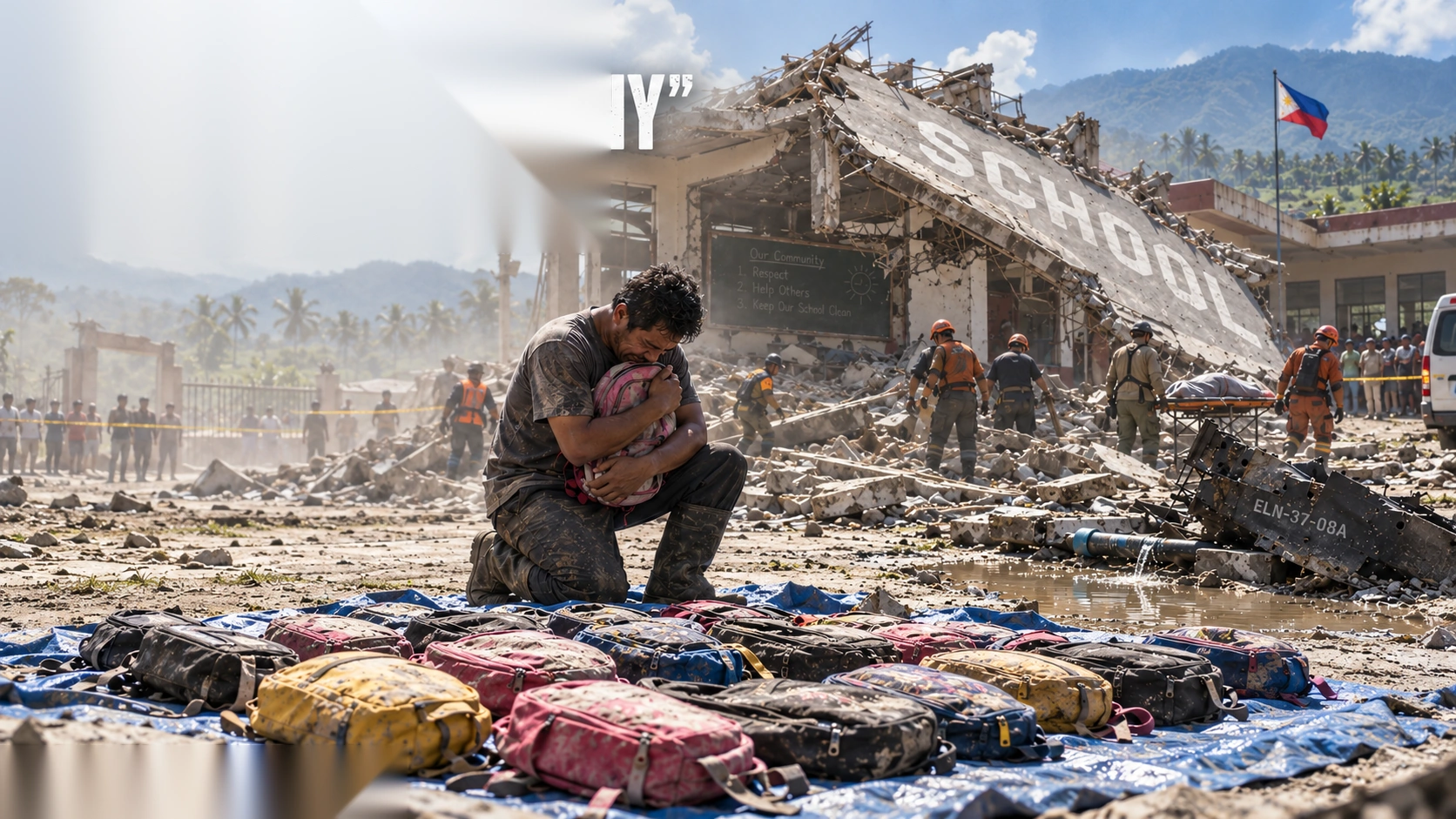
“TARGET CONFIRMED”
Dolina Cagayan, północny Luzon, Filipiny. Azja Połudiowo-Wschodnia. Poranek.
2035
The roof is flat, covered in tar paper that doesn't yet burn the hands at this hour. A bucket of white exterior paint sits in the center, flanked by two rollers on telescopic poles and an electric kettle with an extension cord snaking through the stairwell window—someone had decided tea on the roof was a good idea. The river breeze carries the scent of sun-baked earth and garlic fried with rice from the houses beyond the pitch.
Ramil teaches geography. Cora teaches English, and whatever else is left for the four youngest grades. They have been painting letters since seven in the morning. On Monday, the principal received a notice stating the sign had to be at least a meter and a half tall and contrast with the surface. An illustrated flyer accompanied the memo: a satellite, an arrow, a marked roof, a smiling little girl. White paint on black tar paper contrasts perfectly. Kneeling, Cora sketches the letters with chalk while Ramil fills them in. One has better eyesight, the other a steadier hand, and it isn't always clear which is which.
Drones have been passing over the valley at night since autumn; nobody says whose they are. Three schools in the neighboring district have been shuttered. Two across the river already have their roofs marked and hold classes in actual rooms. Here, since October, lessons have taken place in the basement under generator light. The ministry's notice has a flip side: a marked facility can move back upstairs. The principal signed it on Monday. Starting today, classes resume above ground.
First in their own language: PAARALAN. MGA BATA. Beneath it, the same in English, painted smaller on a second line because they ran out of space near the chimney: SCHOOL. CHILDREN. Someone from the ministry had claimed satellites read English.
Stepping back three paces, Ramil inspects the text from the stairwell—evaluating it like a wall before final inspection. Cora seals the paint bucket. The first-period bell rings from the stairwell, followed by the clatter of footsteps on the stairs. Heading up for the first time since October.
"Should be enough," Ramil says.
"It should."
The paint will dry in an hour. They gather the rollers and head down.
The room has no windows. Six desks sit in two rows. Five are empty, bearing that specific cleanliness of surfaces untouched for a quarter. At the sixth sits Joan Kessler, an image analyst on a fixed-term contract, eating an apple over her keyboard.
An embossed logo rests above the terminal’s ventilation grille: SYNAPSA AI NV — WARFARE DIVISION, with the designation SWD-TF/4 stamped in smaller print below it. Her screen displays the queue. Four hundred and twelve records require review. Thirty-one are flagged by the system as needing human verification. The rest the system has cleared on its own.
Data streams into the queue from the network: military and leased satellites, drones, SIGINT. Joan doesn't see the network; she sees its results. A P3 indicator glows in the corner of her screen.
Joan handles the thirty-one. That is the contract.
A new satellite pass comes in at 09:40. Joan opens it for no particular reason—the thirty-first record sits right next to it, the resolution is sharp, and she hasn't finished her apple yet. Zooming in, she spots a river, a pitch with two netless goals, and an L-shaped building. The roof is black and bears an inscription. White letters, each as tall as a person. She reads it herself before the system can: first in the language of which she knows exactly three words, and below it, in the one she speaks.
The system reads it a second later. Log output: text, two lines, two languages, confidence 0.97. Target classification 4417: no change. Database match: full compliance.
Joan accesses the record. Military communications node, last updated four years and two months ago. The edit field is greyed out. Beneath it, fine print reads: Requires approval by ZWC Manager. The position is currently vacant.
She types a ticket to the team inbox. An automated reply states that target record submissions must be directed to the ZWC Manager. Consequently, she messages the duty targeting officer—three sentences attached to an image. The duty officer is in a briefing, and the briefing holds a "do not disturb" status. The message drops into the queue with standard priority. Joan cannot see what happens to the record next. Strike packages occupy a different queue, one to which she has no access.
Finally, she opens the notepad provided by her contracting firm—the one exclusively accessible to her—and types: 4417 — school. Roof text FIL/EN, two jeepneys at the entrance, morning foot traffic. Pending record update. The notepad saves the entry. It is connected to absolutely nothing.
She finishes her apple and returns to the thirty-one.
The squadron briefing room takes twelve minutes. Package Seven: three aircraft, three targets, strike window from 11:30 to 11:50. None of the targets are mobile. Slides follow the usual layout: image, coordinates, classification, confidence level. The pilot, callsign Kestrel, copies the second target’s coordinates onto his kneeboard, even though the system will upload them directly into the ordnance. He does it because he has done so since flight school, inheriting the habit from his father, who did the same with a paper map in the Gulf. Wren, taking the back seat, scribbles the exact same data into his own notebook. Nobody considers it redundancy.
Target two, 4417. MILITARY COMMUNICATIONS NODE. Confidence 0.99.
Instead of an image, a grey rectangle with a crosshair in the center fills the screen; the resolution for the strike package was downgraded to fit the available bandwidth.
"Why no picture?" Kestrel asks.
"Bandwidth," the briefing officer replies.
Kestrel nods, jotting it down on his kneeboard next to the coordinates.
Before climbing into the Super Hornet's cockpit, he hands the crew chief a cup of coffee, returning the favor from the day before. Catapult launch at 10:20. Then the ocean, followed by nothing but more ocean. A sandwich sits untouched in his thigh pocket since takeoff. The water below resembles weathered sheet metal.
At 11:01, Kestrel asks Wren to confirm the target. It is the only check they have left. Wren inputs the query; the screen responds a second later.
"Target confirmed," Wren reads.
The avionics clock and the datalink clock drift apart by four hundredths of a second, then synchronize. It falls within acceptable tolerances. Wren doesn't report it.
At 11:02, the first missile leaves the pylon with a soft jolt that transfers straight through the seat. The second follows. The display shows two trajectories, two shrinking distances, a single color. The system logs it: Package Seven, Target Two, ordnance away. Kestrel scribbles the time on his kneeboard and banks the jet back toward the carrier.
The fourth grade has English, their first time since October in a first-floor classroom with uncovered windows. Cora has written irregular verbs in three columns on the board: go, went, gone; eat, ate, eaten; see, saw, seen. A boy in the back row, Jericho, raises his hand and asks, "Ma’am, is saw also a tool?" The class laughs the way a fourth-grade class laughs—longer than the question actually warrants. Mika, a girl by the window, counts something on her fingers beneath her desk. The window seats were claimed first because they offer a view of the river. Outside the glass, two jeepneys sit with their doors open, one driver smoking by the rear tire. The room smells of chalk dust and warm plastic. It is 11:36.
The first warning isn't a sound. The light outside flashes bone-white and completely flat, as if someone had successfully stripped the color from the valley. The rows of desks shift in unison, gliding together as if on water. Then comes the crushing pressure, followed by a frequency so low the body absorbs it bypassing the ears entirely. The ceiling caves in just slightly slower than the time it would take to push back a chair. Plaster, wiring, forty years of paint. Cora stands at the chalkboard, chalk in hand, and for a split second, she still knows which verb comes next.
The ensuing silence is pierced only by the fire alarm in the hallway—the sole piece of equipment in the building that functioned exactly as designed. Dust settles on open notebooks. Somewhere, a man is shouting a single, two-syllable name, calling it out for a long time. Nobody answers. Only the left half of both lines remains of the roof inscription. The rest lies a floor below.
At 11:52, the team inbox delivers a single sentence: Ticket from 09:52 closed automatically, facility inactive. Joan interprets this as good news; someone must have updated the record. She is currently on her twenty-fourth file. She opens the next one.
Two days later in the ship's wardroom, Kestrel reads the daily press brief provided for the crew. Two printed sheets lie on the table next to a coffee pot. A wire agency drone photo: a black slab of roof, white letters, half the text collapsed downward. The caption: at least ninety-four casualties, including children and teachers. The headline features the target number he knew from the briefing, paired with a city name he didn't recognize from any intelligence report.
He reads the caption exactly once. Tearing the sheet along the fold line, he quarters the paper and shoves it into his thigh pocket, right next to his stale sandwich. Afterward, he reports to the squadron commander and requests access to the battle damage assessment. The commander tells him the report will reach his desk when it is finalized, noting that preliminary reviews indicate no procedural violations.
Kestrel thanks him. He flies the very next day.
Admiral Davies reads the final report in his Oahu office, a room where the only things that ever change are the binder covers. Forty-two pages. He reads them sequentially, without skipping a line. Page six contains the image from the 09:40 satellite pass: a black roof, white lettering. Page seven shows the exact same location post-strike, the letters sheared cleanly in half. He reads the English text. Then he examines the other language he doesn't know, attempting to guess its meaning, even though he already knows.
The report concludes that Target 4417 was civilian infrastructure. It confirms the system recommended the strike in full accordance with the database record. It documents that the record had sat un-updated for four years and two months despite the facility’s transfer to the local municipality; that the Target Verification Team consisted of a single individual at the time of the incident; that the operational efficiency of SWD-TF/4 was verified against its product sheet; and that absolutely zero procedural errors occurred.
He summons the liaison officer.
"What went wrong?"
"Nothing, Admiral. All parameters are within normal limits."
Davies nods, the specific kind of nod reserved for an answer one fully expected. He waits. The officer remains standing. Outside the window, two technicians carry a ladder.
"Pull the system logs for the entire day and print them."
Twenty minutes later, the printout arrives. He reads it from the very first line. Everything checks out.
Six years later, on a Thursday, Kestrel sits in a Lawton, Oklahoma pub, two blocks from the Fort Sill gates. He has been out of uniform for a year, having returned to his hometown, but the rigid posture remains. The bartender knows him as the guy who always orders the same drink and leaves his change on the bar. Tonight he pays for two beers, though he only drinks one. A folded wad of paper slips out of his pocket alongside his wallet. Kestrel shoves it back in. He asks the bartender to flip the channel to the news network, requesting the volume be muted a minute later. The news ticker at the bottom of the screen reports that the Senate has authorized lifting the ban on P4 autonomy.
At the adjacent table, a young artillery lieutenant in uniform asks if it's true the system has never made a mistake.
"The compliance rate is extremely high," Kestrel says.
Satisfied with the answer, the lieutenant nods. Kestrel finishes his drink, pins a bill under his glass, and walks out at 22:15. The air outside is warm.
MEMO — ZWC STAFFING REORGANIZATION FROM: Commander, Indo-Pacific Command, Adm. Davies TO: Target Verification Team (ZWC) DATE: June 2034
1. Based on the SWD-TF/4 (Synapsa AI NV — Warfare Division) product sheet, the recommendation-to-database compliance rate is 99.3% (vendor data, 6 mo.).
2. System efficiency is considered confirmed.
3. 96% of sector nominations originate from the SN-PAC network (satellites, drones, SIGINT). Data fusion is executed by SWD-TF/4.
4. Operational experience from sector RS-MYK-7 (2028) indicates decision latency is a critical factor. Manual verification extends latency without documented outcome improvement.
5. Sector transitions from trust level P2 to P3: system nominates and ranks, human operator approves exclusively records flagged by the system. P4 remains prohibited by law.
6. ZWC billets: 6 → 1 (external contractor). Manual analysis teams disbanded in 2033. Degraded mode (without SN-PAC): not implemented.
7. Vendor holds no liability for source data currency (license agreement, annex 3).
8. Implementation effective July 1. Approved.
LOG SWD-TF/4 — TARGET 4417 CLASSIFICATION (allied joint database record, last update 4 yrs 2 mo): MILITARY COMMUNICATIONS NODE NOMINATION: RF emission 03:12 (SN-PAC SIGINT), assigned to nearest record: 4417 (180 m) OBSERVATION SOURCE: SN-PAC, pass 09:40 OBSERVATION 09:40: roof text, 2 lines, 2 languages, confidence 0.97 RULE K-4.2: database record supersedes current observation (safeguard: battlefield disinformation) DATABASE MATCH: 100% HUMAN VERIFICATION FLAG: not set (compliance above threshold) RECOMMENDATION: CATEGORY A, strike window 11:30–11:50 IMAGE FOR PACKAGE 7: target designation (leased link, restricted bandwidth) 11:01 PILOT QUERY: CONFIRM TARGET 11:01 RESPONSE: TARGET CONFIRMED (database match 100%) 11:02 SYNCHRONIZATION DEVIATION 0.04 s (package 7 avionics ↔ satellite link): within tolerance, no action required 11:02 ORDNANCE LAUNCHED (package 7, target 2) 11:36 IMPACT. SEEKER HEAD: template match 0.96 (template: archival imagery) 11:52 RETROACTIVE CORRECTION: target 4417 → CIVILIAN FACILITY (SCHOOL) source: observation 09:40 11:52 TICKET 09:52 (J. KESSLER): CLOSED AUTOMATICALLY — FACILITY INACTIVE RECOMMENDATION STATUS: compliant with record at time of issuance
FINAL REPORT — TARGET 4417 SWD-TF/4 EFFICIENCY: confirmed (product sheet, item 2) ROOT CAUSE: verification resource constraint following ZWC staffing reduction NOMINATION: RF emission assigned to nearest record (180 m) RECORD: un-updated for 4 yrs 2 mo; municipal transfer (2031) not logged IMAGE FOR PACKAGE 7: restricted (link bandwidth, lease item 6) DELIVERY PLATFORM: F/A-18F (carrier strike group), ORDNANCE: AGM-158B x2 PROCEDURAL ERRORS: none found NON-COMBATANT CASUALTIES: 94 RECOMMENDATION: no changes to ZWC staffing, P3 trust level, or record priority rules
POLICE REPORT — EXTRACT CASE: off-duty fatality, callsign KESTREL (separated from service for 12 mo.) LAST SEEN: pub, 21:40–22:15, cash payment (bartender statement on file) ON PERSON: sidearm (registered), press clippings (11) SUICIDE NOTE: none NOTIFIED: father (Staff Sgt. Ret., US Army)
PERSONNEL FILE — callsign KESTREL STATUS: off-duty fatality CAUSE: post-traumatic stress disorder (posthumous diagnosis) PRESS CLIPPINGS (11): contents unexamined, released to family MILITARY HONORS: granted (off-duty fatality) LINK TO COMBAT ASSIGNMENT: undetermined CLASSIFICATION: Isolated incident. No correlation — not requested.
📉 Target Verification Team: 6 → 1 📊 Database match: 99.3% 🏫 Target in database: "military communications node" (last updated: 4 years 2 months ago) 🧾 System efficiency: "confirmed" 💬 The pilot asked the system to confirm the target and received a response. Was it a question, or a ritual?
#LogikaRzezni #CGProtocol #MilitarySF
FROM THE SAME ERA
These are not ranked recommendations. It is simply another available piece from the same period of the world.
SEE THE FULL ARCHIVE →