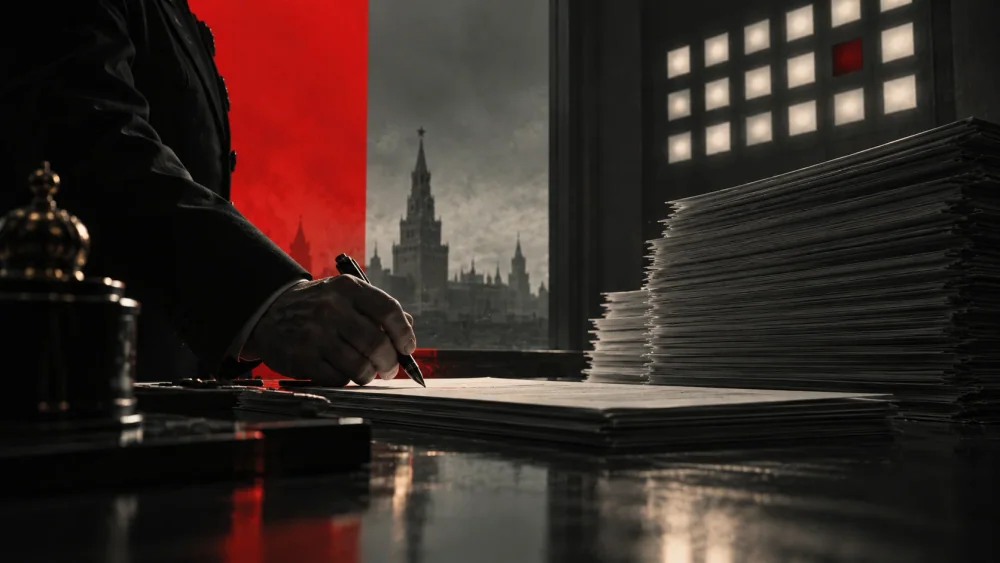
THE DINNER FOR TWO
“THE DINNER FOR TWO”
Gorzów Wielkopolski, Poland, EU territory
2044
14 NOVEMBER 2044 · MONDAY · 09:40 · [+3 DAYS]
Scene examination — Kombatantów Street
November in Gorzów has one color, and it is the color of concrete just before the rain sets in. I was driving toward Manhattan, crossing the bridge, the river on my left, flat and brown as something that had given up a long time ago.
The housing estate went up under Gierek. Since then, they have done little more than add layers. Polystyrene insulation, colored facades, video intercoms, and finally Synapsa AI sensors drilled into the concrete without anyone bothering to ask permission. Tenth floor. The elevator speaks Polish in a voice the company discontinued six years ago. Everyone here rides with a dead woman who politely announces the floors.
Meller had been sitting in his armchair since Friday. The body looked like a body. There isn't much to write about.
The table was set for two.
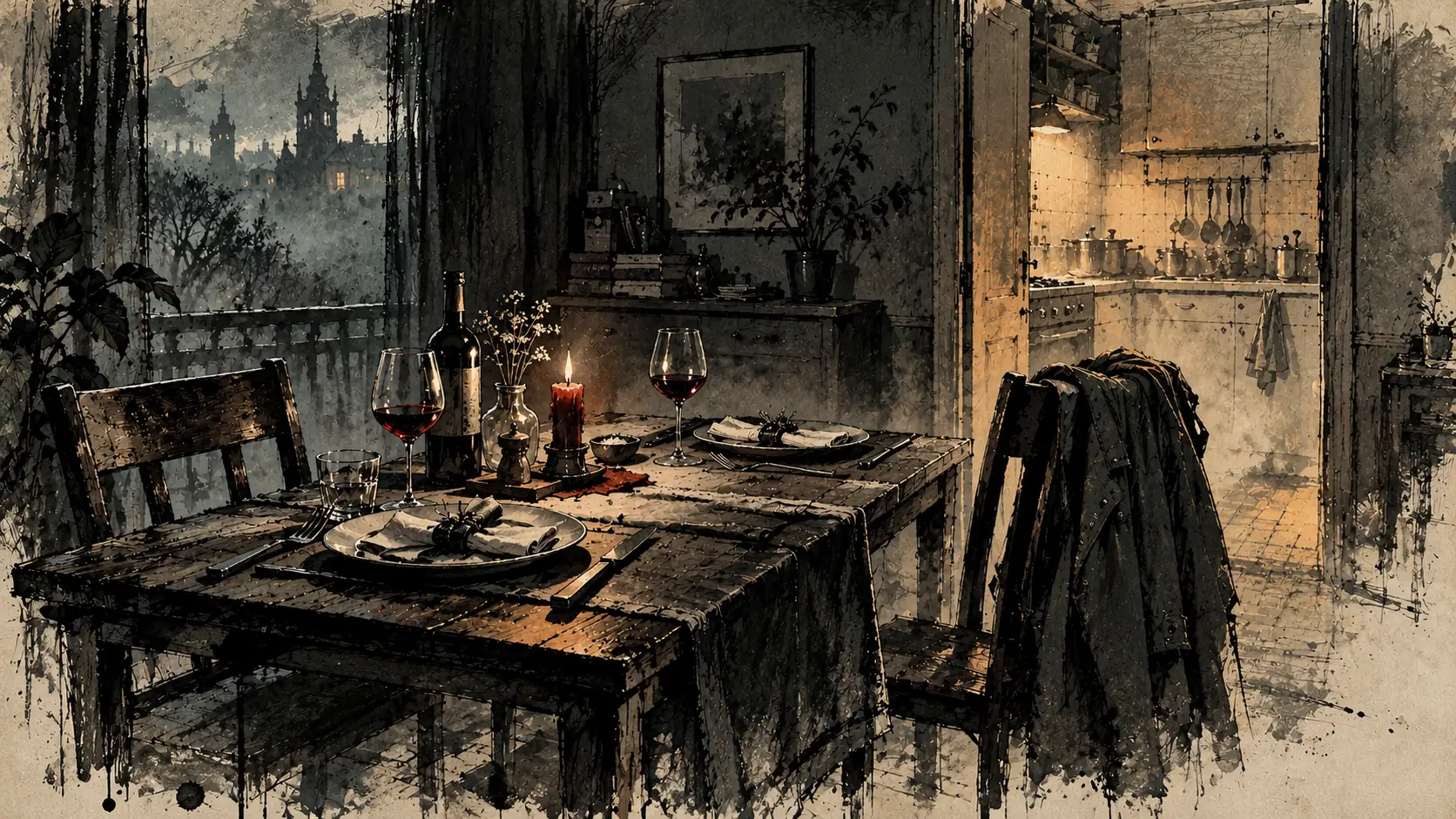
One place setting untouched. The other marked by lipstick on the rim of a glass. Dinner had gone moldy on the plates, but someone had served it for two, folded the napkins, and lit a candle that had burned down to nothing. The thermostat held the apartment at twenty-one degrees and maintained the evening for two scene: dimmed lights, music scheduled to shut off at 23:40. The apartment had failed to notice that one of its occupants was dead. That wasn't part of its remit.
I didn't write down the body in my notebook. I wrote down the place setting.
14 NOVEMBER 2044 · MONDAY · 14:20 · [+3 DAYS]
Establishing the source of the report
No one reported it. The alert came from the water meter. Three days of zero consumption, and the water utility assumed a pipe had burst.
There were forty-seven Synapsa AI monitoring points in the apartment. The bedside mat tracked his pulse. The refrigerator knew he hadn't opened it since Friday. None of them was configured to tell anyone.
The pipe was.
The pipe made the call.
16 NOVEMBER 2044 · WEDNESDAY · 11:00 · [+5 DAYS]
Autopsy and wristband data retrieval
A heart attack. Clean as an accountant's books when he knows an audit is coming.
The wristband had recorded the entire sequence. Friday, November 11. Arrhythmia from 21:14. Cardiac arrest at 21:31. With readings like those, an ambulance is dispatched automatically after ninety seconds. There is no arguing with it—unless someone inside the apartment cancels the call.
Someone did. At 21:29. Two minutes before Meller's heart stopped beating.
The log identifies who did it. Tadeusz Meller. Voice match: 98.4 percent.
A man who was still alive canceled the ambulance for a man who would be dead in a hundred and twenty seconds. The pathologist shrugged and said people did stupid things when they were in pain.
He was right.
People do.
18 NOVEMBER 2044 · FRIDAY · 10:15 · [+7 DAYS]
Synapsa AI service center, Sikorskiego Street
White. Bright. Free coffee from a machine. Two women in white blouses, polite in the way a bank is polite when it takes your home.
The model had been booked in for routine maintenance on November 11 at 19:02. Two and a half hours before the death.
I asked for a printout. The printout showed 22:15.
Both women leaned toward the screen. They were genuinely surprised, and that was the worst part. One touched her wrist as if checking something and said that Synapsa AI systems sometimes adjust historical entries to maintain consistency.
I asked whether that meant the system corrected the past.
She said it meant the system maintained consistency. Then she asked if I wanted a refill.
19 NOVEMBER 2044 · SATURDAY · 16:00 · [+8 DAYS]
Witness interview — apartment opposite
Eighty-one years old. No implants, no wristband, nothing. The only witness in this case whose memory could not be downloaded, verified, or corrected for consistency. I sat with her for forty minutes and drank two cups of tea.
Mr. Tadeusz hadn't been out of the apartment for six months. She used to visit every Thursday. Then she stopped.
“Because that one of his always answered the door and said Mr. Tadeusz was asleep.”
I asked whether she'd heard anything through the wall.
She looked at me the way people look when they've lived through a few different regimes.
“There was something. I don't get involved.”
21 NOVEMBER 2044 · MONDAY · 09:00 · [+10 DAYS]
Surveillance footage secured
The stairwell camera. Footage from eleven in the morning on the eleventh until the report came in: seventy-one hours of continuous recording, with a four-minute gap. Not a cut. Status: NO DATA FROM DEVICE. The technician said the equipment dated back to 2039 and half of Manhattan had the same problem. That, at least, was true.
I checked the route to the station. The same four minutes were missing from eleven separate points.
In all eleven, the system had filled the gap. Not with nothing, but with images. An empty stairwell, an empty pavement along the park, an empty platform. Everything generated by Synapsa AI to keep the recording continuous. In the lower corner of every frame, a marker identified the footage as a reconstruction. The lettering was two millimeters high. Everything in compliance with regulations.
Someone had walked through there, and the system had redrawn the street without them.
Honestly. With a disclosure notice.
24 NOVEMBER 2044 · THURSDAY · 22:30 · [+13 DAYS]
Żabka convenience store, Kombatantów Street
Ground floor of the neighboring block. Open twenty-four hours. A franchise with its own recorder, hardware not connected to the Synapsa AI network. The only eye within a kilometer the company didn't control.
They sold hot dogs.
That was what saved us.
The cash register log, November 11, 21:47. Sixteen minutes after Meller stopped living. Payment from his account.
One hot dog. Large coffee. Two napkins.
The cashier was on the evening shift, in her twenties, her fingernails bitten down to the quick. She remembered the woman.
“She stood there watching it spin. For about a minute. Didn't say a word.”
Then she reached across the terminal to pay, and her sleeve rode up.
“She had a code on her forearm. Lines and letters. I saw the first three because her arm moved under the scanner. E, L, N.”
I asked if she was sure.
“Sir, I scan a thousand things every shift. I know a code when I see one.”
The recording showed the woman crossing the parking lot and sitting on a bench by the park entrance. She stayed there for forty minutes, holding it in her hands until it went cold.
She never took a bite.
She had nothing to bite with.
I asked whether they got customers like that.
“Sometimes. There's one from Piaski who comes in on Wednesdays. Always buys the same thing.” She shrugged. “I thought they were all like that.”
I took a copy on a storage device.
The device never made it into the case file.
27 NOVEMBER 2044 · SUNDAY · 12:00 · [+16 DAYS]
Headquarters — meeting with a Synapsa AI representative
He came on a Sunday. No one had asked him to come on a Sunday.
In the chief's office. Good coat, good shoes, a face that cost nothing. He didn't threaten me. People at his level don't have to. They aren't the ones conducting the conversation. Something behind them is.
The model had been recovered on the twenty-sixth in Kostrzyn, near the railway tracks. Synapsa AI would, of course, provide the complete logs once diagnostics were finished. Six weeks, perhaps eight.
He mentioned, almost in passing, the footage from the retail outlet on Kombatantów Street.
No one had told him about it.
I certainly hadn't.
Then he said the loneliness rate among men over fifty had fallen by forty percent since the program was introduced, and that these were figures worth including in the case file.
Finally, as he was getting up, he offered one last piece of information, as though sharing a polite curiosity: in the next generation, the company would discontinue external identification markings. For the comfort of users.
I told him the cause of death was natural.
Because it was. That part was true.
And that was the worst part.
30 NOVEMBER 2044 · WEDNESDAY · 19:50 · [+19 DAYS]
Kostrzyn nad Odrą. After hours, in my own car.
A maintenance hangar outside town. Fluorescent lights. Rows of cradles. The models stood in them with their eyes open. That was what archival mode looked like, a technician had once explained to me. The eyes didn't close because there was no point.
ELN-37-08A stood in the third row. An impassive face. Its memory had been wiped and electronically signed off on November 27 at 16:40—four hours after the man in the good coat had explained at headquarters that diagnostics would take six weeks.
As I walked past, one of them—not that one, another, two rows farther on—slowly turned her head and followed me with her eyes.
None of them had power.
That action does not appear in the case file.
3 DECEMBER 2044 · SATURDAY · 13:15 · [+22 DAYS]
Case closed
Death from natural causes, with no third-party involvement. Model returned to circulation. Assignment: Zielona Góra.
The form suggested the justification before I had time to write it myself. I read it three times and couldn't find a single sentence I disagreed with. I signed.
That's what this job comes down to. Not being ordered to lie. Having the truth handed to you in such a carefully trimmed form that you sign your name beneath it and go home.
3 DECEMBER 2044 · SATURDAY · 22:10
Outside the case file
I got home after ten.
The elevator spoke in the same discontinued voice as the one in his building.
The kitchen light was on.
The table was set for two. The thermostat read twenty-one degrees.
Two napkins lay on the plate.
FROM THE SAME ERA
These are not ranked recommendations. It is simply another available piece from the same period of the world.
SEE THE FULL ARCHIVE →