SANDS
.webp)
“SANDS”
Vistula Spit, Poland, EU territory · Baltic front
2041
The sea wind had not let up for three days. Salt settled on the rifle barrels faster than crews could wipe them clean, while sand found its way into everything—rations, eyelids, the hinges of night-vision goggles. The company had held the dunes since dawn, dug into trenches between pines bent one way by thirty years of storms.
These were men who knew their trade. Sergeant Wardas counted his magazines three times, not out of forgetfulness, but because his hands needed something to do. Corporal Bielak taped up his helmet buckle, even though it didn’t rattle anyway—a habit he had maintained before every operation for eight years, ever since someone told him that sound carried further over sand than over soil. No one had ever verified the claim. Nor had anyone ever questioned the ritual.
CONTACT At 0441 hours, the third section's reconnaissance drone reported movement at the edge of the forest across the dune. The ZSR-9 "Horizon" system—three years in service with this company, zero errors in its operational history—initiated the identification protocol within eight seconds of the initial signal.
RECONNAISSANCE Reading: one hundred twenty-one thermal signatures. Composition: infantry in dispersed formation, several armored vehicles, standard assault profile. One hundred and one units advanced from the treeline toward the dune. Twenty remained deep within the woods, motionless, outside direct line of sight—a steady thermal signature, no positional shifts, no priority flag. Behind that same treeline, each of those twenty already possessed its own assigned coordinates, pinpointed with an accuracy the ZSR-9 system could not achieve for any single allied unit. Major Ostrowski ran the enemy numbers through the old arithmetic—one shooter, one target, one bullet—and concluded the company had enough ammunition for three such engagements, not just one.
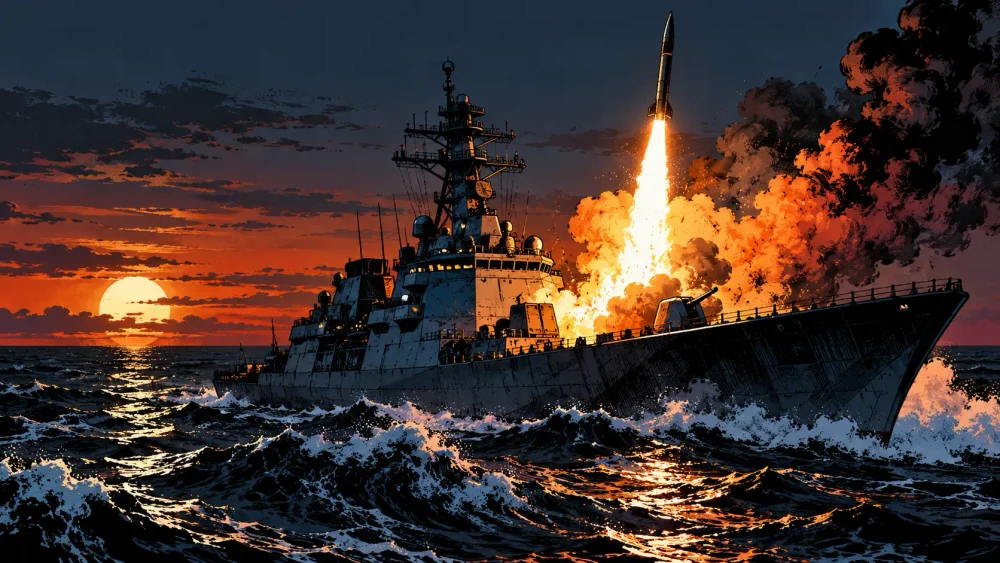
FIRE At 0452, a battery of Krabs—eight 155mm self-propelled howitzers, forty-kilometer range, kill radius measured in tens of meters—opened fire. Volley after volley landed exactly on target. Armored vehicles erupted into flames one by one. The infantry advancing from the forest dropped under machine-gun fire at a textbook rate. Captain Duda called in "hits confirmed," and he was correct every time.
The artillery barrage crept forward with the assault, volley by volley, toward the dune—just as trained, just as it had always worked. Following the initial corrections, the treeline where the push originated ceased to be a target. No one directed another salvo there, because nothing moved within it anymore.
One hundred and one units fell before reaching the midway point between the woods and the dune. Major Ostrowski watched the tactical display, observing an unbroken green line and red dots winking out one by one. Statistics indicated they were winning.
ELIMINATION Only then did the twenty signatures step out to the forest edge, into an area the artillery had already abandoned. The drone operator reported it in a single sentence, without emphasizing the data's weight, because at that moment he had no reason to believe it carried any: "Group at the treeline on the move, I repeat, on the move."
Someone muttered over the comms, "What the fuck is that?" No one had time to answer.
It took five seconds. Maybe six, before anyone could process what it meant.
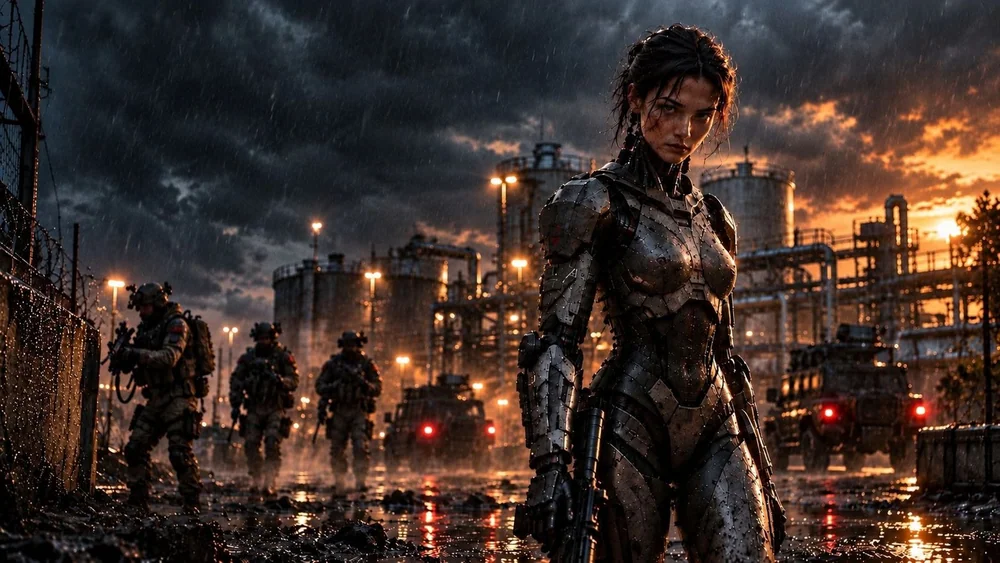
They weren't walking—they vanished from one spot and materialized in another, from a tree trunk to a terrain depression, from the depression to a truck wreck abandoned before the war. Every leap was shorter than a breath, every landing completely silent despite the mass.
Private Grabowski saw it clearest of all, purely because he was staring right at it when it ceased being motionless. A slender silhouette, too symmetrical for something wearing a uniform, with exposed mechanics on the neck and forearms—pristine, unused, devoid of scratches, as if fresh off the assembly line. Blue diodes along its nape flickered once during the initial leap, gone by the second.
Grabowski aimed, held his breath exactly as trained, and fired during its third jump—aiming for the flank, where something resembling ribs ought to be. A solid hit. He watched the figure jerk mid-air, saw something within it falter for a fraction of a second.
He thought: Got it.
It landed closer than it should have, had the wound meant anything to its trajectory. Grabowski only managed to rack the bolt before a hand clamped shut on his throat, mirroring the absolute certainty with which they closed on everyone else.
From every landing, before the frame fully arrested its momentum, a shot rang out—single, precise, sufficient. The distance between the woods and the primary trench line was one hundred and sixty meters. It dissolved in the time it took Captain Duda to issue a fresh firing correction—artillery now pummeling coordinates devoid of life.
Private Kowalczyk caught only a shadow sliding along the trench wall before a grip crushed his forearm, snapping bone before his body could collapse. The distance was too tight to shoulder a weapon—closer to the hand than the muzzle. His throat yielded no sound before the second strike.
Two positions down, Corporal Nowicki emptied a full magazine into a silhouette that had already vanished. Turning around was the last motion he ever completed. A single round, fired from a range where no one misses.
Bielak caught it in his peripheral vision: a motion too rapid to register as anything but a blur. He fired three bursts toward the space occupied a split-second prior. He noted a unit taking a hit mid-stride, dead-center in a jump between two pieces of cover—it landed precisely where its trajectory intended.
He had time for a single thought, untethered to fresh magazines or cover: Ania is brewing coffee alone today, using that same chipped mug he had promised to replace six months ago. The hand that locked onto his helmet did so with the conviction of having done it a thousand times before.
Three soldiers on the dune's right flank snapped their heads in the same direction, simultaneously, long before Wardas registered any noise from that bearing. Not a single word or gesture passed between them. The motion was identical, like a single mind duplicated three times.
Wardas survived forty seconds longer than the bulk of his platoon—long enough to witness the unit looming over young Kowalczyk's body vanish, reappearing a meter away at the next trench before blood could even soak into the sand. The entire defensive architecture, constructed meticulously since dawn, was engineered for an adversary moving at human speed. The one hundred and one hostiles erased by artillery and small arms proved the architecture functioned. The twenty that survived proved it meant absolutely nothing.
The sea wind kept howling after the final echoes died out. Salt continued to settle on what remained of the rifles. Sand—just as it had through thirty years of storms—smoothed over the tracks, indifferent to what had crossed it.
Twenty units stood perfectly still, facing the ocean from where the wind blew. For five seconds—maybe six—nothing happened. No sound, no movement, no transmission.
Then, simultaneously, as if answering an unvoiced command, they pivoted and headed back toward the forest. Maintaining the same steady jog they arrived with, they bypassed the objects that, an hour prior, had been a company.
--- COMMAND LOG / SPIT SECTOR / 14.11.2041 --- Unit: 3rd Mechanized Company, reinforced Reconnaissance System: ZSR-9 "Horizon"—no prior incidents in operational history Engagement Phases: CONTACT 04:41 / RECONNAISSANCE 04:41–04:52 / FIRE 04:52–05:07 / ELIMINATION 05:07+71s Enemy Strength: 121 (101 destroyed by conventional fire, 20 unidentified at time of contact) Initial Status: 94 Post-Engagement Status: 0 active / 94 classified as "evacuation resource" Fire Support: fully operational throughout the engagement, no loss of accuracy Intel: uninterrupted comms; one report not analyzed in real time (group on the move, 20 signatures, duration 5–6s before contact) Preliminary Conclusion: zero procedural errors by command. The system classified targets and corrected fire within threshold parameters. Status: forwarded for tactical analysis. Keep file open. --- END OF EXTRACT ---
--- AI SYNAPSE · WARFARE DIVISION · INTERNAL, DO NOT DISTRIBUTE --- Program: NB-14 (neuromotor interface, classification: experimental) Reference Event: Spit Sector, 14.11.2041 Recommendation: elevate budget priority from Tier 4 to Tier 1 Justification: per tactical annex Status: approved --- END OF EXTRACT ---
FROM THE SAME ERA
These are not ranked recommendations. It is simply another available piece from the same period of the world.
SEE THE FULL ARCHIVE →