DECISION THRESHOLD
“DECISION THRESHOLD”
Republic of Poland, UE territory
2026
1. Discrepancy
Warsaw, 1 Oczki Street. Tuesday, October 13, 2026, 07:20
The night’s rain had left dark stains on the pavement, yet to dry by seven in the morning. People walked with hands thrust deep into their pockets, collars pulled tight under their chins, passing one another without a word—just like any other October Tuesday. Cars idled at the curb in a double row; one blocked the exit from the courtyard at number three, earning a blast from a garbage truck’s horn.
The headquarters of the Military Counterintelligence Service blended seamlessly into its surroundings: glass, concrete, and a barrier raised by two men in tactical vests only after checking IDs. Up on the third floor, inside a windowless office facing the interior, Nikodem had spent the last two hours staring at a document that existed in three versions. Twenty-eight years old, in his third year of service, he possessed a habit his superior called paranoia, but which he considered basic operational hygiene: before anything moved up the chain, he tested if the conclusion could bear its own weight.
The file detailed Russian military activity near Kaliningrad and Belarus. Troop movement manifests, logistical data, multi-source assessments. Version three was the most polished: the intel cross-corroborated seamlessly, the conclusions formed a cohesive narrative, and the pages read like an airtight proof.
Which was exactly what bothered him.
Buried on page eleven lay a detail he had seen before. A supply battalion out of Kaliningrad was designated as the 134th, though the order of battle—which Nikodem knew virtually by heart—listed it as the 143rd. Two transposed digits. The adjacent sentence read: continuous resupply protocol initiated. He had found that identical phrasing, complete with the same numerical transposition, in a separate report routed to the division a week earlier through a different channel, from a different allied partner.
Pulling up the earlier drafts, he compared the revision timestamps. He traced the routing slip—who had read it, who had appended notes, who had signed off. Returning to the raw feed, he combed through it once more, page by page, pencil in hand.
No simple explanation emerged. A clerk rushing through the paperwork might have copy-pasted the error from one file to the next. A shared primary source might exist, entirely absent from the documentation. Or, worst-case scenario: someone had intentionally fabricated the illusion of independent corroboration. None of these possibilities constituted hard evidence yet, but Nikodem was experienced enough to know the third option was the most seductive simply because it tied up every loose end.
Highlighting the passages, he opened the feedback module. He typed out a brief comment, then deleted the final sentence. It sounded too definitive.
He started over:
Re-verification of source independence required. Current material does not preclude data duplication.
He read it once more. His cursor hovered over the submit button long enough for a door to click shut out in the corridor. Then, he hit send.
2. East
Warsaw, 1 Oczki Street. Wednesday and Thursday, October 14–15
Returning to the files the next day, Nikodem spent three hours doing nothing but tracing footnotes. Russian military buildup along the border remained an undeniable fact: heavy transports, rail deployments, shifted logistical footprints, satellite imagery that couldn’t lie. What it all meant, however, remained murky. The deployment might signal operational prep, political coercion, or a standard flex ahead of diplomatic talks. The hardware shifts showed what was happening. The objective remained entirely silent.
He made no attempt to divine the Kremlin’s calculus. Other people, paid better and sleeping worse, handled that. He only needed to establish one thing: the extent to which the prior assessment relied on genuinely independent intelligence.
In the first dossier, a supposedly verified data point referenced a memo, which in turn cited another analysis, pointing to yet another. Hitting the bottom of the chain, he found an unattributed origin point: an encrypted entry, lacking a verification timestamp, missing the signature of any officer who might have double-checked it. The audit trail showed zero evidence that anyone had ever bothered.
This still fell short of proving manipulation. But it was enough to cast doubt on how the intel had been weaponized.
He mapped the dependency matrix on an A3 sheet, color-coding with three different pens. Red for records leading back to the same unverified nexus. Green for those boasting genuine, isolated corroboration. Blue for the anomalies with untraceable origins. When finished, the schematic resembled a subway map where every line converged on a single terminal. It was a structure straight out of intelligence textbooks: Curveball—the lone Iraqi defector whose fabricated claims propped up the entire pre-war WMD narrative until the whole thing collapsed.
The desk phone rang at 15:40. It was a captain from the cell that had fed them the first report. The man spoke with frictionless courtesy, the tone of someone who always opens with small talk about the weather.
"Saw your flag in the system. I realize it’s protocol." The captain paused. "But your feedback form just bottlenecked the entire package, and command needs that package this week."
"The discrepancy bottlenecked it," Nikodem replied. "The flag merely documented it."
"So you’re saying our intel is garbage."
"I’m saying I can’t tell if two reports that landed on my desk as distinct sources aren't actually the same document. It’s not an accusation. It’s a question."
Dead air stretched over the line as the captain evidently weighed whether his response would end up on a transcript.
"I’ll pass that along," he finally said, cutting the connection.
Nikodem replaced the receiver. Staring at his tri-color matrix for a moment, he printed a clean version of the dependency tree and set it beside his keyboard. In the margin of one page, he scribbled a question:
Who benefits from making this intel look independent?
A moment later, he added a second line:
Assume nothing. Establish the facts first.
He snapped the notebook shut. Outside the window, the sky was already turning the color of bruised iron.
3. Ania
Thursday evening, October 15, and Saturday, October 17
Ania called at nine. He didn’t pick up until the second attempt.
"Look who’s alive," she said.
"Barely."
"Good. I’ve been trying to find out all day if you’re coming down this weekend."
His eyes drifted to the monitor. An unfinished document glowed on the screen, the color-coded matrix resting on the desk beside it.
"I’ll be there. Unless something shifts."
"Something can always shift."
He offered no reply.
"Nikodem?"
"Listening."
"I asked if I should count you in for dinner or not."
A faint smile cracked his expression.
"Count me in."
"Fine. Just don't call me at five on Saturday to say you can't make it."
"I'll try my best."
"That's exactly what I'm afraid of."
The conversation drifted. She talked about a friend changing jobs, weekend groceries. Nikodem listened, but she had to repeat her question twice.
"Are you even there?"
"I'm here."
"Then tell me what I just said."
He drew a blank.
Silence hung on the line, underscored by the faint clatter of her setting something down on a table.
"Right. We'll talk when you get here."
They had known each other since sophomore year of high school, ever since she lent him her chemistry notebook—the only place the subject was written clearly enough to decipher. Nikodem had been hopeless at chemistry, yet unparalleled in history and math. Ania still remembered how he would grind through equations late into the night before exams, only to end up tutoring the rest of the class, pointing out exactly where their logic had failed.
After graduation, their paths diverged for a few years. He studied history at the University of Warsaw, writing his thesis on Polish radio intelligence during the 1920 war—focusing on Jan Kowalewski, the man who cracked Soviet ciphers early enough for command to exploit them. His advisor noted that instead of asking who won, Nikodem always asked how anyone could have known. During his studies, someone had taken an interest, inviting him for an interview, and then another. Today, he held a position he vaguely described to his parents as "military administration."
Ania didn’t know the operational details. Over time, she had learned which questions not to ask over the phone, though she never stopped asking about everything else.
Saturday night found them sitting over a late dinner in her Białystok kitchen. She pushed a plate toward him.
"You don't have to tell me what you're working on," she said. "But lately, you aren't even listening."
"I've got a lot on my plate."
"I know."
"It's nothing to do with you."
She looked at him, then returned to her food.
"I never said it was."
He wanted to add something, but couldn't find words that didn't sound like another excuse. Shifting tactics, Ania asked if he remembered a high school classmate who had completely mangled his dates during finals, spending half the oral exam trying to convince the board he meant a different era entirely.
Nikodem snorted. For a few minutes, they fell back into their old rhythm, and for the first time in four days, the 134th Battalion vanished from his mind.
Then his encrypted duty phone rang.
4. The Feedback Loop
Warsaw, 1 Oczki Street. Wednesday, October 21, 08:05
He heard it in the elevator. An analyst from a lower floor was playing a morning news stream on speakerphone. The anchor’s voice cut through the static, immediately followed by a guest—a parliamentary defense committee MP speaking with the rapid, bulletproof cadence of a man accustomed to live mics.
"—and as we know, the Russians have already transitioned to a continuous resupply protocol, specifically in the sector holding the 134th supply battalion. This is not a drill. We cannot afford complacency."
The elevator halted on the third floor. Nikodem stepped out, making it halfway down the corridor before realizing he had frozen in place.
The exact same phrasing. The exact same unit designation, carrying the exact same transposed digits. A battalion that did not actually exist.
Dropping into his chair, he pulled the broadcast audio. He verified the transcript, then tore through the unclassified briefings that might have fed the politician’s talking points: committee memos, press releases, parliamentary briefing packets. He had no way of knowing where the MP sourced the intel, nor if the man grasped its dubious origins. The politician might have parroted it in good faith, having been handed it as gospel. Or he knew exactly what he was doing.
The fallout, however, was brutally visible. Classified data, previously quarantined within secure networks, had breached the public domain and was actively calcifying into verified fact. By noon, three major news portals quoted the MP’s soundbite, not the raw intelligence. By evening, fresh punditry would cite those articles. The ecosystem was auto-generating corroboration that corroborated absolutely nothing.
At 09:30, Nikodem stood in the doorway of the division chief’s office, holding a printed transcript and a two-page forensic breakdown of the intel’s origin. The chief—a lieutenant colonel with graying temples and a habit of peering over his reading glasses—read the entire file standing up.
"Who’s your suspect?"
"No one." The answer left Nikodem’s mouth faster than intended. "The MP might be acting in good faith. The scope is wider than a single report. We monitor military threats, the ABW handles domestic subversion, and Cyber Command tracks digital footprints, assuming there are any. Everyone is looking at a fractured picture."
"Which is why you’re avoiding writing that it’s the Russians."
"Because a politician repeating a data point on television doesn’t magically constitute independent confirmation. Until we have that, anyone citing this is signing their name to an unchecked phantom."
The chief removed his glasses, pinching the bridge of his nose.
"You know this reeks of their playbook."
"It looks exactly how they would want it to look. That’s what bothers me."
Silence stretched as the lieutenant colonel weighed the implications. Finally, he handed the file back.
"Append all this to the master file. In writing, paginated. And do me one favor: draft it so no one upstairs can ever claim we failed to warn them."
Returning to his desk, Nikodem opened the master document. He appended the dependency warnings, the public circulation blowback, and the inherent blind spots of all three agencies. Reaching the final paragraph, he paused over a sentence he had intended to delete.
This time, he left it in.
5. Margins of Certainty
Warsaw, 1 Oczki Street. Friday, October 23, 14:00
The second-floor briefing room featured drawn blinds and a twelve-person table currently occupied by four. The lieutenant colonel, Nikodem, a woman from the ABW whose name no one had spoken aloud, and the captain from the cell that supplied the initial report. The captain smiled politely.
The division chief scrutinized the dossier for a long time, tracing the flagged citations with his index finger.
"What can we state with absolute certainty?"
Nikodem had the answer chambered, but he let the room wait a beat.
"A segment of the intelligence previously deemed independent likely shares a single point of origin. In several instances, establishing the primary source proved impossible. This fundamentally degrades the reliability of the prior assessment."
"And the manipulation?"
"Possible. Unproven."
The lieutenant colonel set the file down.
"Russian forces are conducting military operations. We know that. What’s the takeaway?"
"This material cannot definitively answer that. We can’t rule out operational staging. Simultaneously, we cannot treat the current data set as sufficient proof of actionable intent."
"So we have compromised data, but no proof of deliberate distortion."
"Correct."
"And we don't know if this alters the actual threat assessment."
"It alters the certainty with which we can justify it."
The captain leaned across the table.
"Let me ask you point-blank. If all of this is real, and the threat is imminent, your report—choked with caveats—is going to tranquilize the people supposed to pull the trigger. You're turning a confirmed threat into an academic hypothesis."
Nikodem measured his words before firing back, doing so with such glacial precision that the ABW operative glanced up from her notes.
"There are two types of failure," he stated. "If we underestimate a genuine threat, the cost is exponentially higher than a few days of redundant combat readiness. But if we overestimate it—and someone engineered that illusion—we execute exactly the maneuver they wanted. In both scenarios, survival dictates knowing exactly where we stand. I am simply pointing out the ground that isn't there."
The captain had no counter. The woman from the ABW made a single, terse entry in her notebook.
Gathering the files, the lieutenant colonel stood.
"Draft an executive summary for command. Strip out the speculation regarding the source of the manipulation. Isolate the verified intel from the unverified anomalies." He paused at the door, lowering his voice. "And do not dilute the operational conclusions just because the telemetry is flawed. If the threat remains viable, state it without flinching."
Back at his workstation, Nikodem purged several lines from the draft that strayed into conjecture. He retained the discrepancy breakdown, the inventory of flagged data, and the cascading impact on situational awareness. In a separate annex, he outlined countermeasures actionable regardless of whether the source of the anomaly was ever identified.
In the "Perpetrator" field, he entered nothing. In the "Nature of Incident" field, he refused to classify it as a mere technical glitch.
He routed the package up the chain at 18:52. The system acknowledged receipt with a single, automated line. No signature.
6. The Report
Warsaw, Chancellery of the Prime Minister. Monday, October 26
The brief ran four pages, accompanied by a single data matrix. It reached the Prime Minister’s Chancellery on Monday morning, carried by a cleared courier in a red-striped secure pouch.
The findings offered no grounds to declare an attack on Poland imminent. Conversely, they offered zero cover to dismiss the threat. The document demanded a reassessment of specific intelligence streams, extreme discipline in public messaging, and the maintenance of high-readiness postures. Hardening critical infrastructure, executing allied consultations, and auditing sources required no absolute certainty of enemy intent. They required risk assessment and proportional kinetic response.
The dossier left crucial questions unanswered. It named no culprit for the data mirroring. It reached no verdict on whether the apparatus had suffered a hostile psy-op, an internal routing failure, or a toxic combination of both. The report did not close the loop. It merely altered the gravitational rules under which the next decisions would be made.
Nikodem learned the file had been pushed up the chain only through a stray comment in the hallway, dropped by someone completely unaware they were speaking to its author. He remained blind to the high-level executive debates, ignorant of which recommendations would survive contact with political reality.
He stuck to his lane. In the following weeks, he audited fresh intercepts, fielded inquiries from the captain—who had suddenly adopted a tone of immaculate email courtesy—and updated the matrix as new telemetry trickled in. Some anomalies were resolved. Others remained glaring black holes: the phantom 134th vanished from the ecosystem as seamlessly as it had spawned, and no entity ever claimed credit for its insertion.
No smoking gun emerged to fuse the disparate discrepancies into a unified theory.
7. Six Months Later
Białystok, Jurowiecka Mall. Saturday, April 17, 2027, 16:10
He had been staring into the jeweler’s display case for twenty minutes, having finally accepted that choosing between the final two rings was not an analytical problem.
The clerk had pulled both for him. One was understated; the other featured a stone significantly larger than he had anticipated.
"The first one," he finally said.
"Are you certain?"
He gave it a final look.
"No. But the second one isn't her style at all."
Smiling, the clerk boxed the ring. Nikodem paid, sliding the receipt into his wallet and burying the velvet box deep inside his jacket’s inner pocket. For a moment, he rehearsed what he would say. They had known each other far too long to require a speech.
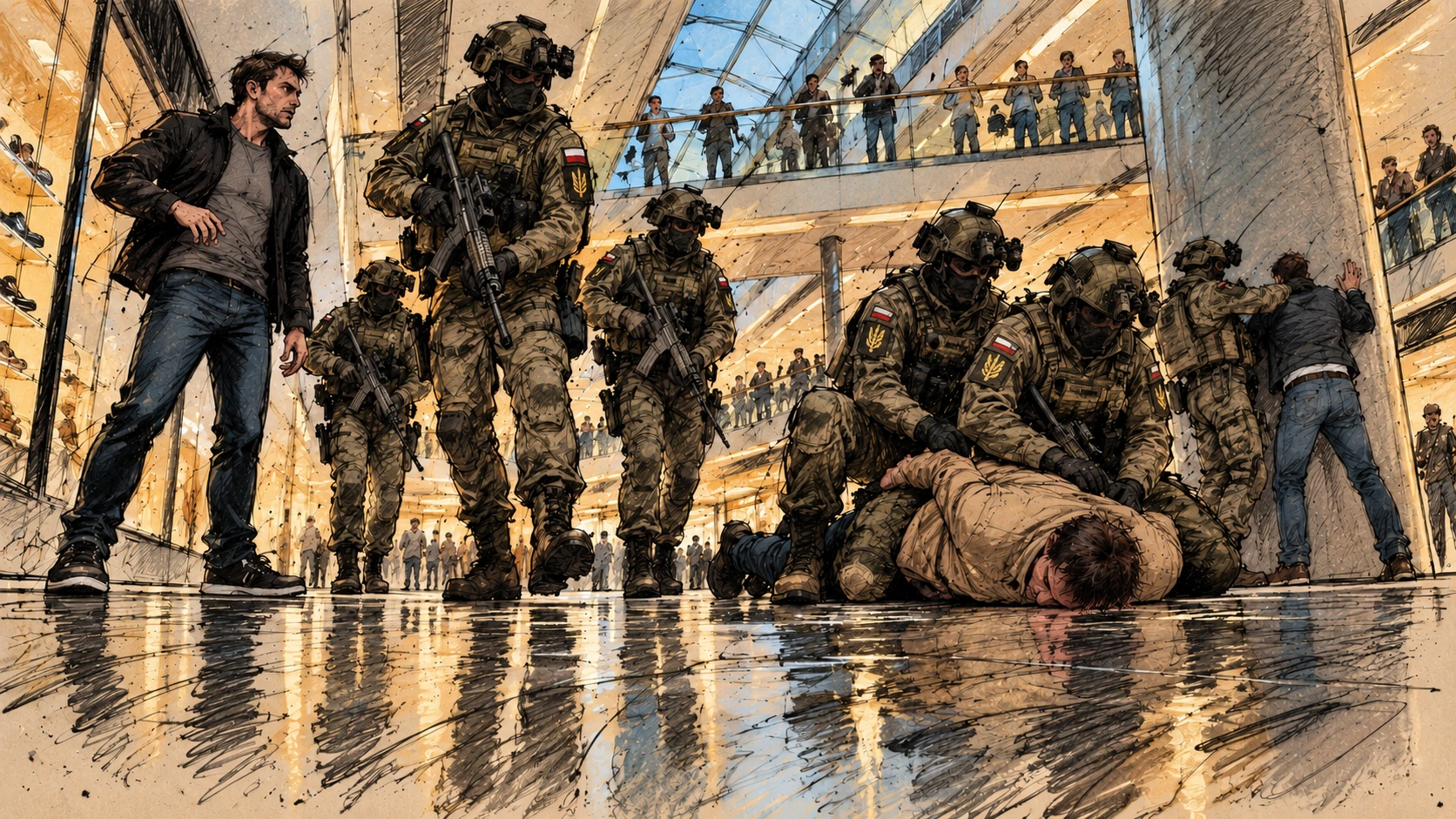
Exiting the mall, he clocked a man idling by a shoe store display. When Nikodem adjusted his trajectory, the man mirrored the shift—too fluidly to be a coincidence, too casually to read as overt aggression. A few meters down the concourse stood a second man, phone in hand, staring at the screen in a way no one actually reading a screen ever does. A third materialized near the concourse junction.
Nikodem bled off his speed. Instincts drilled into him over three years of service forced him to count the exits. He knew surveillance tradecraft: a clean tail meant the target never spotted a single watcher, yet here he was, looking at three simultaneously. He shouldn’t be seeing them. Not unless someone wanted to be seen.
The man by the window moved to intercept.
"Mr. Podolski. We need to talk."
Nikodem never got the chance to reply.
"Hold it, Police! Hit the deck!"
Six operators swarmed from the main entrance and a utility corridor, flanking them in teams of three. They moved with predatory speed, not quite running. Balaclavas, bump helmets with night-vision shrouds, plate carriers, tactical gloves. Earpieces wired into collars, throat mics flush against skin. Suppressed Grot assault rifles held at low ready, trigger fingers indexed safely on the receivers.
Police. Except police didn’t run operations in full tactical multicam.
Nikodem locked onto the shoulder patch of the nearest operator. Beneath a muted white-and-red flag sat an emblem: a sword entwined with an olive branch. He knew the insignias of every unit his division liaised with, and dozens they didn't. He had never seen this patch in his life.
The first watcher—the one who had used his name—stepped back, sliding his right hand under his jacket. He never finished the draw. The closest operator rolled his rifle and drove the stock into the man’s temple in a short, brutal arc. The watcher crumpled to the tiles before his jaw could unhinge. Two operators drove knees into his spine; a third wrenched the hidden arm free, pinned both wrists behind his back, and cinched flex-cuffs tight. Something small and matte black vanished into an operator’s glove before Nikodem could identify the caliber.
The second watcher was violently dragged away from the junction. The third tried to backpedal but got walled up against a concrete pillar before his third step. Scanning the tightening perimeter of masked faces, he muttered quietly in Russian: "Suka, blyad."
The operator at the pillar didn't flinch, simply driving the man's skull harder into the concrete.
The entire takedown took fifteen seconds. Nikodem didn’t know what the first man had been reaching for. The operators hadn't known either, and they hadn't stuck around to find out.
"Three targets secured," someone whispered into a mic. "Sector clear."
Screams echoed across the concourse. A shopper dropped a grocery bag. Phones whipped out to record.
Nikodem stood frozen, his hand resting near his jacket pocket.
"With me," one of the operators commanded, his voice muffled through the balaclava.
"Where?"
"Now."
No explanations were offered. They escorted him out through a service exit, loaded him into an unmarked SUV, and extracted him to a secured, windowless safehouse. Only then, as the heavy door slammed shut and the deadbolts threw, was he allowed to ask a question.
"Who issued the order?"
The operator let the silence drag a fraction longer than necessary.
"Your superior did not issue this order."
Nikodem held his gaze for a long beat.
"Then who did?"
"I do not possess information I am cleared to share with you."
No one had patted him down. No one had confiscated his encrypted phone—a lapse in protocol that suddenly screamed for attention. The device buzzed against his leg. Pulling it out, he read a text from Ania:
Don't forget about tonight. Love you.
He pocketed the phone. The ring box remained secured inside his jacket.
Three hostile assets had been neutralized, yet he had no idea who they were or what they wanted. He possessed no confirmation of their handler, nor the identity of the ghost commander who had greenlit the tactical intervention.
Someone knew exactly where he would be. Someone else decided he needed to be forcefully removed from the board.
He sat down on a steel chair. For the first time in months, there was no dossier to dissect, no raw data feed to audit. All that was left was to wait for the man capable of explaining the new rules of engagement.
8. Beijing
Beijing, Fuxing Road. Monday, October 19, 2026, 20:10 Local Time
Evening air over Fuxing hung cool and arid. Through a faint layer of urban smog, headlights bled across the sprawling artery, while wind dragged dead leaves along the pavement as if sweeping with deliberate apathy. Monumental government complexes cast monolithic shadows over their plazas. The Bayi building loomed above the street, massive and utterly inert.
High up on an executive floor, a dossier rested on a desk. The cover bore a title in crimson Hanzi: Russia — Poland / EU.
A man in a bespoke dark suit, stripped of any rank or identification badge, opened the file and began to read. He took no notes. He never flipped back to reread a page. When finished, he closed the binder and realigned it exactly where he had found it.
He walked to the reinforced glass and stared out at the sprawling grid of the city.
Behind him, spanning the entire wall, hung a massive map of the Asian Federation—a geopolitical designation yet to appear in a single Western intelligence brief. It swallowed China, Russia, Central Asia, and the Eastern/Southeastern rim. Overlaid across the continents were strategic logistical corridors and zones essential to Chinese hegemony. Borders and disputed territories were demarcated by lines so fine they bled into a single borderless expanse from a distance.
Russia was painted red.
Turning away from the skyline, the man reached for a smartphone resting beside a cup of tea that had gone cold hours ago. On the rear casing, visible only when it caught the light at a precise angle, ran a subtle laser engraving:
Shenzhen Robotics.
He punched in a number and raised the device to his ear.
"We begin."
#LogikaRzezni #CGProtocol #MilitarySF
FROM THE SAME ERA
These are not ranked recommendations. It is simply another available piece from the same period of the world.
SEE THE FULL ARCHIVE →