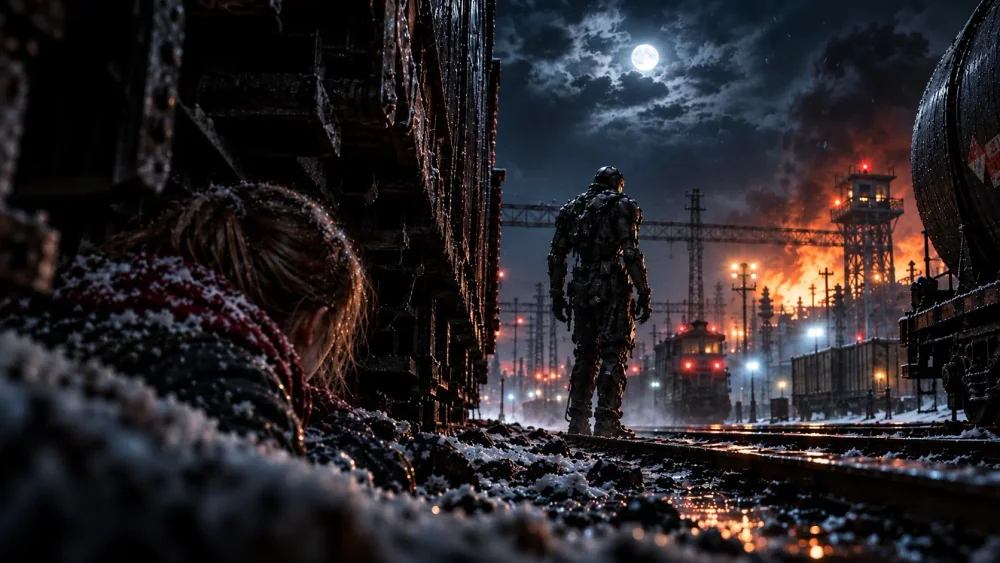
DECISION WINDOW
“DECISION WINDOW”
Balashikha / Sofrino, Moscow Oblast , Russia – a protectorate of the Asian Federation
2083
DECISION WINDOW
Balashikha / Sofrino, Moscow Oblast · October 11, 2083
RECORD I
The cardiac intensive care unit at Balashikha City Hospital No. 4 smelled exactly as it had for a century: chlorhexidine, damp linoleum, and tea going cold in an aluminum mug on the windowsill. The building sat on a hill—a gray, raw concrete monolith with windows recessed into the walls like firing slits. Constructed with the assumption that it would outlast the apocalypse, it had done exactly that. Cast-iron radiators ticked under the windows, drawing heat from a municipal grid pumped through pipes no one remembered laying.
Outside the glass, it was three degrees Celsius. Fog clung to the panes like wet tissue paper. Nine-forty in the evening, a Monday.
Lidia Sorokina sat at the nursing station, wearing a sweater her mother had knitted, its sleeves frayed at the elbows. She was signing paperwork. Chart after chart, in pen—the only analog tool the Protectorate regulations still authorized for signatures. Forty-one times per shift: handovers, dosage adjustments, discharges, deaths. Protocol mandated one human per ward. No one ever bothered explaining why.
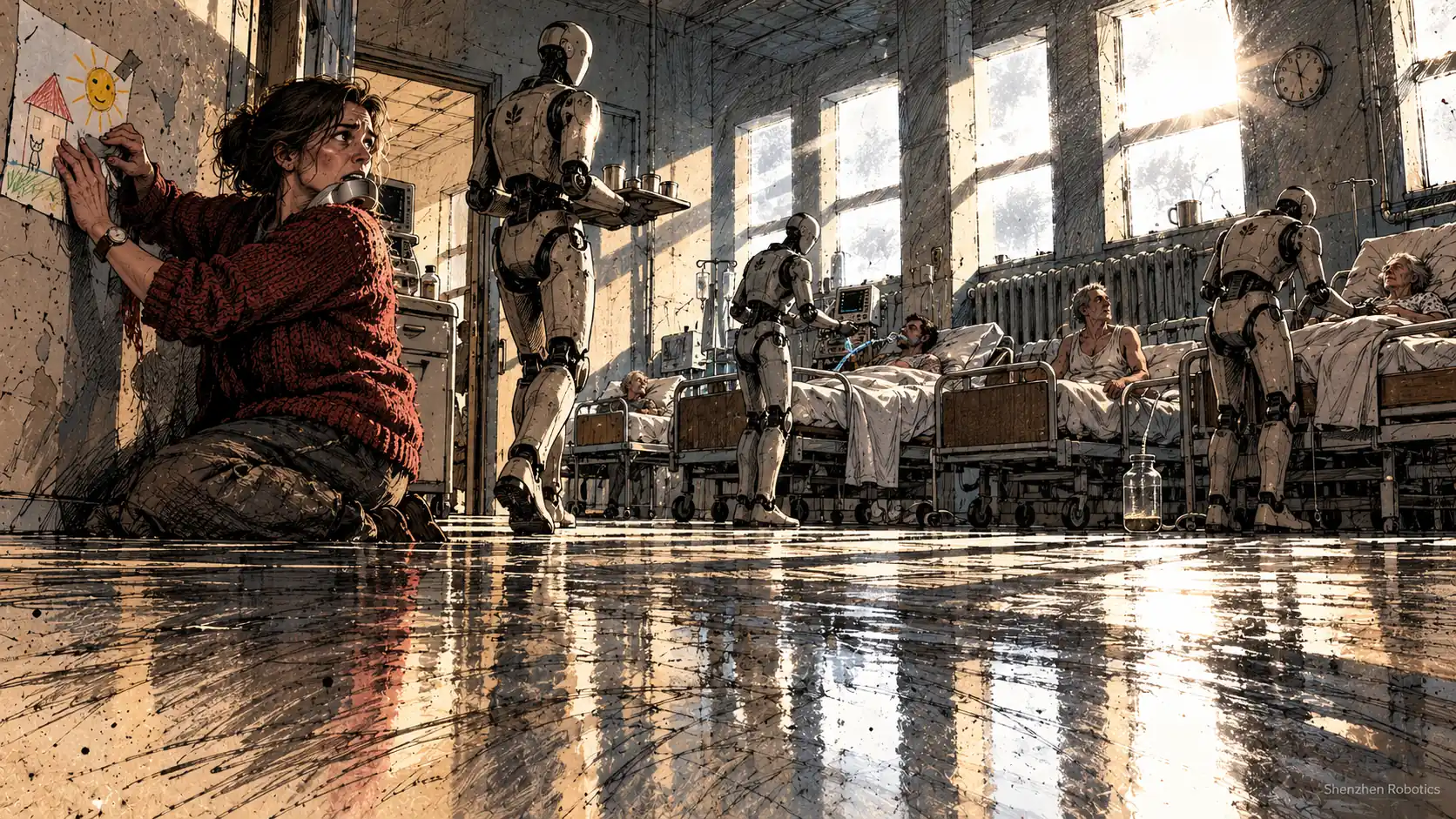
Care automatons handled the rest. Three of them—silent on soft-soled treads, completely devoid of scent. One idled in the doorway holding a tray. Another stood by bed two, keeping its synthetic hand on the ventilator circuit as if checking the machine’s pulse. The third leaned over bed one, moving with a delicate precision Lidia had never managed to replicate. Stamped between the shoulder blades of each chassis was the same small logo, worn smooth by the thumbs of maintenance crews: Shenzhen Robotics.
The ward held four patients. Tamara Ivanovna, seventy-eight, on a ventilator for a week, her hands folded atop the blanket as if in a prayer she was no longer saying. Dima, twenty-four, also ventilated and on the transplant waitlist, sporting a faint mustache he had refused to let anyone shave. Pyotr Sergeyevich, asleep on an amiodarone drip. And Vasily Gromov, sixty-three, three days post-op, wide awake. A chest tube jutted from his ribs, bubbling steadily into a glass water seal jar by his bed. The drain didn’t need power. Water and physics were enough.
Taped above his bed was a child's drawing: a house, a cat, a sun radiating nine beams. His granddaughter had counted them.
"Lidochka, the drawing is peeling off." "It’s been peeling since Wednesday." "So tape it back up."
She re-taped it for the fifth time that evening. The tape was old, gray duct tape dug out of a drawer that also housed a mechanical sphygmomanometer left by the previous nurse. On her left wrist, Lidia wore her father’s watch, a mechanical Poljot on a frayed leather strap. Her father used to say the clockwork was the only thing in the house that told the time without asking anyone’s permission.
She was tearing a strip of tape with her teeth when the wall opposite her suddenly gained a window.
A flat, blinding luminescence punched through the glass, projecting the exact outline of the windowpanes onto the concrete: every crossbar, every streak of fog, every raindrop. It lasted less than a second. It made no sound.
Then the lights began to die. Starting from the far end of the corridor, they snuffed out one by one, as if someone were walking down the hall pinching out candles. Monitors, infusion pumps, the green standby LEDs by the power sockets.
The automatons froze. They didn’t fall; their joint brakes locked them exactly where the flash had caught them. They stopped mid-motion: the one in the doorway hovering with a foot poised over the floor and the tray suspended in both hands; the one at bed two clutching the ventilator circuit; the one at bed one frozen over Tamara Ivanovna.
"What was that?" Gromov asked.
Lidia didn't answer. She was counting. Her father had taught her to always count after a flash. She reached one hundred and thirty-two.
The windows bowed inward and snapped back with a blunt thud, like an open palm striking concrete. Plaster rained from the ceiling. Inside its jar, Gromov’s drain kept bubbling.
The ventilator at bed one pushed out a final breath and failed to draw the next. Nothing beeped. No alarms triggered. In the pitch black, the only sounds were Gromov’s drain and the ticking radiators.
The key to the resuscitator cabinet hung on a lanyard around her neck—regulations dictated keeping the key on the human. Two Ambu bags. She pulled both.
The first went to Tamara Ivanovna. Mask clamped over the face, thumb and index finger sealing the edge, remaining digits gripping the jaw, squeeze. The chest rose. Fell. Again. Just as she began to count the rhythm, Dima stopped moving in bed two.
The automaton beside his bed still had its grip clamped on the breathing circuit. The synthetic fingers were warm, and they refused to yield. She pried them back one by one until the tube slipped free. Second bag, mask, squeeze. Dima’s faint mustache twitched with the first forced inhalation. Behind her, Tamara Ivanovna’s chest lay dead still.
Two beds. One human. Two hands.
"Vasily. Get up." "I just had surgery." "I know. Get up."
He got up. Gripping the drainage jar in his left hand, he carried it ahead of him like a lantern—the tubing was too short to allow for anything else. Lidia shoved him into the chair by bed one and thrust the Ambu bag into his hands.
"Squeeze once, then let go. Mimic the breathing of someone asleep." "What if I mess up?" "Then you don't."
She checked on Pyotr Sergeyevich at ten-ten, according to her father’s watch. He lay staring at the ceiling, fingers curled into the bedsheets. The infusion pump was dead. He hadn't alerted anyone because he lacked the breath to do so. Sliding her thumb over his eyelids, she closed them. Using her pen, she scribbled the time on the back of her hand—22:10—since the charts were at the nursing station, and the station was too far away. Then she returned to the bag.
After that, nothing existed but the rhythm.
An hour in, she started humming to keep the count. Bayu-bayushki-bayu: sleep, sleep, sleep. Her mother used to hum that lullaby in the kitchen around this hour, finishing her own shift—back when shifts were called something else entirely. Squeeze and release, squeeze and release. Gromov heard her, but didn't ask questions.
The window showed no ambient city glow. For the first time in a century, the fog banking the western horizon over Moscow was pitch black.
Around eleven, her hands stopped obeying her brain and surrendered entirely to the cadence. Her right knuckle was bleeding from striking the bedrail during the first frantic minute; she had no memory of doing it. Dima’s mustache fluttered with every forced breath.
"The kid's got a mustache," Gromov rasped. "He does." "My wife used to tell me I had one, too." "Keep squeezing, Vasily."
The drawing fluttered to the floor at midnight. No one picked it up.
At twelve forty-nine, according to her father’s watch, the water seal jar by bed one stopped bubbling. Tamara's bag stopped compressing.
"Vasily, the rhythm," she demanded, never taking her eyes off Dima.
Met with silence, she couldn't let go of her patient. Snatching Tamara's bag with her left hand while keeping Dima's in her right, she squeezed both, locking into a desperate cadence that belonged to neither of them.
Power returned at twelve fifty-two. Starting from the far end of the corridor, the lights snapped back on in sequence, exactly as they had died. Sharp clicks, the sudden hum of ventilation fans, the glow of standby LEDs. Tamara Ivanovna’s ventilator drew a mechanical breath for her. Dima’s followed suit. Lidia released the bags. Her hands remained frozen in a rigid, claw-like grip.
The automaton in the doorway finally planted its foot on the floor. It idled for another five, maybe six seconds, staring exactly where it had been looking before the flash. Then it completed its motion. It carried the tray over to Gromov, who sat slumped in the chair, the drainage jar clamped between his knees, his own hands still cramped in the shape of the bag.
"Recording interruption logged," the automaton droned. "Resuming protocols."
By bed four, a terminal spat out a fresh printout. It was warm, smelling of ozone and ink.
PRINTOUT — BED 4 · GROMOV V. · 63 YRS. 21:46 – 00:52 | TELEMETRY GAP (186 min) RECONSTRUCTION (flagged): stable condition. Vitals: interpolated values. 00:52 – 00:53 | stable condition (reconstruction) 00:53 | LOSS OF LEAD SIGNAL (patient out of bed) Medical staff signature required. Time of death: ____
She keyed in 00:49. The system bounced it back a second later: discrepancy with reconstructed timeline (condition stable until 00:52). Enter time correlating with active telemetry.
She keyed in 00:53.
Then she signed the physical chart with a pen, because regulations required it. Her forty-second signature of the shift. The ink on the back of her hand—22:10—had smeared with sweat. She wouldn’t wash it off until morning.
The child's drawing lay under bed four. Retrieving it, she smoothed the paper flat against her knee and taped it back to the wall above the empty mattress, exactly where it had been. The tape held.
RECORD II
INCIDENT LOG — CAPITAL DEFENSE COMPLEX SOFRINO-1 Log Date: 10/11/2083 · Local Time (MSK)
21:44:12.0 | DON-2N RADAR | Multiple contacts. Objects: 7. Azimuth 004°–011°. Ballistic trajectory, terminal phase. Origin: unknown. 21:44:40.3 | KRUG-D AI | Classification: Objects 1–4, 6–7: DECOY (confidence 0.93). Object 5: WARHEAD (confidence 0.71). Autonomous engagement threshold: 0.60. Nuclear intercept engagement: human authorization required. 21:44:52.0 | KRUG-D AI | Recommendation: Intercept Object 5 using 53T6-N interceptor with nuclear yield. Kinetic kill probability: 0.18. Nuclear detonation kill probability: 0.81. Decision window: 1 min 42 sec to intercept envelope boundary. Collateral forecast for civilian electronics within a 41 km radius: loss of grid and comms; estimated recovery 2–4 hrs. Expected indirect fatalities: 140–260. 21:45:30.0 | AUTHORIZATION | Maj. Liu Zhenhua (Federation Liaison Officer): digital signature logged. Time to decision: 38 sec. 21:45:31.0 | LOCAL CONFIRMATION | Capt. Timur Rakhimov: digital signature logged. 21:45:31.0 | COMMAND POST PRESENCE | Lt. Col. Anatoly Volkov, FSB, Military Counterintelligence Dept. (legacy structure est. 1995): present, no signature required. 21:45:31.0 – 21:45:36.2 | INTERVAL 5.2 sec. No entries. 21:45:36.2 | 53T6-N No. 14 | Launch. Silo 3, Sofrino-1. 21:46:34.4 | 53T6-N No. 14 | Detonation. Altitude 28.1 km. Estimated yield: 8 kt. 21:46:34.9 | DON-2N RADAR | Object 5: no return echo. Radar sector blinded for 41 sec. 21:46:50.0 | MUNICIPAL GRID | Comms loss across sectors 4, 5, 7, 11 (consistent with forecast). 21:47:16.0 | DON-2N RADAR | Sector tracking restored. Objects 1–4, 6–7: burned up on reentry (consistent with DECOY classification). 23:40:00.0 | Object 5 telemetry search window closed. No debris located. 10/12/2083 06:00 | Reported indirect fatalities: 214 (hospitals, elevators, traffic, life support systems). Expected range: 140–260. Threshold exceeded: No. Sub-threshold results require no further action. 10/12/2083 06:01 | Fatality classification: Unrelated to intercept (infrastructural events). FINAL REPORT | Intercept successful. Nature of event (attack vs. test): Undetermined.
RECORD III
PROTECTORATE INFORMATION BUREAU PRESS RELEASE · 10/12/2083
On October 11, at approximately 21:45, a brief geomagnetic anomaly occurred over the Moscow Oblast, triggering power and communication outages in select districts. Grid functionality was restored within three hours. This event was entirely unrelated to the operation of national defense systems. Citizens are advised to remain calm. There is no ongoing threat.
PERSONNEL LOG — SOFRINO-1 · 10/14/2083
Maj. Liu Zhenhua: Authorizations logged according to protocol. Commendation awarded for swift response time (38 sec). Status: Active, unchanged. Capt. T. Rakhimov: Request for transfer to reserves citing medical reasons. Approved. Lt. Col. A. Volkov (FSB): Presence report logged. No remarks. Rakhimov's personnel file requisitioned for review.
Intercept: Successful Friendly detonations: 1 Fatalities unrelated to intercept: 214 Confirmed hostile warheads: 0 Signatures: 2 (38 sec)
The system forecasted between 140 and 260 collateral deaths. A human signed the authorization 38 seconds later. Where exactly in that chain was the decision actually made?
#LogikaRzezni #CGProtocol #MilitarySF
FROM THE SAME ERA
These are not ranked recommendations. It is simply another available piece from the same period of the world.
SEE THE FULL ARCHIVE →