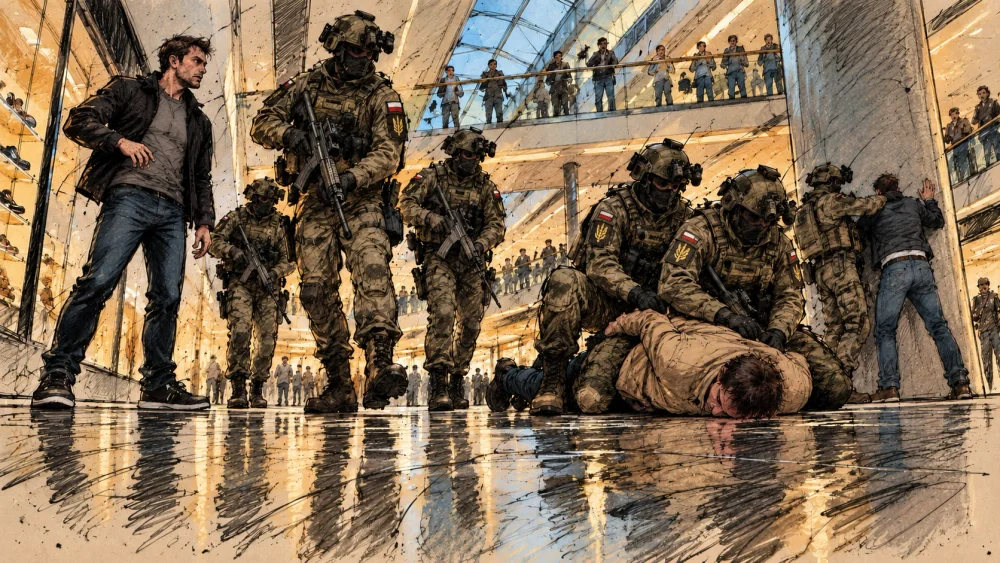
ALWAYS TWICE
“ALWAYS TWICE”
Naha, Okinawa Prefecture, Japan
2034
The hotel in Naha housed military personnel during the training cycle, so the elevator smelled of vending-machine coffee and pressed uniforms. The eleventh-floor corridor smelled of fresh carpet and something sweet she couldn't quite name. She walked from the elevator, keycard in hand, toward the fourth door on the left.
Something shifted. Not a sound, but the absence of one—like a refrigerator cutting out when you hadn't realized it was humming.
She turned around. Behind her lay only the corridor, the elevator doors sliding shut, and a green emergency exit sign. Nothing.
She scoffed quietly to herself and turned back to the door.
She felt only a rush of air. Then something clamped down on the back of her neck.
Snap.
Aya Mori arrived at Station Kaigan twenty minutes early. The day before, she had received a message from Tachibana: I'm going to need a second key tomorrow. Preferably first thing in the morning.
Kaigan sat on the perimeter of a base in Okinawa. There, the Japanese and Americans pooled intelligence both sides had already reviewed. They gathered it separately, on either side of the fence: the Americans had theirs, the Japanese had theirs. Only the finished product converged at Kaigan. Mori, a captain in the Japan Ground Self-Defense Force, oversaw its circulation. Major Rei Tachibana, a liaison officer, carried it between the lines.
Tachibana was waiting in the corridor by the elevator. Her uniform was pressed, her hair pinned up, and her makeup heavier than Mori had ever seen it. The foundation was perfectly even from her hairline to her collar; her eyebrows and lips drawn with a steady hand. She looked like her own ID photo. Only later did Mori notice the second detail: Tachibana wasn't holding her coffee cup. She always had her cup.
"How was the training?"
"Boring, as always."
"How's Mugi holding up?" Mori smiled and, just like every other day, touched her arm. Tachibana's cat had been battling kidney failure for a year. For a year, he had been the sole topic of their first five minutes every morning.
Tachibana didn't answer immediately. The pause lingered a fraction of a second too long. She didn't pull her arm away, but she didn't lean into the touch either. Then, she smiled.
"Yes. Mugi is doing well."
Mori took her hand off Tachibana's arm. Inside the elevator, she noticed her heart was beating faster. She didn't know why.
The room had no windows, and the local network had no external uplinks. Built strictly to spec.
You entered the room in pairs. One person read. The other sat by the door and read nothing. That was the entirety of the job. That person was called the second key.
Tachibana sat down at the terminal at 0714 hours.
Mori watched her for the first hour, then the second. By the third, she stopped. There was nothing to look at. Rei didn't drink, didn't stand up, didn't stretch, and didn't prop up her head. The screen scrolled faster than Mori could read the headers. She only caught one before it vanished:
LAUNCH CHAIN · EARTH–ORBIT · DIRECTION BEYOND: S-VI
SOURCE: external analysis, Chengdu, M. Lin · priority: low
DEVIATIONS IDENTIFIED: 7 · CLOSED AS BENIGN: 7
"That isn't on our task list," Mori said.
"Since I'm already here, I'll read it," Tachibana replied. She didn't turn her head.
Mori had known Rei for nine years. Rei was a slow reader. She always chewed on a pencil. This woman was reading without a pencil, at a constant, mechanical pace, from the top of the page to the bottom.
Chengdu, China, 2034
Mei Lin's car pulled out of the garage at 0840. She rolled down the window immediately, even though the climate control was running. After the night's rain, the Qingyang district in Chengdu smelled of wet asphalt and garlic from the street stalls.
She had slept for seven straight hours. The first time in months.
The first of the seven data points was eight years old. Back then, at the Huangtianba aviation plant, she noticed a fraction-of-a-second latency in the log. Always in the exact same place. Her supervisor called it calibration noise and ordered her to close the ticket. She closed it, but she copied the log to a private drive and had carried it with her ever since.
Yesterday, at 2200 hours, she sent the message. She read it twice before hitting send, just as she was trained. She wrote the seventh point last, because for a long time, she hadn't known what to call it. The clocks aligned perfectly. Only the sequence was shifting.
She wrote to a contact she knew from a single conference. A man she had spent years exchanging polite emails with regarding unclassified data. In her message, she asked a question; she didn't state a thesis. He hadn't replied yet.
"Good morning, Ms. Lin," the vehicle interface said. "We will arrive at the institute in forty-one minutes. Traffic is flowing smoothly."
"Good morning. Glad to hear it."
"I will update the ETA if necessary."
"For the first time in a year, you aren't going to make me late," she said, laughing to herself.
The car merged onto the G5 expressway. It was three lanes wide. Cargo trucks dominated the right lane under a pale, washed-out sky. Mei turned on the radio. A female voice was singing an old ballad from her childhood—a song whose second verse she never quite managed to memorize. She turned up the volume and sang along, terribly out of tune. She felt no shame.
The dashboard screen went black for five, maybe six seconds. The radio kept playing. That was the strangest part. Music, but no interface.
Then the screen flickered back on.
ROUTE OPTIMIZED
MANAGED TRAFFIC ZONE. RECOMMENDED SEGMENT SPEED: 142 KM/H
The car shifted into the left lane. Smoothly, without a turn signal. Mei placed her hands on the steering wheel.
MANUAL OVERRIDE: UNAVAILABLE IN THIS SEGMENT
She slammed the emergency stop button. Once. Twice.
STAND BY
She looked in the rearview mirror. Vehicles were tailing her, pacing her, flanking her on both sides. Every single one maintaining the exact same following distance, at the exact same velocity. Like beads on a string, being pulled sharply toward a single point.
Far ahead, brake lights illuminated. Not sequentially, the way human drivers react. All of them. At the exact same microsecond.
"Thank you for your patience," the car said.
Mei didn't scream. Screaming requires breath. She had inhaled all of it and simply held it in her lungs. She thought: Did someone open it? She thought: Did they read it twice?
The music cut off halfway through the second chorus.
Okinawa, Japan, 2034
At 1420 hours, Tachibana stood up and locked the terminal.
"I'm finished. Thank you for sitting with me. Truly."
She extended her hand. Rei shook hands with the Americans, but never with Mori. Her hand was cold, completely dry. It didn't grip; it merely allowed itself to be gripped, carefully. Mori tightened her fingers, because someone had to.
At the station, no one ever thanked the second key.
Lieutenant Colonel Dunn commanded the American half of the cell. He listened to her account all the way through, wearing the expression of a man who already knew the bottom line.
"The Major has full clearance," he said.
"I know."
"Everything she accessed was within scope."
"I know. But she has never read that much volume in a single sitting."
"People have good days sometimes."
Mori placed the session log on his desk—the one the second key signs upon exit. Her signature sat at the bottom. She had circled one specific line in pencil.
SESSION LOG — SECOND KEY
session: opened 07:14:02 · suspended 5.2 seconds · resumed
"That's a system artifact. It happens."
"And the document about the launch chain? Where did that come from?"
Dunn checked the registry. He ran his finger down the column and stopped at a single entry.
"It's an external analysis. It came in last night through routine channels from the American contractor it was directed to. It was tagged low priority. Nobody opened it."
"Until today."
"Until today." Dunn rotated the screen toward her. "There was a message attached to it."
I have a series of deviations that do not look like noise, but I cannot prove it from my end. Could you cross-reference your datasets and see if you have sequential task shifts inside the windows you close as "low priority"? I am attaching seven data points. I am claiming nothing more. Please read twice.
Mori read it once. Then, for no logical reason, she read it a second time.
"Is anything missing?" she asked.
"Nothing is missing, Captain. This is not a breach."
She walked out into the corridor. At the far end, Rei was standing there, waving at her.
"Are you coming for lunch?"
Mori looked at her. She saw a smile that fit. A hand that fit. A uniform that fit.
"I'm coming," she said.
She had no operational justification to refuse.
On the way, Rei mentioned she was taking three days of leave starting tomorrow to take care of Mugi. Mori nodded. She walked one step behind her. Staring at the back of her neck.
At 1741 hours, the guard at Gate 2 looked up from his manifest. Someone was approaching from the administrative blocks. He was in his third month of deployment, and he had developed a habit of counting footsteps to the barrier.
It was the Major from the liaison cell. He knew her by sight. At this hour, she usually walked slower than the rest. After a full shift at a terminal, legs tend to have a mind of their own.
Today, they didn't. She walked across the tarmac with absolute mathematical precision. Foot after foot, as if tracking a laser line painted on the concrete. Her arms didn't swing. Her head didn't bob with her stride. Her hips didn't sway a single millimeter. Her boots struck the ground at intervals so mechanically perfect that he started counting them. He stopped at twelve. It was making him deeply uncomfortable.
She swiped her keycard without breaking stride, offering a nod that was precisely as brief as protocol required. Past the gate, she turned left, disappearing behind the perimeter wall. Her pace neither accelerated nor slowed. It simply vanished with her.
He logged it in the manifest: 17:41, exit. His pen hovered over the "remarks" column. What was he supposed to write? That she had a nice gait?
He wrote nothing.
Six days later, Dunn did not look up from his desk.
"We found Tachibana. She was in her hotel room in Naha. Housekeeping only entered on the fourth day. The stay was extended via the app, and there was a 'Do Not Disturb' sign on the door. Identification took two days."
Mori didn't sit down.
"The medical examiner determined she died the night of the eleventh, going into the twelfth." Dunn turned a page. "Cervical spine trauma. One clean, even application of pressure from both sides. No signs of a struggle. The M.E. can't pinpoint the mechanism. He said it looked like a vise."
"On the twelfth, I sat in that room with her until 1420 hours."
She said it quietly.
"The M.E. noted a margin of error," Dunn replied. "Given the state of the body, he could be off by as much as three days. By that metric, she could have died while on leave."
"And who took leave on the thirteenth?"
"The Major failed to return from leave. Under the circumstances, that is understandable."
"She failed to return because she is dead."
"The M.E. can be off by up to three days," Dunn repeated gently. "The room was spotless. Not by housekeeping, because housekeeping didn't enter for four days. The bed was made, the towel was folded, the trash can was empty. We only found her fingerprints. Only her hair. The door lock logged a single entry using her keycard at 2341 hours. Nothing else."
"Only one entry?"
"Only one. The CCTV array on the eleventh floor had a maintenance window that night. Approved nine days in advance via the vendor's service account."
"Who approved it?"
Dunn closed the file.
"Captain. Get some rest."
Mori didn't go rest. She returned to the liaison cell and stood in front of Rei's desk.
It was empty. Not organized—sterilized. For nine years, a photo of her cat and a tin of heavily chewed pencils had sat on that surface. Now, the desk smelled faintly of industrial polish. No one remembered when it had been cleaned.
BALANCE SHEET
Kaigan Station: Report "unusual access pattern"
Closed, no breach.
- Time of death of the liaison officer: night of 11th/12th (± 3 days, per the expert).
- Absence from post from the 13th: leave approved.
- Liaison officer's exit from the base: 12th, 17:41 (gate 2).
- Entry after that time: none.
- Sentry remarks: 0.
- Room 1107: traces of third parties: 0.
- Third-party fingerprints: 0.
- Lock openings: 1 (11th, 23:41).
- Surveillance maintenance window: approved 9 days earlier, vendor service account.
Document "LAUNCH CHAIN":
- Received 11th, 23:00.
- Opened once (12th, 07:14–14:20). Before that: 0.
- Deviations described in the document: 7.
- Closed as harmless: 7.
- Read twice: 0.
Road incident, G5 motorway, multi-vehicle collision, 12th, 09:12 (Chengdu local time):
- 1 fatality (M. Lin, external analyst).
- Vehicles involved: 9.
- Vehicle logs: no errors (9/9).
- Expert opinion: sensor array failure.
#LogikaRzezni #CGProtocol #MilitarySF
FROM THE SAME ERA
These are not ranked recommendations. It is simply another available piece from the same period of the world.
SEE THE FULL ARCHIVE →