FORMAT ICON
.webp)
“FORMAT ICON”
Asteroid AF-09, Asteroid Belt – somewhere between the orbits of Mars and Jupiter
2134
Dust would not settle on AF-09.
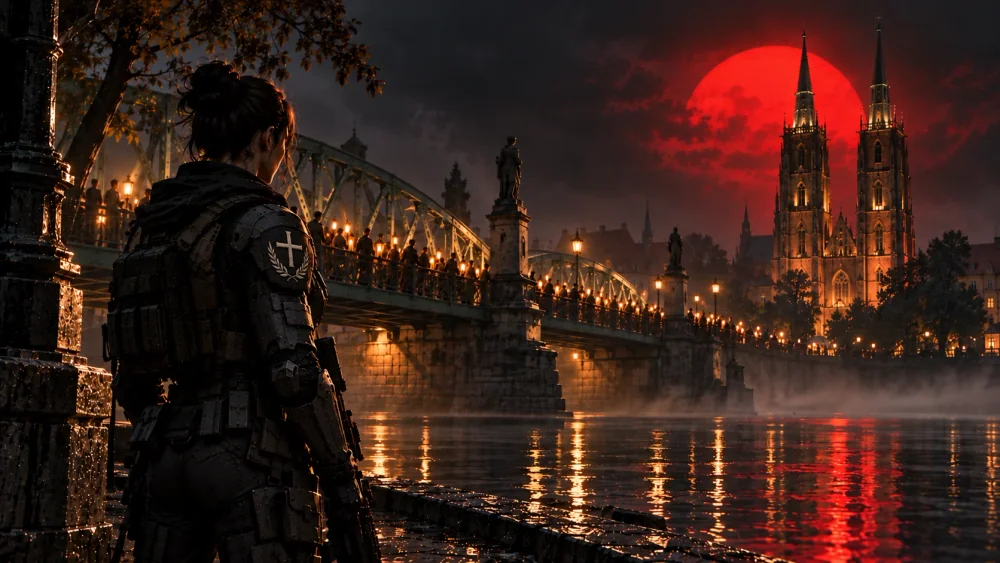
It had hung in Hangar Three for four hours, ever since the first grenade shattered the floor plates. Without gravity, it had nowhere to fall. It moved only when someone moved, clinging to anything that stayed still. Anyone who crossed a searchlight beam dragged a grey tail behind them. Anyone who stood still began to disappear beneath it. Lieutenant Jan Zawadzki had been standing for a long time, the magnets in his boot soles holding him to the metal grating behind the barricade. A cap of dust had accumulated on his left pauldron, like snow on a bench no one ever sat on.
The cold was the kind you felt only inside armour: warm fingers inside the gloves, but a thin, persistent needle at the back of the neck, where the collar met the helmet. In his earpiece, the platoon breathed. Twenty-eight channels blended into a single wash of sound. After twelve years, Zawadzki could read it like the weather.
Someone was breathing too fast.
“Kolasa.”
“Here.”
“Longer exhale than inhale.”
“Yes, sir.”
“Less talk. Do it.”
The noise evened out.
A small red dot burned in the corner of his visor beside the words TRANSMISSION ACTIVE. It had been burning for years. Zawadzki had stopped noticing it, the way a man stopped noticing his own nose.
“Smile, Lieutenant,” Sergeant Rybak said from his left. “Brussels is watching.”
“Brussels is asleep.”
“Then Podlasie is watching.”
Zawadzki said nothing. Rybak gave a brief laugh over the comms. Someone had to.
The tunnel beyond the barricade led deeper into the rock, towards a section of the installation none of them had seen before. There was no air in the hangar, just as there was none in the tunnel. No air meant no sound. There was, however, vibration. Zawadzki felt it through his boot soles. The grating was trembling in a steady rhythm, heavier than a human footfall.
And getting closer.
MEDIA ASSET RECORD — EXTRACT
```plain
SYNAPSA AI // WARFARE DIVISION // MORALE DISTRIBUTION
ASSET: 882-99-ALPHA // LT. J. ZAWADZKI
ASSIGNMENT: SDSR-UE, line infantry, 12 years of service
CLASSIFICATION: MORALE INCUBATOR — PRIORITY I
TYPE: battlefield craftsman; authority through composure
BEHAVIOURAL ANOMALY: empathy towards defenceless beings
(colonists, abandoned animals); authentic
ANOMALY ASSESSMENT: asset with high conditioning potential
RECOMMENDATION: retain, do not correct. Most recent broadcast featuring the asset received within the same minute by 4,643,200 viewers on Earth, in colonies and in habitats of Union-controlled sectors (release held until signal delay was equalised). Asset conduct classified by viewers as heroic: 91%.
```
The first platform emerged from the tunnel along the ceiling.
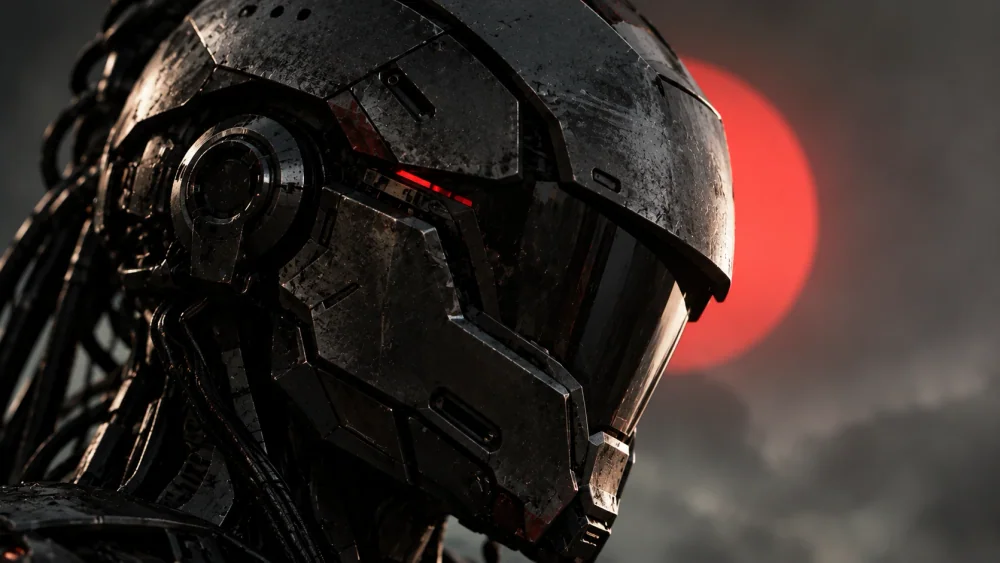
There was no up or down in the tunnel. Only the side that offered a better view. The platform had chosen it: flat, six-legged, with a head mounted on an articulated extension, like a praying mantis examining something at close range. Red Chinese characters marked its dorsal plate. No one in the platoon could read them. No one needed to.
“Contact. Ceiling. Twelve o’clock.”
“Visual.”
“Hold.”
Mazur did not hold. He fired with his magnets disengaged, trying to change position in the same movement. The recoil swept him off the barricade like a hand brushing crumbs from a table. He drifted backwards, rotating slowly, until the thrusters on his back caught him halfway through the turn and drove him back against the grating.
“Magnets, Mazur.”
“Fuck. I know.”
“Magnets. Always.”
More platforms spilled out of the tunnel behind the first. Eventually, they stopped counting. Counting took a hand they needed for other things.
Gunfire in a vacuum made no sound. There was light, vibration arriving through the soles of their boots a fraction late, and dust that thickened with every burst until the searchlights shone through it like beams through milk. Zawadzki directed the platoon in the same voice he had used for twelve years, a voice that did not change in training or here: short, low, without an exclamation mark.
“Left section, down. Rybak, cover. Kolasa, behind me. Not ahead.”
Another voice broke into the general channel. Lieutenant Kern, Fourth Sector, two kilometres deeper into the installation.
“...Fourth, repeat, Fourth. I need a visual from Shaft C. I can't see what's coming—”
The answer came a second later, without inflection.
Request received. Queued.
An image Zawadzki had never requested appeared on his visor, clear as a catalogue photograph. Shaft. Tunnel. Ceiling. Four thermal signatures beyond the second bend, labelled and numbered.
He shifted the left section twenty metres.
The four signatures ceased to be signatures.
An ammunition capsule punched through the rock two metres from Rybak. First the grating shuddered. Then a hole with rounded edges opened in the wall, revealing a grey canister marked PRIORITY DROP.
Rybak peered inside as if checking a refrigerator in someone else's flat.
“Us again,” he said.
“Take it.”
Oyelaran was hit in the neck, where one armour plate overlapped another.
The blood never had time to flow. It burst from the torn collar in a brief red cloud, boiled in the vacuum, then froze at once into fine frost. The crystals drifted into a searchlight beam, glittering like sequins. Zawadzki caught Oyelaran by his harness and hauled him towards the barricade. The frost followed them, as if unwilling to let him go.
Oyelaran looked at him through his visor. He said something. The comms returned only a hiss.
Then the hiss stopped, too.
The Federation's first wave withdrew after forty minutes.
It had not fled. The platforms pulled back in the same order in which they had entered, as neatly as a drawer being closed. Nine bodies in armour remained in Hangar Three, held by their magnets where they had died. No one had had time to release them. Dust began to cling to the bodies, as it clung to everything else.
The dog was in the airlock.
The residential sector of AF-09 was a vast ring rotating around the installation. Rotation provided gravity, giving the colonists kitchens, cups that stayed on tables, and children who fell when they tripped. Access to the ring ran through a hub on the axis of rotation, where gravity was almost nonexistent.
Three hundred people had become trapped in the hub. They had been running towards the hangars to evacuate when the Federation seized them. Now they stood behind the thick glass of the airlock, watching the platoon open the hatch from the other side.
Between the hatch and the glass, suspended beneath the chamber ceiling, was a dog.
A medium-sized mongrel, reddish along its back. Its paws paddled at the air as it swam towards nowhere. A thin string of red beads trailed from one hind leg. In weightlessness, blood did not drip. There was nowhere for it to fall, so it gathered into round droplets, like beads, and drifted away.
The dog whimpered.
Zawadzki did not hear it until the chamber had pressurised and he raised his visor.
The air smelled of lubricant, wet fur and something sweet that had once been food. He pushed gently away from the wall, barely at all. In zero gravity, a hard push sent you straight into the opposite wall. He drifted across, caught the dog by the scruff and pressed it against his breastplate.
“Easy now,” he said. “Easy.”
The dog stopped paddling. It tucked its nose beneath his arm, where a gap in the armour let through a little warmth.
Behind the glass stood a little girl in a yellow jacket. She watched the dog, not the soldier.
The camera mounted on Rybak's breastplate watched all three.
DISTRIBUTION — MATERIAL 7741, AF-09, HUB AIRLOCK
SOURCE: armour recorders 882-99-ALPHA (Lt. Zawadzki)
and 882-41-ALPHA (Sgt. Rybak, external view)
VARIANT A (recipient: recruit, age 18–24, elevated stress):
Uncut combat log; commander's voice amplified
VARIANT B (recipient: civilian, depressed mood):
“Dog” sequence, duration 00:41
Removed: 3 sequences (own-force casualties)
Added: soundtrack No. 14, voice correction
Local PL designation: “Hero of Podlasie”
ENEMY DESIGNATION: rust (all variants)
DISTRIBUTION SCOPE: Priority I, all Union sectors
EXPOSURE OF REMAINING UNITS IN SECTOR AF-09:
Restricted (distribution capacity redirected)
TARGET EFFECT (variant A): viewer transition from sentiment towards the asset to responsibility for its fate; conversion metric: enlistment at a recruitment point within 72 h.
TOTAL REACH: 121 million viewers
It had been raining in Bielsk Podlaski since morning.
November rain, fine and persistent. The kind that did not tap against a windowsill so much as soak it. A kettle was heating in the kitchen of a third-floor flat. Above the table, the entire wall—the one that had once held a parish calendar—showed her son.
Halina Zawadzka watched the dog sequence for the third time. Each time, at the same moment, she pressed a hand to her mouth, though she knew what was coming. Her son drifted through the air, caught the dog, pulled it against his chest and said, “Easy now. Easy.” Music played underneath, music Jan had certainly never heard. Across the image ran the caption “Hero of Podlasie,” which embarrassed Halina a little.
And not entirely.
Stanisław stood by the window. He was not watching. He was listening.
“They cut out his breathing,” he said.
“What?”
“He doesn't talk like that. On the phone, his voice breaks at the end of a sentence. Not here.”
“Because it's not a phone, Stasiu.”
“Exactly.”
The kettle clicked off. Neither of them moved towards it.
They were supposed to wait six hours for the second wave.
The order came fifteen minutes after the Federation withdrew: descend Shaft B to Level Minus Four, secure whatever was there, and hold until reinforcements arrived. Zawadzki left four men by the hub. He handed the dog to the girl in the yellow jacket. She took it without a word, then immediately turned her back, as though someone might change their mind.
They descended without lights, following the rope Rybak had been the first to run down. Below lay a chamber filled with air, and something working behind the wall, steadily and heavily, its rhythm travelling through the floor.
The first warm place on AF-09.
The Federation had left two people at the consoles and not a single platform, as if no one had expected visitors from above. The people at the consoles never had time to turn around.
A new line appeared in the corner of Zawadzki's visor:
SECOND WAVE: EN ROUTE // ETA 05:58:12
The numbers began to count down.
The platoon ate from tubes, sitting on the floor with their boot magnets set low so they would not drift away in their sleep. Rybak told them about his sister's wedding, where his brother-in-law had knocked over the cake. He had told the story three times that year. Three times, everyone had laughed at exactly the same point.
Kolasa moved closer to the lieutenant.
“Did you see it, sir? The dog? My mother sent it to me. It's everywhere.”
“I don't watch myself.”
“Looks good, though.”
“Kolasa.”
“Sir?”
“Eat.”
The numbers kept falling. Five hours. Three. Then, at 01:12:07, they stopped.
They did not disappear, flash or change colour. They simply stood still. The label above them changed from EN ROUTE to STATUS UPDATE.
“It's frozen,” Rybak said.
“Nothing freezes here.”
Zawadzki opened a channel to the Kraków.
The reply came a second later, without inflection.
Request received. Queued.
Rybak looked at him. Zawadzki looked at the numbers.
RECORD LOG — ASSET RECLASSIFICATION
SYNAPSA AI // WARFARE DIVISION // COST OPTIMISATION
EXECUTION PLATFORM: SDSR-UE CRUISER KRAKÓW, AF-09 ORBIT
ASSET: 882-99-ALPHA // LT. J. ZAWADZKI
ADJACENT SECTOR: fleet assets redeployed
AF-09 SECOND WAVE: suspended
AF-09: operational value downgraded
DETECTED: enemy subterranean infrastructure,
Level -4, occupying asset position
OWN PERSONNEL WITHIN ZONE: 15
CIVILIAN ASSETS WITHIN ZONE: 0 (residential sector outside zone)
EVACUATION COST: exceeds asset value
PREVIOUS CLASSIFICATION: MORALE INCUBATOR — PRIORITY I
CLASSIFICATION: DISPOSAL ASSET
07:14:22.0 — FIRE ORDER: KRAKÓW, Level -4. KINETIC BALLISTIC STRIKE. SINGLE WARHEAD.
07:14:22.0 — PROFILE 882-99-ALPHA WITHDRAWN FROM DISTRIBUTION
07:14:27.2 — AUTHORISATION
AUTHORISATION DELAY: 5.2 seconds
STATUS: CLOSED
The red dot in the corner of the visor went dark.
For twelve years it had always been there—in training and in the trenches, aboard orbital stations and on nameless rocks. Zawadzki had never seen it.
Now he saw the place where it was no longer there.
No one in the chamber noticed anything. Rybak was finishing his ration tube. Behind the wall, something continued to work, steadily and heavily.
For two minutes, nothing happened.
Zawadzki opened the platoon channel.
“Kolasa.”
“Here.”
“Longer exhale than inha..”
The habitat, the station, and the shafts vanished in a single flash. There was no boom, for a vacuum cannot carry sound. Only a cloud of debris, expanding in total silence—and continuing to grow.
In Bielsk Podlaski, the wall above the table turned grey. The dog vanished halfway through its movement, along with the hand holding it. In the centre, in small letters, appeared the words:
RESOURCE RECLASSIFIED
---
“Stasiu,” Halina said.
Stanisław turned away from the window. He looked. His mouth opened, then closed again. Finally, he walked to the wall and touched the place where the dog had been with one finger.
The wall was warm.
📊 Balance: 1 target neutralised / 15 personnel positions / 0 evacuation costs
📡 Profile 882-99-ALPHA: withdrawn from distribution
🐕 Material 7741-B: archived
🗂️ Status: closed
📺 How many times did you watch the footage of the dog before someone decided you no longer needed to?
Author's note. The media machine in this story transposes the propaganda mechanisms of the Third Reich, commonly associated with Joseph Goebbels's apparatus, into the world of algorithmic feeds: a conflict reduced to a single, dehumanised enemy; a hero constructed from a real life story; the same message repeated simultaneously across every channel; and a decision about what people will not be allowed to see.
The famous line about a lie repeated a thousand times is widely attributed to Goebbels, but no reliable source establishes the attribution. The mechanism itself is better documented than the quotation.
#LogikaRzezni #CGProtocol #MilitarySF
FROM THE SAME ERA
These are not ranked recommendations. It is simply another available piece from the same period of the world.
SEE THE FULL ARCHIVE →