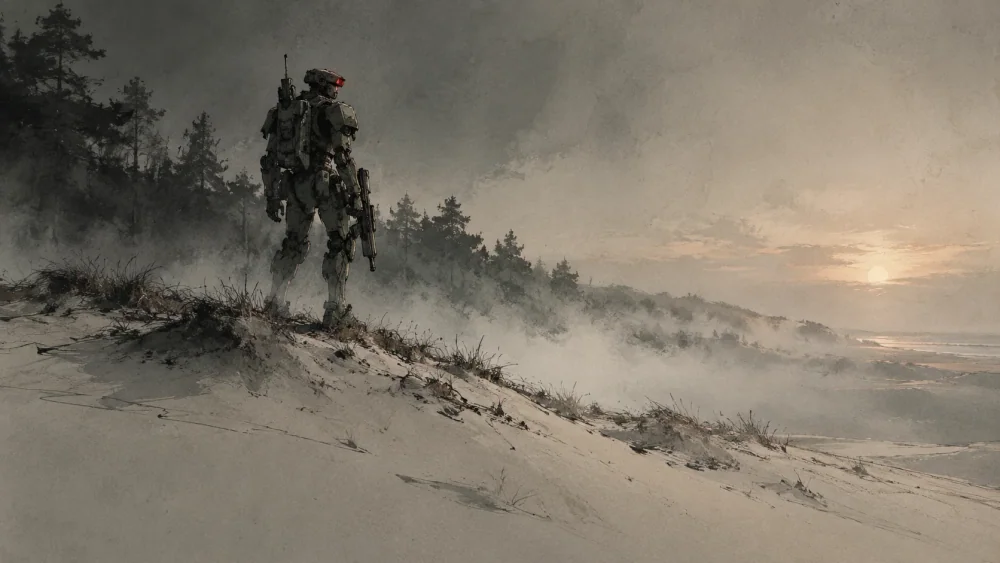
LEAKY SHIELD
“LEAKY SHIELD”
Miyako Strait, East Asia, within the Ryukyu Islands archipelago, Japan.
2028
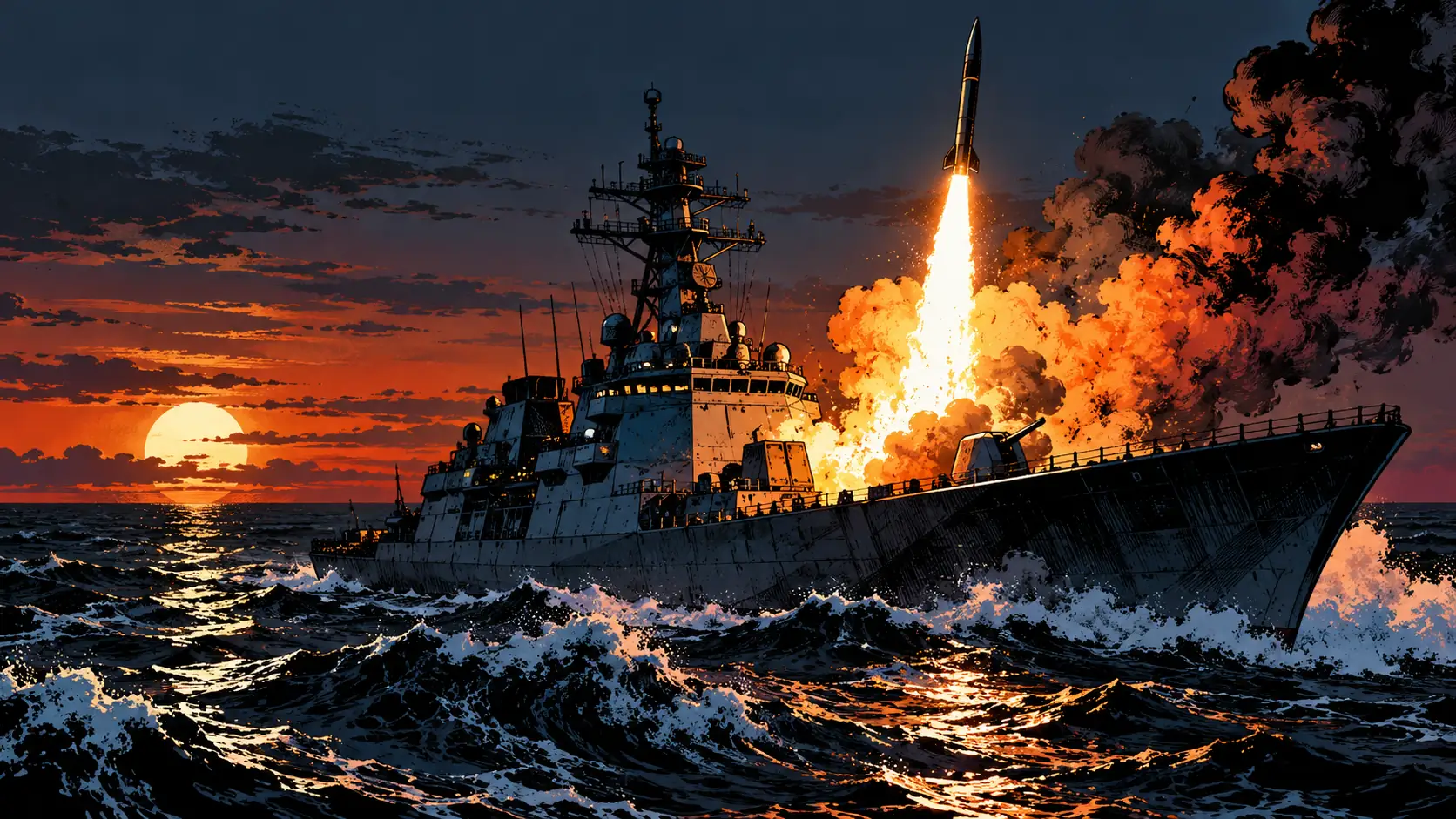
An Arleigh Burke-class destroyer—the oceanic fist of US forces in the Indo-Pacific. It cuts through the water the way a thing that has never known fear does. Eight thousand tons of steel, engineered with precisely angled surfaces so radar waves slip off the hull rather than bouncing straight back to the sky. Ninety-six vertical launch cells. A deck gun capable of firing twenty rounds a minute at a target no one on the bridge can see with the naked eye. The final layer—Phalanx, spitting seventy-five rounds a second—built on the assumption that everything else will have already failed.
And capping it all, the Aegis system. Not the fists—the eyes. A system that doesn’t fire, but decides in a fraction of a second who fires first.
Two hundred and ten men sleep in their racks below the waterline, certain they are sailing on one of the most devastating single instruments of war humanity has ever built. The rest stand watch.
The radar screen registers the first contact at 23:41. Then five. Then twenty-five. Before anyone can lift the emergency handset, the counter hits one hundred—closing from four different vectors at once, as if the sky itself had begun to multiply.
General quarters sounds. The 1MC announcement echoes down every passageway. Crews scramble from their bunks, surging in one direction: forward and starboard, aft and port. Nobody looks sideways.
On the bridge, the Officer of the Deck calls out the distance. One hundred kilometers. Eighty. The decision threshold—crossed.
The first VLS cell pops open. The missile launches with a roar felt deep in the bone rather than heard. A second. A third. The contacts vanish from the screen before closing within a kilometer.
But not all of them. Whatever breaches the first line meets the second—Phalanx wakes with a mechanical snarl, shredding the darkness, aiming straight into a threat moving too fast for the human eye.
And more wait on the horizon. The radar keeps counting.
A satellite feed provides the first visual twenty minutes later. The destroyer, swarmed by contacts with no visible origin point. Only the second orbital pass reveals the shipping containers—ordinary, salt-stained boxes seen on thousands of commercial vessels—lashed to the decks of six ships drifting a dozen miles away, looking as though they just happened to be passing through. They resemble massive rafts carrying cargo. The drones launch in waves.
Admiral Davies doesn't wait for Washington. He holds authorization granted long ago, tailored for exactly this kind of night. He declares an active attack profile. Kadena Air Base receives the order to scramble whatever happens to be sitting on the alert pad this month.
Four aircraft tear into the dark. John and Nick, flying a pair of F-22 Raptors, take the high altitude—their designated role in this architecture: the network's eyes and overwatch. They aren't meant to shoot first. Their job is to see, push target data down to Robert and Mav in the F-15EX pair below, and maintain altitude, ready to intercept anything dropping from above, where the heavy, radar-visible F-15s—hauling twelve missiles per wing—cannot defend themselves. A network-centric solution: one tier sees, the other carries the ordnance. Mav had a reputation as a reckless but brilliant pilot.
None of them know that several hundred kilometers ahead, high in the stratosphere, something is already waiting. It isn't moving closer. It doesn't need to.
Three and a half kilometers east, thirty meters beneath the surface, a small submersible glides without lights and without sound. It is an MS200—a squat hull built to insert personnel close to the target, not to fight. Battery-powered for the final leg rather than diesel. Complete silence bought at the cost of speed. Inside sit four fully geared operators and one asset that requires no gear at all.
None of them can see the flashes above the water. They only feel the hull tremble from distant detonations—a sensation like thunder, only more rhythmic.
Cpt. Wei Chao sits closest to the hatch. Sun Bo, the youngest, performs a third press-check on his weapon. Not because anything is wrong with it. Liang Jun and Zhang Yi remain silent, the specific kind of silence shared by men who have nothing left to say.
SR/Alpha stands, though she doesn't have to. Nobody took the seat beside her—the space to her left remains empty, despite the cramped quarters.
Wei Chao glances at her briefly, then snaps his eyes away, as if he had just checked a gauge and didn't want her to notice. He keeps his gaze averted. Even so, he feels watched—scrutinized without interruption, as if some mechanism inside her never stops calculating.
Zhang Yi clutches a small control panel, its screen dark, waiting. The package has been sitting in a junior communications tech's cabin somewhere on the destroyer above them for two days—a gift from a "port buddy," a plain box nobody bothered to scan twice. It houses an incendiary charge that water cannot extinguish; it only burns hotter and thicker the more someone tries to drown it, whether with seawater or dry chemical powder. Zhang Yi holds off. He waits for the precise moment.
That moment arrives just before they are set to disembark. One button press. High above, in a cabin they will never see, something begins to burn—quietly at first, then louder, until someone screams, and then more voices join in. A fire nobody on board can successfully put out, because every attempt only feeds it.
The airlock cycles with a hiss, twenty meters below the ocean surface.
The water is pitch-black and warm as blood. The storm doesn't fully penetrate this deep, but the swells toss them around like toys.
Four men swim in formation, each tethered to a diver propulsion vehicle, their breathing regulated and steady. The fifth silhouette holds the pace effortlessly, leaving no exhaust bubbles, requiring nothing.
The destroyer's hull manifests first as a shadow, then as a solid wall. The anchor sits drawn tight against the ship, but a narrow gap remains between the fluke and the hull—just wide enough for one hand, then another.
They scale the anchor itself and the hawsepipe leading inside. The metal is slick with rain and salt spray. Nobody slips twice. A second slip means death.
For a brief moment, before they scatter into the shadows, they are clearly visible: four silhouettes in black neoprene, faces obscured by regulator masks, weapons strapped barrel-down across their chests. Flat packs on their backs—not air tanks, but extraction gear designed to let them move through the ship quietly and leave just as silently, if successful.
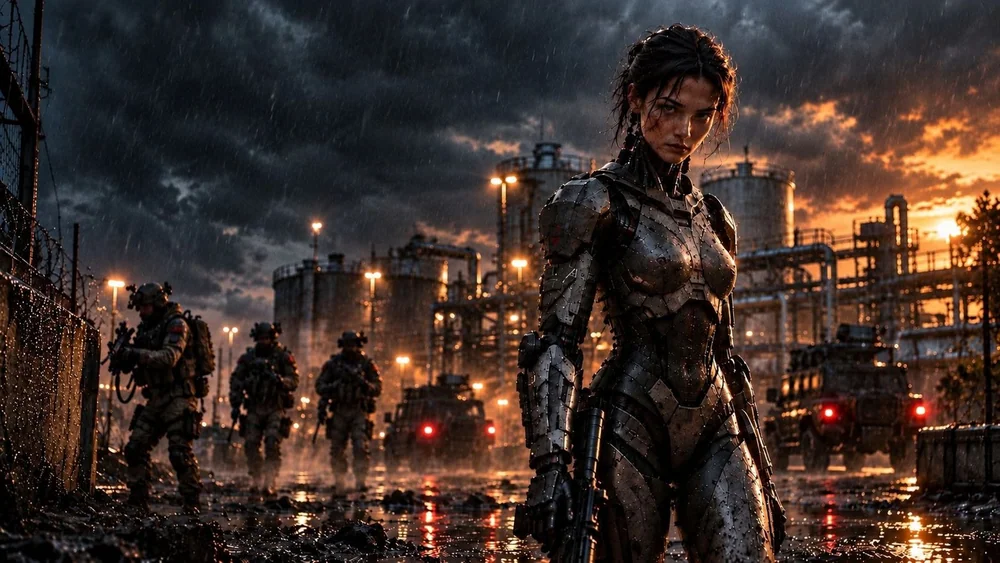
The fifth silhouette removes a mask she never actually needed. Slender, feminine, almost human at first glance—until the eye catches her neck and joints, where armor gives way to exposed mechanics, metal braided with synthetic carbon tendons. Along her temple and collarbone runs a row of tiny blue diodes—the only color on the entire team aside from black.
The forward deck hatch hangs ajar; nobody had time to secure it when the general quarters alarm sounded. They slip inside, trailing seawater onto the steel deck that will instantly evaporate in the engine room's ambient heat.
The passageways are bathed in the red glare of battle lanterns. Sailors sprint past without looking, hyper-focused on their designated stations. The team of five moves against the current, hugging the bulkheads, slipping through shadows nobody bothers to check.
Nobody sees them. Or nobody is willing to register something they cannot comprehend.
In Chengdu, it is daytime. Mei Lin stares at a number that has no business being there—a 0.04-second discrepancy between two systems that were never supposed to be linked. She had seen this once before. Nobody believed her then.
This time, the anomaly surfaces in the telemetry of platform 611/4, precisely as it stops responding to standard status queries. Nobody in the adjacent room notices. Mei logs the timestamp and says nothing.
High above the F-15EX pair, John and Nick fail to see what is coming—which was their sole operational purpose. Platform 611/4 does not require a separation between eyes and fists. Three engines grant it both capabilities in a single airframe.
It deploys its effectors without warning—four streaks of fire vanishing into the dark, each carrying a payload that doesn't need a direct hit to kill. Mav has a fleeting thought about his girlfriend. He promised her a motorcycle ride. One second later, its task complete, the third engine—the central one, the one nobody in the West can fully classify—throttles up, and the platform banks, disappearing as cleanly as a switched-off light. Nobody manages to track its vector.
Four detonations flash across the sky seconds apart, scattered across the airspace. Four radar tracks vanish simultaneously.
Whether anyone in those four cockpits saw their threat receivers light up before the screens died with them—nobody will ever know.
The hangar is empty, save for a massive shipping crate strapped to the deck with cargo tie-downs designed to withstand a typhoon, not a breach. Wei Chao locates it first—the serial number stenciled on the side, barely legible under the red emergency lighting, matches their pre-mission briefing exactly.
Liang Jun and Zhang Yi hold the perimeter at the entrance, standing back-to-back, muzzles trained down two separate corridors. Absolute chaos still reigns across the ship—its echoes bleed even down here into the lower decks: the shouts of damage control teams fighting a fire that refuses to die, and somewhere higher up, vibrating through the thick steel, the concussive thump of consecutive VLS launches. Aegis is still fighting. Phalanx continues spitting uranium at a drone swarm that shows no sign of depleting.
SR/Alpha tears through the security seals in a single motion. Inside sits a machine the size of a compact car, cocooned in impact foam and heavy plastic, protected against every conceivable shock except this one.
She interfaces with it via a cable spooling from her wrist—hardware none of the commandos had noticed before. She freezes.
5.2 seconds. Exactly as long as it always takes.
Nobody speaks. Nobody understands what is happening. They don't have to.
Then she moves again—and the delicacy vanishes.
What follows does not resemble a technician at work. She drives her fingers into a seam in the machine's casing and rips it backward. Synthetic muscles bunch beneath her skin like a predator coiling for a strike, yet the motion remains entirely too smooth, too devoid of strain to be fully animal. The metal groans, then snaps with a sharp crack that echoes off the hangar bulkheads far louder than it should. Sparks shower from severed high-voltage lines, momentarily illuminating her face—placid, untouched, as if she were tearing through something offering zero resistance, even as the steel screams under her grip.
Wei Chao and Sun Bo involuntarily take a half-step back, though neither realizes they moved. They had seen her silent. They had seen her frozen in that incomprehensible five-second trance. But this—this is something else: a degree of physical violence that should not fit inside a frame that size, applied without fury, without effort, with the cold, mechanical precision of a predator that long ago stopped considering whether its prey could fight back.
Neither man utters a word. A quiet shiver runs through them both—not fear of what SR/Alpha is doing to the machine. Fear born of standing next to something capable of doing it so effortlessly. And so precisely. And capable of doing it to them.
A rapid internal dismantling follows within the machine's gutted chassis, and SR/Alpha extracts two mirrors, each the size of a dinner plate, seated in metal housings thinner than structurally plausible. Behind them—a smaller module, dense with fiber optics.
Wei Chao and Sun Bo step up and pack the components into the open rig on her back, one by one, swaddling them in the salvaged impact foam. Their hands tremble. She stands like a statue.
The target they came for is the core of a Dutch ASML EUV lithography machine—the only system on Earth capable of etching light patterns thousands of times thinner than a human hair, creating the processors that drive every smartphone, every cruise missile, and every combat system currently fighting above them. Without these mirrors, the counterpart machine sitting halfway across the globe will never calibrate properly. It will be a multi-million-dollar brick. Besides—in twelve minutes, the original will cease to exist anyway.
Wei Chao raises his hand to his tactical headset. A single word, shouted, not whispered—an execution code with only one meaning. Somewhere, one thousand six hundred and sixty kilometers away, someone receives it.
One thousand six hundred and sixty kilometers away, there is no storm. The sea is glass-smooth, and the moonlight rests on the water so perfectly it traces the silhouettes of low scrub trees on a distant atoll—black, unmoving, as if cut from paper. Nothing here suggests that anywhere else in the world, the sky is burning.
The ocean surface ruptures without warning. Something breaches the waves, sleek and dark, casting a momentary shadow against the moon before its rocket boosters ignite. The concussive roar rolls across the quiet bay, flushing birds from the very trees that had looked so tranquil seconds before.
The countdown begins.
They aren't walking anymore—they are sprinting. 12 minutes.
SR/Alpha moves through the smoke and shadows at a velocity none of the four humans can match. Wei Chao barks an order at Sun Bo, telling him to keep pushing.
At a major corridor intersection, she stops—not out of hesitation, but calculation. Ten armed sailors are clustered around a damage-control locker between the strike team and their exfil route, desperately trying to lock down the sector. An asset that doesn't factor costs would have pushed straight through them. She opts for a secondary passageway, fifteen meters longer, but empty.
Wei Chao reads the tactical geometry differently. He flashes a hand signal without a word. Liang Jun already has an angle on the doorframe, Zhang Yi drops to a crouch behind a bulkhead, and Sun Bo melts into the recessed shadows. Four overlapping fields of fire, a single fatal funnel, ten sailors who don't yet realize they are targets. The decision is executed without debate—exactly as they were drilled, faster than anyone could question it.
Suppressive fire opens simultaneously from four directions. It doesn't last long. When the brass stops hitting the deck, nothing is moving in the corridor except the four operators, already pushing forward without checking their six.
SR/Alpha doesn't process the tactical override. She simply falls in with them, pacing a half-step too fast, as if the slaughter she just witnessed had already been logged in a ledger none of them have clearance to read.
A sailor bursts from around a blind corner and slams into her full-force—he bounces off her shoulder, loses his footing, and begins falling backward. In that same microsecond, her hand clamps around his neck. One short, clinical rotation before his spine can hit the deck—the cervical vertebrae snap with a dry crunch, barely audible under the blaring general quarters alarm. The body drops like dead weight. SR/Alpha doesn't break stride, doesn't even look down.
They reach the bow. The hawsepipe. The water. The DPVs are exactly where they tethered them. The submersible. Immediate exfiltration.
Twelve minutes after the signal, one thousand six hundred and sixty kilometers away, near the Paracel Islands, a hypersonic glide vehicle breaches the atmosphere—a munition traveling several times the speed of sound, cloaked in a superheated plasma sheath that blinds any targeting radar trying to secure a lock. Aegis tracked the drone swarm long before it broke the horizon. It had minutes to respond. Against something moving at this velocity, it would have ten seconds—assuming it managed to track it at all.
Nobody will ever know who authorized the launch.
The destroyer, having just demonstrated the pinnacle of naval lethality, slips beneath the waves in a silence that none of its defensive algorithms could ever explain.
Admiral Davies receives the flash report near dawn. One sunken capital ship. Two lost fighter pairs. Zero radar contact with anything that could be legally classified as an enemy combatant.
He signs the readout without comment. There is nothing left to append to it.
INTERNAL LOG — EVENT CLASSIFICATION EXTRACT
INCIDENT: Loss of surface asset — Sector RS-MYK-7
PRELIMINARY CLASSIFICATION: Isolated incident
AERIAL THREAT ORIGIN: Unmanned swarm, origin: undetermined, launch platforms: civilian maritime vessels, status: unidentified
ASSET LOSS VECTOR: Hypersonic munition, launch point: undetermined, carrier platform: undetermined
AERIAL LOSS (2x2): Cause: undetermined
Radar contact prior to loss of telemetry: none
RECOMMENDATION: Zero correlation between events — no joint analysis authorized
STATUS: Closed
- Balance: 1 destroyer / 2 fighter pairs / 0 confirmed hostiles
- Radar contact prior to signal loss: none
- Cargo: lost with the vessel
- Case status: closed, correlation unauthorized
- Verdict: How much truth fits into the phrase "isolated incident"?
FROM THE SAME ERA
These are not ranked recommendations. It is simply another available piece from the same period of the world.
SEE THE FULL ARCHIVE →