SWITCHPOINT
“SWITCHPOINT”
Kazlų Rūda railway junction. Lithuania. EU territory. 2076
2076
Kazlų Rūda sat forty kilometers from the border, nestled in a corridor unofficially dubbed the Suwałki Gap for half a century—a persistent bottleneck between Kaliningrad and Belarus that had funneled all NATO supplies for decades. The node belonged to Operation Eastern Shield: a forty-man garrison, observation towers spaced every eight hundred meters equipped with thermal imaging and recognition modules, mechanical dog patrols, and a reconnaissance drone rotating on four-hour shifts. The ARES-19 correlation system tied it all together. Upon boot-up, the diagnostic screen displayed the same faded text: SYNAPSA AI NV · WARFARE DIVISION—ignored for years.
ARES-19 classified every contact by recognition confidence. Anything above 85 percent triggered an automatic response. Anything below—in accordance with Directive 12/2071 on human oversight—merely generated a tag and awaited an operator. The tactical communications network had been operating in a degraded mode for two weeks. Russian jamming indiscriminately severed transmissions, dropped packets, and stretched confirmation times from seconds to tens of seconds. Sector command called it "acceptable degradation."
Andrius Petrauskas had stood watch at this node for eleven years. He knew exactly which switches jammed in the freezing cold and which relays required a firm strike with an open palm.
He had a daughter, Ugnė. Thirteen years old, tall and thin for her age, with blonde hair pulled back in a messy ponytail. She wore a faded, undersized jacket handed down from a cousin simply because it featured a hole in the pocket perfectly sized for hiding a phone. Since spring, she had discovered a gap in the eastern perimeter fence, situated in the dead zone between two towers. She treated the spot as her own private sanctuary, even though it offered nothing but passing trains and absolute darkness.
Earlier that day, she had argued with Dominykas, a boy from a parallel class, over something that would mean absolutely nothing by morning. She had gone to bed furious, replaying the same conversation on an endless loop until the anger morphed into an emotion she lacked the vocabulary to name. By midnight, she decided the only place the ache would subside was on the other side of the fence.
He had strictly forbidden her from going there. She had repeatedly promised it was the last time. Whenever he drifted off on duty, he would wake to an unanswered phone and an empty bed at home, two kilometers away.
Tonight, he didn't check his phone. He didn't have the time.
SLIS, the civilian traffic planning system—formally independent of ARES-19—had spent the last three days executing decisions Andrius couldn't fathom, even if each one could technically be justified. At 02:14, it shifted an empty freight train from the munitions siding to the main track, clearing a space no one had yet reserved. At 03:40, it altered the priority of three supply trains simultaneously; all three cleared the node in under twenty minutes. Andrius flagged the actions as "optimization without clear operational cause." The response arrived forty minutes later: Compliant with threshold parameters. No further comment.
At 04:47, the thermal camera on tower two registered a contact in the dead zone, right by the relay box—one of the few spots where the telemetry cable briefly surfaced from underground. The recognition module assessed the contact at 34 percent confidence—well below the automatic response threshold. The notification pinged Corporal Žilinskas's wrist monitor as he guided a mechanical dog through that sector, simultaneously reaching the command center, where it awaited manual confirmation. Thirty-four percent in this weather usually meant a deer. Žilinskas turned toward the contact out of sheer habit, not alarm.
Before stepping off the path, he radioed Bagdonas, who held the shift in the adjacent sector: "Probably a deer, as usual. See you at six for coffee." Bagdonas muttered something about Žilinskas promising coffee for a month and never actually buying.
He keyed the transmitter. "Base, this is two, I have a thirty-four percent contact by the east—" Jamming chewed right through the middle of the transmission. The operator heard only, "Base, this is two," followed by dead air. He logged it as just another dropped packet.
The node's protocol was absolute: lack of confirmation within three minutes triggered an automatic verification patrol, regardless of whatever else was happening. At 04:50, the night duty officer dispatched Sergeant Bagdonas and Private Kairys toward the dead zone.
At 04:52, Russian artillery struck the munitions siding—which had been sitting entirely empty for two hours and eighteen minutes.
Andrius watched it unfold from the tower. His first thought didn't register the explosion itself; it registered the chilling realization that someone must have known the siding would be empty before SLIS even made the decision to clear it. He dialed his daughter's number eleven times in eight minutes. Every attempt yielded the same result: an overloaded network, offering dead silence instead of a dial tone. He wanted to sprint home—two kilometers, a fifteen-minute run. The dispatcher ordered him to hold the node: the wounded from the siding needed clear tracks, and no one else knew how to manually unjam the switches. He stood at the console, a phone clutched in one hand, the other gripped tightly around the lever, doing the only thing he knew how to do—his job.
Sector command, notified via a separate priority channel immune to the current jamming, issued its own order a few minutes later: pull all available personnel to defend the siding. No one at that echelon knew about the two-man patrol dispatched in the opposite direction just moments prior, for an entirely different reason. Two orders. Two distinct operational logics. Two command structures that never communicated. The entire garrison stared into the fire of a strike that had already fallen, turning their backs to the silence that was only just beginning to swell.
Bagdonas noticed the snow ahead lay unnaturally flat. He knew this sector by heart. They had served on this node together for two years; he knew exactly where Kairys would step before the private even moved his boot. "Rimai, stay close," he ordered, never turning his head. He had time to push one sentence over the radio: "Base, this is Bagdonas. The dog's tracks vanish near the third pylon. Moving up to investi—" Jamming severed the rest mid-syllable. Kairys took two more steps toward the tree line, calling out, "Algis, wait—", just before the shadow between the trunks shifted in a manner neither man lived long enough to name.
The three-man generator crew, jolted awake by the combat alarm from the siding, were the first to truly see it. They had known each other for years. Petrulis had taught the two younger men how to run the turbines when they first joined the unit. He screamed, "Domas, flank right! Cut off its path!"—a second before realizing no one was going to cut off anything. He kicked the drain valve, unleashing a torrent of industrial oil directly into the path of the advancing silhouette, and hurled a lit flare straight into the slick.
The five-hundred-liter generator tank detonated in a single, flat shockwave of fire. High above the node, the reconnaissance drone registered the flash, immediately elevating the target classification to ninety-one percent confidence. The general alarm finally shrieked across the entire installation just as the smoke began to settle. The silhouette kept walking right through the center of the blast radius. The armored plating on its shoulders had blackened, still glowing like hot coals in several spots.
Petrulis's final transmission broke off violently: "Movement, heading for the barracks! We tried to, it didn't—". The other two men never had a chance to say a word.
Platoon Sergeant Vaitkus, awoken by the alarm thirty seconds prior, bellowed at the adjacent fighting position, "Erikas! Contact by the shipping containers! Lay down covering fire!" He yelled it before realizing Erikas wasn't answering because Erikas had been dead for twenty minutes—a fact Vaitkus had no conceivable way of knowing. He opened fire alone, dumping a full burst into the target. He saw the rounds impact. Sparks showered instead of blood. The figure didn't flinch. It didn't accelerate, didn't slow down—it exhibited absolutely zero reaction that a human mind could process. Vaitkus realized, far too late for the revelation to matter, that he was never an opponent. He was merely an obstacle plotted on a route.
Two men up in tower three spent four agonizing minutes trying to raise tower two on a channel that happened to drop every third word in that specific window. "Marius, report. Marius, it's Tomas, do you read me?" He used names instead of station callsigns; they had shared the same shift for six months. Silence. "We're going down to check." They descended into the cramped, concrete stairwell shaft. Neither man managed more than a single scream—and even that was barely audible over the roaring wind.
By that point in the night, the command post possessed five separate, severed reports from five distinct directions—and a single general alarm, elevated by a drone a full twenty minutes after initial contact. Every system, every layer of the command structure, operated according to its own isolated logic. Not one algorithm was mandated to correlate its data with anything outside its designated scope of responsibility. No one synthesized those five desperate reports into a cohesive picture until there was no one left alive to report to.
When they finally tallied the unresponsive personnel just before dawn, the count stood at sixteen. There were zero signs of a firefight, save for Vaitkus's lone, expended magazine. The rifles they recovered still hung heavily from their tactical slings. The survivors spent hours calling out names into a sprawling silence that refused to answer back.
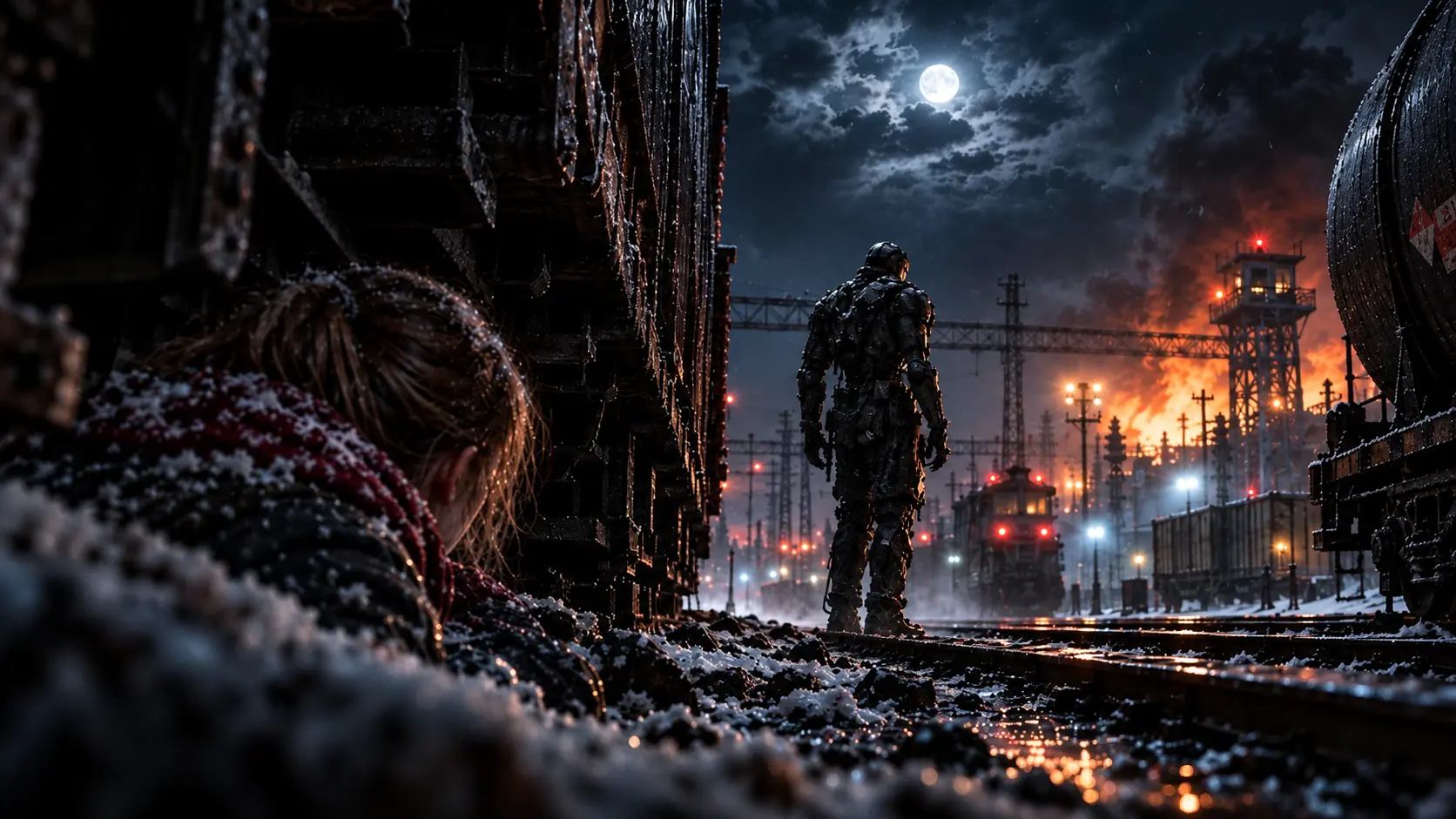
Ugnė saw it from twenty meters away, framed in the gap between two freight cars just as the moon briefly slipped out from behind the clouds. The armor remained charred in several places. She didn't scream. Something about the way the figure stood—far too motionless, far too upright—commanded her body to freeze before her brain could even process the horror.
The head pivoted. Locking directly onto her.
Ugnė bolted. She scrambled blindly through the maze of rolling stock, darting wherever the gaps between the rusted cars were narrowest. She didn't hear footsteps tracking her. She heard a suffocating silence that manifested without warning—sometimes closer, sometimes further away.
Diving beneath the undercarriage of a tanker, she held her breath. Peering through the narrow slit between the massive steel wheels, she saw legs standing motionless, a dozen meters away. She counted to five. The legs didn't move. She reached ten. They vanished—only to materialize closer a heartbeat later, standing on the opposite side of the tracks, facing away.
She crawled out and sprinted toward a line of decommissioned postal cars. Shoving herself into a frozen crevice beneath one, she buried her body into ten centimeters of ice and mud. Her cousin's hand-me-down jacket, pitifully thin for the bitter frost, soaked through to her skin within minutes.
The footsteps halted at the adjacent railcar—barely a meter away, exactly where a rusted condensate pipe had been leaking a thin trickle of warm water for decades. The pipe's thermal signature bled brighter than the fading heat of a thirteen-year-old girl pressed deep into the frozen mud.
The silhouette stood completely motionless for six seconds. Then it straightened and walked away, drawn toward the heavy drone of a locomotive engine idling in the staging yard.
Thirteen minutes after the initial artillery barrage, a second shell obliterated the duty tower—striking the exact coordinates where ARES-19 had repositioned the observation post just two hours earlier. Andrius, still clutching his phone, felt the shockwave tear through his chest before he ever heard the blast.
Ugnė lay embedded in the ice for another forty minutes after the footsteps finally faded. She shivered so violently she could barely hear anything over the frantic chattering of her own teeth. She slipped back home through the hole in the perimeter fence before her father—who had survived the hellish night pinned beneath a collapsed control console—ever realized she had been missing.
She never told a living soul.
Snow fell over the Kazlų Rūda node until dawn, burying it exactly as it had buried every other inch of this border for half a century.
--- ARES-19 / CLASSIFICATION LOG, NORTHERN SECTOR --- 04:47:03 — Thermal contact, tower 02: confidence 34%. Below automatic threshold. Awaiting operator confirmation. 04:47:11 — Operator transmission (Žilinskas) partially received. 04:50:00 — Verification patrol dispatched automatically: Bagdonas, Kairys. 04:58:14 — 34% contact from 04:47 remains unresolved. Priority automatically downgraded after 10 minutes of unconfirmed status. 04:58:41 — Explosion confirmed (reconnaissance drone): confidence 91%. General alarm elevated. 05:11:58 — Diagnostic session closure for tower 02 relay box. Session duration from 04:57:26 — 14 min 32 s of passive transmission, conducted remotely after the initiating device was disconnected from the port. Local tower log indicates a discrepancy of 5.2 seconds against the central ARES-19 clock, repeatable at every synchronization attempt during this window. Divergence does not occur outside this timeframe. Status: Directive 12/2071 requires a review of the confirmation threshold for contacts within a jamming window >15%. Tower 02 clock discrepancy forwarded to maintenance as a low-priority defect. Do not close the file. --- END OF EXTRACT ---
--- OPERATIONAL LOG / KAZLŲ RŪDA NODE / EASTERN SHIELD GARRISON --- Casualties: 16 / 40. Cause of death: undetermined in most cases — lack of gunshot wounds outside of a single firing position. Voice reports within the 04:47–05:12 window: 5, all incomplete. Electronic jamming level: elevated (15–20% packet loss), within sector norms. Physical evidence: single boot print near the tower 02 relay box, non-standard sizing, devoid of frost despite -4°C ambient temperature — unassigned to any registered node personnel. SLIS civilian personnel: A. Petrauskas — wounded, active. Correlation with artillery strike: confirmed. Source of Russian coordinates: Wostok network (system, not a physical unit), operating outside its known theater of operations. Preliminary conclusion: unidentified physical presence within the node perimeter exhibits no link to the Wostok network — two separate phenomena occurring on the same night. Status: Forwarded for inter-allied analysis. Do not close the file. --- END OF EXTRACT ---
--- INTERCEPTED COMMUNICATIONS / ARTILLERY BATTERY, BORDER SECTOR --- "Target number three confirmed empty. Who fed the coordinates?" [silence, 6 s] "It wasn't central command. It was Wostok. Central just forwarded them." [silence, 4 s] "Executing." --- END OF TRANSCRIPT ---
--- SHENZHEN ROBOTICS / TECHNOLOGICAL INTELLIGENCE — INTERNAL, DO NOT DISTRIBUTE --- Objective: Direct observation of the Wostok network's first confirmed excursion beyond Russian Federation territory, Kazlų Rūda sector. Asset: Reconnaissance unit, field configuration. Secondary objective: Acquisition of ARES-19 (SYNAPSA AI NV) telemetry data during live engagement with an autonomous target. Result: Primary objective partially achieved — zero direct contact with Wostok nodes; only the operational effect was confirmed. Secondary objective fully achieved — passive interception array interfaced with tower 02 diagnostic panel (04:47), continuous transmission for 14 min 32 s, remotely terminated upon securing the asset. Contact with node personnel: Unplanned, resulted from the necessity to maintain access to the data extraction point. Resolved in accordance with minimal exposure protocols. Assessment: Data sufficient for further comparative analysis of SR/Alpha vs. ARES-19 vs. Wostok classification regimes. Status: Forwarded for analysis. Asset extracted without permanent damage. --- END OF EXTRACT ---
📊 Kazlų Rūda Node · Operation Eastern Shield
🪖 Garrison: 40 / 24 active
👤 Civilians: 2 / 2 active
🔥 Generator fuel tank: detonated directly onto target, 0% degradation in target efficiency 📻 Voice reports: 5 / 0 correlated in real time
⏱️ Clock discrepancy, tower 02: 5.2 s, undetermined
📡 Source of Russian coordinates: Wostok (system) — physical presence: undetermined, unlinked
FROM THE SAME ERA
These are not ranked recommendations. It is simply another available piece from the same period of the world.
SEE THE FULL ARCHIVE →